Top 15 OT Compliance Challenges for Energy Producers
The Evolution of Energy Compliance and Regulatory Pressures: Background
For decades, the energy and utilities sector operated under the assumption that physical isolation and specialized industrial control systems (ICS) would naturally shield power generation, transmission, and distribution assets from regulatory scrutiny and cyber threats. As modern digital transformation integrates cloud-based analytics, smart grids, and automated substation monitoring into legacy infrastructures, that traditional boundary has vanished. Regulatory bodies worldwide have responded by overhauling compliance mandates, shifting from static checklists to rigorous, continuous verification standards like NERC CIP, IEC 62443, and NIS2. Energy producers now face the monumental challenge of aligning complex operational technology environments with fast-evolving legal frameworks without disrupting high-availability power generation. Navigating these overlapping mandates requires deep technical insight, precise asset visibility, and proactive risk management to avoid crippling financial penalties and severe grid disruptions.
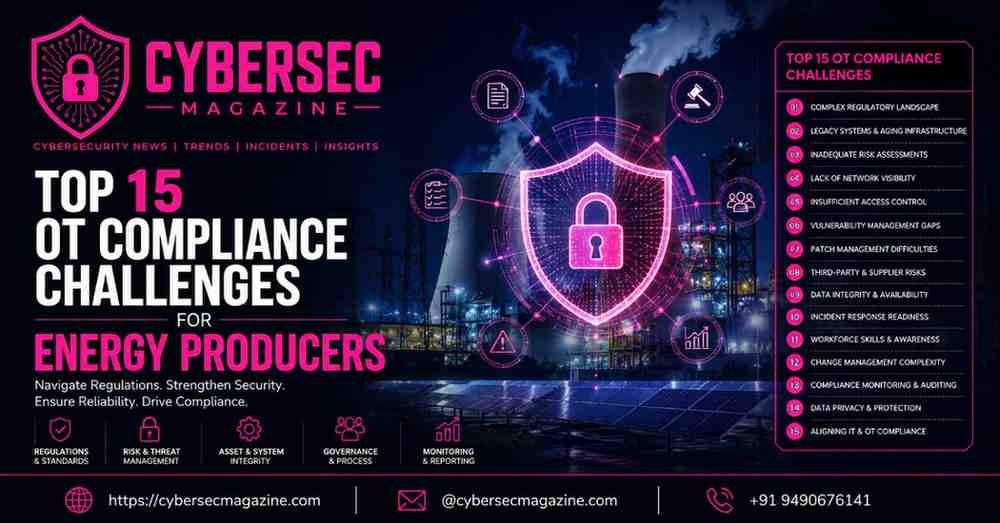
Top 15 OT Compliance Challenges for Energy Producers
1. Managing Legacy Asset Visibility Across Distributed Infrastructure
Energy producers inherit sprawling, multi-decade-old infrastructure spanning remote substations, hydro dams, and solar fields, making complete asset discovery an immense hurdle. Compliance frameworks like NERC CIP mandate exhaustive inventories of all cyber assets, yet passive discovery in fragile OT environments remains difficult. Legacy controllers and proprietary serial devices often crash or drop packets when probed by traditional IT scanning tools. Achieving real-time asset visibility without introducing operational downtime or violating strict safety protocols is a primary compliance bottleneck for modern utility operators.
2. Bridging the Cultural and Technical Divide Between IT and OT
Meeting modern regulatory standards requires seamless collaboration between enterprise IT security teams and traditional plant-floor OT engineers, who often maintain competing priorities. IT professionals prioritize rapid patching, data confidentiality, and enterprise encryption, whereas OT engineers focus strictly on system availability, physical safety, and deterministic uptime. When compliance audits demand sudden network changes or firmware updates, friction between these departments frequently stalls remediation efforts. Establishing a unified governance model that bridges this cultural divide is essential for satisfying auditor requirements without risking plant operations.
3. Securing Third-Party Vendor and Supply Chain Access
Power generation facilities depend heavily on specialized third-party vendors and contractors to maintain turbines, smart meters, and SCADA infrastructure. Regulatory frameworks increasingly hold energy producers strictly accountable for vendor-introduced risks, requiring verifiable access control and session monitoring. Many suppliers, however, still rely on permanent, unmonitored VPN tunnels or legacy dial-up connections that violate core zero-trust mandates. Enforcing secure, just-in-time remote access and rigorous cryptographic verification across an expansive vendor ecosystem remains a persistent compliance challenge.
4. Addressing Unpatchable Legacy Vulnerabilities and End-of-Life Systems
Many critical energy assets-such as older Programmable Logic Controllers (PLCs) and Remote Terminal Units (RTUs)-run on legacy firmware that manufacturers no longer support or patch. Compliance auditors demand proof of vulnerability management and timely patching, yet applying a software patch to a 15-year-old power plant controller can cause catastrophic system failure. Energy producers are frequently forced to implement complex, compensating controls, such as micro-segmentation and deep packet inspection, to satisfy regulators while operating unpatchable legacy hardware safely.
5. Implementing and Maintaining Rigorous Network Segmentation
Regulatory standards like NERC CIP and IEC 62443 require strict separation between corporate enterprise IT networks and sensitive industrial control environments. Designing, validating, and maintaining these micro-segmentation boundaries across complex hybrid architectures requires continuous monitoring and extensive documentation. As new smart grid sensors and renewable energy units are integrated, unauthorized cross-zone traffic frequently creeps back into the network. Proving to auditors that electronic security perimeters are continuously enforced without blind spots is an ongoing operational burden.
6. Establishing Continuous Compliance and Automated Audit Readiness
Traditional compliance management relied on periodic, manual point-in-time audits where teams scrambled to compile spreadsheets and static configuration screenshots. Modern regulatory regimes increasingly demand continuous compliance, requiring energy producers to prove a permanent state of security readiness 365 days a year. Gathering real-time evidence across thousands of distributed field assets requires sophisticated security information and event management (SIEM) tools tailored for OT data. Transitioning from reactive, manual audit preparation to automated, continuous telemetry collection strains internal resources and technical budgets.
7. Complying with Stringent Incident Reporting Mandates
Recent regulatory updates across global energy sectors have introduced aggressive timelines-sometimes as short as hours-for reporting cyber incidents and significant operational anomalies. Meeting these strict windows requires immediate detection, rapid forensic analysis, and clear communication channels between plant operators, legal teams, and government regulators. In complex OT environments where distinguishing between a mechanical fault and a cyber-attack is difficult, rushing a report can lead to misinformation or panic. Building an incident response structure fast enough to satisfy strict regulatory reporting deadlines without compromising operational focus is exceptionally challenging.
8. Enforcing Multi-Factor Authentication (MFA) Without Disrupting Operations
While multi-factor authentication is a standard requirement for enterprise IT environments, deploying MFA across industrial control systems presents unique operational hurdles. Field operators working in harsh weather conditions or wearing protective gear cannot always complete complex authentication prompts on local human-machine interfaces (HMIs). Furthermore, many legacy industrial control protocols do not support modern token-based authentication mechanisms natively. Balancing rigorous regulatory demands for MFA with the physical usability and deterministic timing of plant-floor operations requires creative engineering solutions.
9. Managing Configuration Baselines in Fast-Evolving Environments
Regulatory standards require energy producers to establish, monitor, and verify strict configuration baselines for all software and hardware running within critical cyber assets. However, operational environments undergo frequent tuning, emergency maintenance, and routine updates that can easily drift away from approved baselines. Detecting unauthorized logic changes on a PLC or unapproved firmware modifications on a substation gateway requires continuous change-tracking mechanisms. Maintaining pristine, auditor-ready configuration documentation across dozens of remote generation sites is a constant administrative challenge.
10. Navigating Complex, Overlapping, and Conflicting Regulatory Frameworks
Energy producers operating across multiple jurisdictions often find themselves forced to comply with a bewildering array of overlapping and sometimes contradictory regulatory standards. A utility might need to satisfy NERC CIP reliability standards, IEC 62443 industrial security baselines, and local national critical infrastructure laws simultaneously. Each framework demands different documentation formats, technical controls, and auditing cadences, leading to compliance fatigue and duplicated effort. Harmonizing these disparate requirements into a single, unified security program requires immense legal and technical coordination.
11. Protecting High-Voltage Substations and Remote Edge Locations
Modern smart grids rely on thousands of unmanned, highly distributed substations and renewable energy collection sites scattered across vast geographic areas. These remote edge locations are inherently vulnerable to physical tampering, local network sniffing, and unauthorized wireless connections. Regulatory frameworks hold utilities accountable for securing every remote node as rigorously as a main control room. Deploying physical security hardening, environmental monitoring, and encrypted edge communications across hundreds of remote miles is both technically complex and financially demanding.
12. Establishing Robust Personnel Screening and Insider Threat Programs
Human error and malicious insiders represent some of the most unpredictable vectors leading to critical infrastructure compromise and compliance failure. Regulatory standards mandate rigorous background checks, role-based access restrictions, and ongoing security awareness training for all personnel with access to OT networks. In unionized or heavily contracted energy environments, implementing mandatory background screening and enforcing strict principle-of-least-privilege access can face administrative pushback. Balancing workforce trust with mandatory regulatory compliance requires delicate governance and transparent communication strategies.
13. Securing Operational Data Flow Through Complex DMZ Architectures
Energy producers must continuously stream operational data from plant floors up to enterprise historians and cloud analytics platforms for business optimization. Compliance mandates dictate that this data exchange must occur through highly secure Demilitarized Zone (DMZ) architectures utilizing unidirectional gateways or strict proxy inspection. Configuring these data pathways to support high-throughput metering without creating potential inbound attack vectors requires advanced networking expertise. Any misconfiguration in the DMZ firewall rules can result in immediate regulatory non-compliance and elevated cyber risk.
14. Managing Cryptographic Key Lifecycles in Legacy OT Systems
Modern security controls rely heavily on robust cryptography to secure network traffic, authenticate device communications, and protect remote management tunnels. However, implementing Public Key Infrastructure (PKI) and managing cryptographic key rotations across legacy industrial assets is exceptionally difficult. Many legacy devices lack the onboard processing power required for advanced encryption or cannot handle certificate expirations without rebooting. Maintaining valid cryptographic hygiene across a fleet of aging industrial controllers without breaking operational workflows is a major technical hurdle.
15. Demonstrating Quantitative Risk Mitigation to Board Members and Auditors
Compliance is not merely about checking boxes; regulators and corporate boards increasingly demand proof of quantifiable risk reduction resulting from security investments. Translating abstract technical metrics-such as mitigated protocol anomalies or patched firewall rules-into clear financial and operational risk language is difficult. Security leaders in the energy sector often struggle to justify ongoing compliance budgets because proving an attack did not happen is inherently challenging. Developing transparent, data-driven risk models that satisfy both strict auditors and financially focused executives remains the ultimate compliance test.
Conclusion: Securing the Energy Grid of Tomorrow
As energy producers race to modernize power grids and embrace digital innovation, navigating the complex landscape of OT compliance has never been more critical. Meeting rigorous regulatory standards like NERC CIP and IEC 62443 requires moving beyond reactive, checkbox mentalities toward a culture of continuous, operational resilience. By overcoming asset visibility bottlenecks, bridging IT-OT divides, and deploying advanced automated monitoring, utility operators can protect their critical infrastructure from evolving threats. Evaluate your organization’s compliance posture, audit your remote edge defenses, and enforce proactive security controls today to ensure a safe, reliable, and fully compliant energy future.