Top 12 Security Controls for Railway Signaling Systems (OT focus)
The Evolution of Railway Signaling Cybersecurity: Background
For generations, railway signaling and train control systems relied on physical safety margins, mechanical interlocking, and isolated, proprietary networks to ensure absolute operational safety. Today’s modern mass transit and freight networks have undergone massive digital transformation, integrating IP-based communications, Centralized Traffic Control (CTC), and Communications-Based Train Control (CBTC) to maximize track capacity and efficiency. However, this convergence with standard IT architectures has exposed critical vulnerabilities to sophisticated cyber adversaries. Threat actors targeting transportation infrastructure can potentially manipulate switch positions, override interlocking logic, or disrupt signaling communications, creating catastrophic safety risks. Implementing rigorous, OT-focused security controls tailored specifically for railway signaling is now an urgent mandate for transit authorities worldwide to protect passengers, rolling stock, and national supply chains.
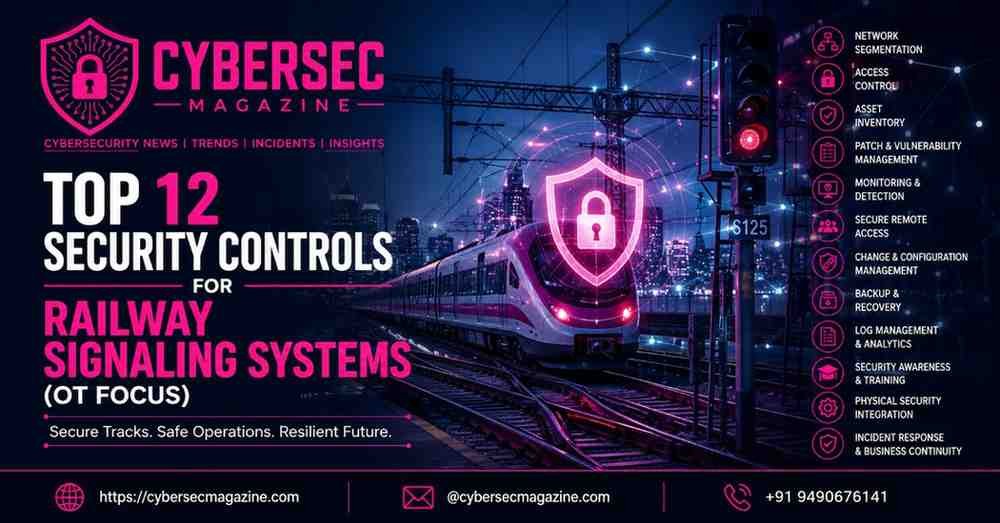
Top 12 Security Controls for Railway Signaling Systems
1. Air-Gapping and Micro-Segmentation of Interlocking Networks
The foundation of railway signaling security begins with absolute network isolation between corporate enterprise IT systems and the vital interlocking controllers managing trackside switches and signals. Security architects must enforce strict micro-segmentation, dividing the signaling network into granular safety zones using industrial-grade firewalls that drop all unapproved traffic by default. This segmentation ensures that an attacker compromising a station’s enterprise Wi-Fi or ticketing system cannot pivot laterally into the vital safety network. By maintaining hard boundaries around interlocking logic, transit authorities guarantee that only validated, cryptographically secured commands can reach physical trackside actuators.
2. Cryptographic Authentication for Track-to-Train Communications
Communications-Based Train Control (CBTC) and wireless signaling protocols frequently transmit movement authorities and speed commands over open radio frequencies between wayside equipment and moving trains. Adversaries can exploit this open medium to execute message injection, spoofing, or replay attacks designed to trick trains into unsafe braking or acceleration profiles. Implementing robust cryptographic authentication, message integrity checks, and rolling session tokens for all wireless transmissions prevents unauthorized radios from injecting fraudulent commands. Securing the air interface ensures that every movement authority received onboard a train originates from a verified, legitimate wayside controller.
3. Real-Time Protocol Anomaly Detection for Specialized Rail Protocols
Railway signaling environments rely on specialized, deterministic protocols such as European Train Control System (ETCS) specifications, Vital Processor Interlocking (VPI) protocols, and proprietary vendor communications. Standard IT monitoring tools are completely blind to these unique industrial packet structures and cannot spot malicious payload alterations. Deploying specialized passive network monitors that deeply inspect rail-specific protocols allows security teams to detect unauthorized interlocking commands, timing anomalies, and register overrides instantly. Catching these deviations in real time enables operators to intervene before cyber-physical disruptions can impact active train schedules.
4. Hardware-Based Secure Boot and Firmware Integrity
Trackside electronic interlocking units and vital controllers are deployed in remote, often physically accessible locations along the rail line where local tampering is a constant physical risk. To counter physical and remote firmware tampering, all signaling microcontrollers and safety computers must incorporate hardware-based secure boot mechanisms and Trusted Platform Modules (TPMs). These cryptographic roots of trust verify the digital signature of the operating system and application firmware every time the controller powers up, blocking modified code execution. If an unauthorized binary or malicious patch is detected during boot-up, the controller locks into a safe state, preventing compromised hardware from controlling track switches.
5. Strict Access Control and Session Auditing for Engineering Terminals
Signaling maintenance relies heavily on specialized engineering laptops and diagnostic terminals used by certified technicians to calibrate track circuits and modify interlocking tables. These high-privilege workstations are prime targets for threat actors seeking to harvest administrative credentials or deploy malicious configuration files. Organizations must enforce strict multi-factor authentication, role-based access control, and complete session recording for every engineering intervention. Furthermore, configuration management tools must require dual-person authorization for any logic changes, ensuring that no single compromised credential can alter vital safety parameters.
6. Independent Fallback and Physical Interlocking Protection
Cyber resilience in rail transport demands the preservation of physical safety layers that operate independently of digital control networks. Critical signaling assets must retain hardwired, mechanical, or electromechanical relay interlocks that function as an unhackable fallback layer in the event of a total cyber outage. If digital systems experience anomalies or suspected compromises, these physical fallback mechanisms ensure that opposing routes cannot be signaled simultaneously. Integrating cyber defense with traditional safety engineering principles guarantees that digital failures can never override fundamental physical safety laws.
7. Secure Key Management Infrastructure for Train Radios
Modern signaling systems rely extensively on cryptographic keys to secure wireless signaling channels, interlocking communications, and remote maintenance tunnels. Poor key management-such as hardcoded default master keys or infrequent key rotation-leaves entire rail corridors vulnerable to systemic compromise. Implementing a centralized, highly secure Public Key Infrastructure (PKI) automates the secure generation, distribution, and rapid revocation of cryptographic keys across all wayside and onboard units. Ensuring that keys expire and update on strict schedules prevents threat actors from exploiting static cryptographic credentials captured during passive network sniffing.
8. Comprehensive Asset Discovery and Vulnerability Mapping
Effective defense requires complete visibility, yet many transit agencies struggle with outdated asset inventories covering legacy trackside equipment, axle counters, and signaling servers. Security teams must deploy passive asset discovery tools that map every connected device across the signaling network without interrupting critical safety traffic. Regular vulnerability assessments should be conducted in staging environments or during scheduled maintenance windows to identify unpatched firmware and protocol flaws. Maintaining an accurate, real-time inventory ensures that emerging threats targeting specific signaling components can be mitigated immediately.
9. Centralized SIEM Integration and Security Logging
Railway signaling networks generate immense volumes of diagnostic, status, and event data across distributed interlockings, track circuits, and control centers. All firewalls, diagnostic servers, and security sensors must forward their logs in real time to a centralized Security Information and Event Management (SIEM) platform tailored for OT operations. Security analysts must configure custom correlation rules to detect suspicious behavioral patterns, such as repeated authentication failures, unusual configuration downloads, or unexpected controller resets. Centralized, tamper-proof logging ensures that security teams can reconstruct complex attack timelines and respond swiftly to emerging incidents.
10. Robust Redundancy and Fail-Safe Network Architecture
Safety is the paramount requirement in rail transport, dictating that any system failure or cyber attack must drive the infrastructure into a predefined safe state, such as halting all trains. Signaling networks must be engineered with redundant communication paths, dual-redundant safety controllers, and fault-tolerant ring topologies that maintain operation during equipment failure. If a network disruption or active cyber attack severs primary communication lines, redundant fail-safe paths ensure continuous monitoring without risking erratic control behavior. Designing for fail-safe resilience protects passengers by ensuring that system degradation never results in ambiguous or dangerous track conditions.
11. Vendor Security Governance and Supply Chain Risk Management
Signaling infrastructure is heavily dependent on specialized third-party vendors who supply interlocking hardware, CBTC software, and ongoing maintenance support. A compromise within a vendor’s software update pipeline or remote support tunnel can introduce malicious code directly into the transit network. Transit authorities must enforce rigorous supply chain security governance, requiring vendors to prove secure coding standards, independent code audits, and zero-trust remote access controls. Vet all software updates through strict staging environments and cryptographic verification before deployment to protect the rail ecosystem from upstream compromise.
12. Incident Response and Cyber-Physical Tabletop Exercises
Even the most robust security controls cannot guarantee absolute immunity against highly sophisticated, state-sponsored cyber adversaries targeting critical national infrastructure. Transit operators must establish specialized incident response plans explicitly designed to handle cyber-physical emergencies affecting railway signaling and train control. These plans must be tested regularly through rigorous tabletop exercises involving both IT security teams and traditional railway signaling engineers. Collaborative preparation ensures that when an anomaly occurs, technical staff can safely isolate compromised signaling zones, transition to manual backup procedures, and restore normal transit operations rapidly.
Conclusion: Securing the Future of Rail Transport
As railway systems embrace digital transformation to meet the demands of modern mobility, securing signaling infrastructure has become an urgent national security priority. Relying on legacy air-gaps or outdated network designs leaves critical transit systems vulnerable to sophisticated, automated cyber threats. By implementing rigorous security controls-ranging from micro-segmentation and cryptographic radio authentication to hardware secure boot and fail-safe redundancy-transit authorities can protect their passengers and infrastructure. Evaluate your network architecture, audit your interlocking boundaries, and enforce proactive cybersecurity measures today to ensure a safe and resilient operational future for global rail transport.