Top 12 Questions for Vendor Security Roadmap Calls (2026)
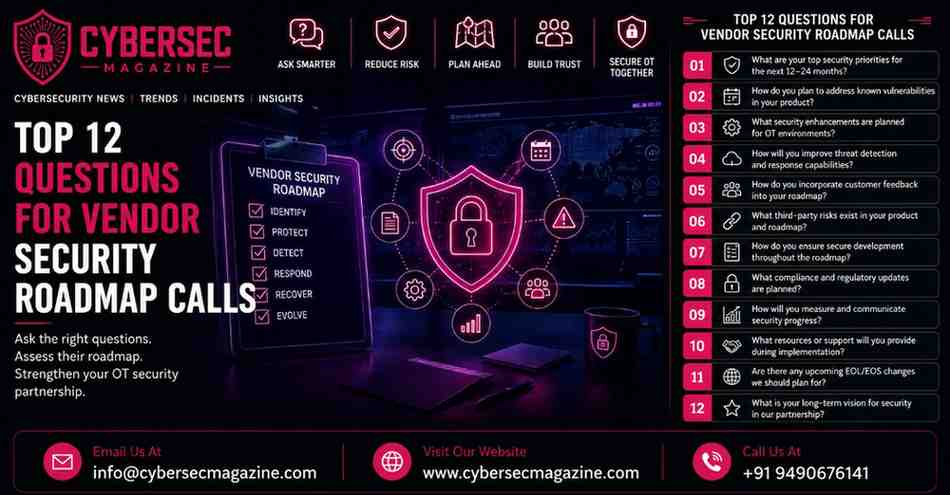
Master your vendor risk assessments in 2026. Discover the top 12 critical questions to ask for robust OT/ICS supply chain security and operational resilience.
The New Reality of Industrial Procurement
The days of treating cybersecurity as a secondary consideration during industrial procurement are over. In 2026, the convergence of IT and OT has turned every vendor touchpoint into a potential gateway for sophisticated, persistent threats. As adversaries shift from simple disruption to long-term “living-off-the-land” persistence, utility operators and manufacturers must demand more than just marketing assurances from their technology partners. Today’s industrial ecosystem requires a rigorous, evidence-based approach to vendor selection, where security is not a feature but a foundational commitment to operational safety. Whether you are onboarding a new automation partner or reviewing existing service level agreements, these 12 questions are designed to cut through the noise and reveal the true depth of your vendor’s security maturity.
1. How is security integrated into your “Secure by Design” development lifecycle?
True security begins long before a device or software hits your factory floor; it starts in the vendor’s R&D phase. Ask them to explain their Secure Development Lifecycle (SDL) and how they mitigate risks during the initial coding and design stages. You are looking for proof that they prioritize vulnerability reduction, such as secure coding training for their engineers and automated security testing, rather than just patching holes after release. A vendor who cannot articulate this process is likely relying on “reactive” security, which leaves your environment vulnerable to zero-day exploits.
2. Can you provide an SBOM (Software Bill of Materials) for all components?
Supply chain visibility is the baseline for modern industrial security. You need to know exactly what is inside the systems you are plugging into your critical infrastructure. Demand a transparent, machine-readable Software Bill of Materials (SBOM) that identifies every third-party library, driver, and component within their product. This transparency allows your security team to proactively identify if a new, publicized vulnerability (like a Log4j-style event) affects the systems running your PLCs or HMI stations.
3. What is your public vulnerability disclosure and patching policy?
Transparency in incident response is a critical indicator of vendor maturity. Ask for a clear policy regarding how and when they disclose vulnerabilities and what their predictable patching cycle looks like. You need to know if they participate in the CVE (Common Vulnerabilities and Exposures) program and how they communicate workarounds while a permanent patch is being developed. A vendor that hides their vulnerabilities is a high-risk partner; you need a proactive partner who treats your security as their own.
4. How do you handle and audit remote support access?
Remote access is the most common vector for unauthorized entry into OT environments. Never accept a “VPN-only” answer; ask specifically how they secure and monitor remote support sessions. The ideal vendor provides granular, time-bound access that is heavily logged and multi-factor authenticated (MFA). They should be able to show you how they ensure their own technicians cannot “pivot” from a support session into restricted parts of your network where they do not belong.
5. How does your solution integrate with our existing SOC/SIEM ecosystem?
Industrial environments are already noisy; you do not need another siloed dashboard that forces your team to manually correlate data. Ask the vendor how their logs and alerts can be exported into your existing Security Operations Center (SOC) or SIEM (Security Information and Event Management) platform. Seamless integration ensures that critical anomalies-like an unexpected change in ladder logic or an unauthorized firmware upload-are flagged in your central system, allowing for faster, more unified incident response.
6. Do you have a “Safe Harbor” policy for security researchers?
A vendor that welcomes independent security research is a vendor that is confident in their product’s integrity. Ask if they have a public “Safe Harbor” policy, which encourages researchers to report vulnerabilities without fear of legal reprisal. This commitment often results in faster identification of flaws by the white-hat community, making the product safer for everyone. If they treat security research as a threat rather than an asset, they likely have a fragile security posture.
7. How do you prove your backups are immutable and air-gapped?
In a ransomware-heavy threat landscape, your backups are your last line of defense, and attackers know it. Ask the vendor to explain the technical controls that make their system backups immutable-meaning they cannot be deleted or modified even by a compromised administrator account. If they cannot provide concrete proof of off-line or air-gapped recovery options, their “ransomware protection” claims are likely nothing more than marketing fluff.
8. What is your internal protocol for third-party service provider access?
If your vendor outsources any of their own IT or support functions, you have inherited the risk of their sub-contractors. Ask for details on how they perform due diligence on their own partners. You need to know that the third-party firm they hired to manage their cloud infrastructure is held to the same rigorous security standards as the vendor themselves. Do not be afraid to ask for their third-party risk assessment procedures and audit results.
9. Can you operate in “Island Mode” if connectivity is lost?
Operational continuity is the hallmark of a resilient industrial system. Ask the vendor if their solution requires a constant internet “phone-home” connection to function, or if it can maintain full local control in an “islanded” environment. If an attacker cuts your external link, your critical assets must continue to run safely. A system that “bricks” or disables features when offline is a significant liability in an environment where network outages are a distinct possibility.
10. How do you manage privileged administrative accounts?
Privileged access is the “holy grail” for attackers seeking to manipulate industrial processes. Ask the vendor how they control, monitor, and rotate the credentials for administrative accounts within their products. They should have clear policies on avoiding shared credentials and a strategy for implementing “least privilege” access. If their system uses hardcoded default passwords for all installations, you should immediately flag this as a critical security non-starter.
11. What is your plan for end-of-life (EOL) and legacy hardware support?
Industrial assets often have 20-year lifespans, while IT security cycles are measured in months. Ask the vendor what their support lifecycle looks like and what happens when a component reaches EOL. Do they provide security patches for legacy hardware, or are you forced to rip-and-replace to stay secure? Understanding this roadmap allows you to plan your long-term capital investments and avoid being trapped with unpatchable, insecure equipment.
12. Have you conducted recent, executive-level tabletop exercises?
A security roadmap is only as good as the team that executes it under pressure. Ask the vendor if they have participated in (or led) tabletop exercises that included senior leadership, not just technical staff. These drills test the decision-making process during a crisis-who is in charge, how are communications handled, and how quickly can operations be restored? A vendor who takes this seriously is a partner who truly understands that industrial cyber risk is a business-level survival issue.