
Top 12 OT Vulnerability Prioritization Tools (Risk Scoring)
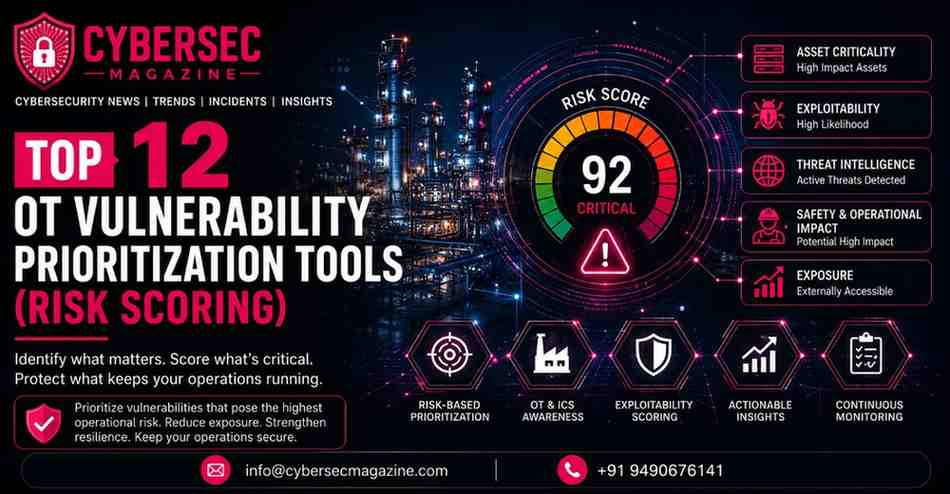
OT vulnerability management has changed. In industrial environments, the question is no longer “What vulnerabilities exist?” but “Which ones can actually hurt the process, the people, or production?” NIST’s OT guidance emphasizes that OT security must account for mission impact, operational context, and typical OT vulnerabilities, not just IT-style findings. At the same time, CISA advises organizations to use the Known Exploited Vulnerabilities catalog as an input to prioritization, and its vulnerability-management messaging points to exploitation status frameworks such as SSVC rather than relying on severity scores alone.
That matters because CVSS is still useful, but it is only one input. NVD explains that CVSS is commonly used for severity measurement and remediation prioritization, yet OT teams also need asset criticality, exposure, exploitability, safety impact, and operational context before deciding what to fix first. In other words, OT risk scoring should help teams protect uptime and safety, not just close tickets.
This article highlights 12 tools and platforms that publicly document OT/ICS vulnerability prioritization or risk scoring capabilities. The list is editorial, not a market ranking, and it favors platforms that help industrial teams turn raw vulnerability data into action.
Why OT risk scoring deserves its own category
Industrial systems behave differently from enterprise IT. Many assets cannot be patched immediately, some are safety-critical, and many are running legacy protocols that were never designed for internet-connected threat environments. NIST’s OT guide notes that OT risk management must reflect the mission and business functions supported by the system, while CISA’s KEV guidance pushes defenders to prioritize vulnerabilities that are known to be exploited. Together, that means OT teams need prioritization models that understand both exploitation likelihood and operational consequence.
The best tools in this space combine passive discovery, vulnerability intelligence, asset criticality, and workflow support for remediation. Some go further with custom risk frameworks, KEV awareness, or threat-informed prioritization so teams can focus on the few issues that truly matter.
Top 12 OT Vulnerability Prioritization Tools
1) Claroty xDome Vulnerability & Risk Management
Claroty’s vulnerability and risk management module is built for industrial and critical-infrastructure environments and explicitly uses a custom risk-scoring framework to help teams understand CPS risk in their own environment. Its public materials say the platform helps organizations mitigate risks before they affect uptime, personnel safety, or service availability.
What makes Claroty stand out is the move from generic severity to environment-aware prioritization. Instead of treating every vulnerability as equal, it focuses remediation work on what the organization can actually reduce and measure over time. That is especially useful for large OT estates where patch windows are scarce and operational disruption is expensive.
2) Nozomi Networks Guardian
Nozomi Networks positions its platform around OT and IoT vulnerability management, automatically identifying and scoring open vulnerabilities and using NVD-based scoring to help determine which devices are at risk. Its risk-assessment materials also stress threat actors actively targeting a region or industry, which is valuable context for prioritization.
For industrial teams, the value here is context. Nozomi does not just show what is vulnerable; it helps security teams understand which exposures line up with active threat activity and which deserve immediate attention. That is exactly the kind of operationally useful scoring OT programs need.
3) Tenable OT Security
Tenable OT Security uses Vulnerability Priority Rating, or VPR, to generate risk scores for vulnerabilities and specifically says it focuses teams on high-risk vulnerabilities that are actively exploitable rather than only high-CVSS items. Tenable also describes a “do-no-harm” discovery model using passive monitoring and vendor-approved safe active querying.
That combination is important in OT because prioritization is only useful if discovery does not disrupt operations. Tenable’s approach is attractive for converged OT/IT environments that need practical scoring, actionable remediation, and a safer way to discover what is on the network.
4) Dragos Platform
Dragos’s platform offers risk-based OT vulnerability management and says its prioritization guidance helps defenders mitigate vulnerabilities without disrupting operations. Dragos also frames its approach around the reality that OT teams must focus on only a small percentage of vulnerabilities that need attention right now.
The practical value is OT-native prioritization. Dragos ties vulnerability management to industrial threat intelligence and operational constraints, which is useful for sectors like manufacturing, utilities, and oil and gas where downtime and unsafe changes are unacceptable.
5) Microsoft Defender for IoT
Microsoft Defender for IoT provides OT vulnerability management, asset discovery, and risk-based vulnerability management in the Defender portal, with passive and agentless network monitoring to build a complete inventory and context. Microsoft’s documentation makes clear that the platform is designed to help OT security teams manage network exposure and remediation actions from one place.
Its strength is scale and integration. For organizations already using Microsoft’s security stack, Defender for IoT can be a practical way to bring OT visibility and prioritization into a broader security operations workflow without building a separate island of tooling.
6) Armis Centrix
Armis describes Centrix as a cyber exposure management platform that delivers real-time visibility, risk assessment, and proactive protection across IT, OT, IoT, and IoMT devices. Its public materials emphasize AI-powered risk scoring and business-contextual intelligence to deduplicate and prioritize vulnerabilities by exploitability and threat intelligence.
This is valuable for industrial operators dealing with sprawling estates and mixed device classes. Armis is especially relevant when a team wants one exposure-management view across plant equipment, enterprise assets, and connected devices that all contribute to risk.
7) Forescout eyeInspect
Forescout’s eyeInspect product explicitly says its OT risk scoring is built for OT realities, using asset criticality, network exposure, and Known Exploited Vulnerabilities to cut through the noise. Forescout’s ServiceNow integration also shows a remediation-oriented workflow for OT, IoT, and unmanaged devices.
That KEV-aware approach matters because a vulnerability that is actively exploited deserves different treatment from one that is merely theoretical. Forescout’s model is appealing to teams that need site-specific prioritization and clear remediation actions, not just another vulnerability feed.
8) TXOne Networks Stellar Discover and StellarOne
TXOne’s Stellar Discover is a lightweight OT endpoint sensor that maps inventory and vulnerability surface without kernel drivers, reboots, or conflicts with existing EPP/EDR. TXOne says the telemetry feeds StellarOne for VSAR-prioritized vulnerability management at enterprise scale.
That matters in environments where traditional agents are too disruptive. TXOne’s operations-first approach is useful for organizations that want endpoint visibility and prioritization while preserving plant stability and minimizing deployment friction.
9) Honeywell Cyber Insights
Honeywell Cyber Insights is a purpose-built OT cybersecurity solution that provides asset visibility, near-real-time threat detection, vulnerability management, and actionable insights across OT systems. Honeywell also describes the platform as a way to identify assets, uncover vulnerabilities, and maintain compliance with cybersecurity regulations.
Honeywell’s strength is operational familiarity. Its materials emphasize cutting through the noise and focusing on vulnerabilities and threats that are relevant to the site, which is exactly the right idea for industrial prioritization programs.
10) Cisco Cyber Vision
Cisco Cyber Vision now places risk scoring front and center, stating that it prioritizes vulnerabilities with risk scores and threat-informed vulnerability defense. Cisco’s documentation says its scoring can be applied to devices, sites, lines, or datasets, and recent material says it uses asset criticality, exploitability, and operational context to prioritize weaknesses.
That is a strong fit for large industrial organizations that want a risk model tied to operational structure. Cisco Cyber Vision is especially relevant where teams need to align vulnerability prioritization with MITRE ATT&CK mapping and broader industrial visibility workflows.
11) Siemens SINEC Security Inspector
Siemens describes SINEC Security Inspector as a security testing solution for OT/IT environments that combines market-leading and in-house tools on a common platform. Siemens also documents an OT scanner scenario for asset and vulnerability discovery, making it relevant for organizations that want structured industrial assessment workflows.
Siemens is a good fit where the security team wants vulnerability discovery tied to industrial engineering environments and product-specific hardening guidance. That makes it useful for prioritization, especially when paired with Siemens advisory and hardening workflows.
12) Fortinet OT Security Platform
Fortinet’s OT Security Platform emphasizes visibility, segmentation, automated policy enforcement, secure remote access, and FortiGuard OT threat data. Fortinet also highlights virtual patching for vulnerable legacy OT devices, which can be a practical risk-reduction measure when patching is delayed or not feasible.
While Fortinet is broader than a pure prioritization engine, it matters in OT vulnerability programs because prioritization is only half the job. If an asset cannot be patched right away, compensating controls such as segmentation and virtual patching help reduce the immediate risk while the organization prepares a safer long-term fix.
How to choose the right OT prioritization tool
The best OT vulnerability prioritization tool is the one that matches the plant’s realities. Teams should look for asset discovery that does not disrupt operations, scoring that incorporates exploitability and criticality, KEV awareness, workflow integration, and reporting that the operations team can actually use. NIST’s OT guidance and CISA’s KEV emphasis both point to the same principle: prioritize vulnerabilities in the context of the mission, not just the label on the CVE.
A strong selection process should also ask a harder question: can this platform help us reduce risk without creating new operational risk? In OT, the answer to that question is often more important than the raw feature list.
Final thoughts
OT vulnerability prioritization is moving away from generic severity and toward contextual risk. That shift reflects how industrial environments actually operate: patching is constrained, uptime matters, safety matters, and not every critical-looking CVE deserves immediate action. NIST, CISA, and the vendor platforms above all reinforce the same direction of travel-use exposure, exploitability, asset criticality, and operational context to decide what to fix first.