
Top 12 OT Security Strategies for Smart Buildings & Facilities
The Convergence of Smart Infrastructure and Cyber Risk
The contemporary smart building is a complex, hyper-connected ecosystem where operational efficiency meets digital transformation. Gone are the days when facility management relied strictly on isolated pneumatic controls, manual temperature adjustments, and localized security guards. Today, modern commercial complexes, hospitals, airports, and corporate campuses utilize advanced Building Automation Systems (BAS), Heating, Ventilation, and Air Conditioning (HVAC) controllers, smart lighting networks, and automated physical access systems. While these IoT-enabled innovations successfully optimize energy consumption, reduce carbon footprints, and dramatically elevate tenant comfort, they have simultaneously turned commercial real estate into a lucrative target for cybercriminals and sophisticated threat actors.
The underlying vulnerability of smart buildings stems from the traditional convergence of Information Technology (IT) and Operational Technology (OT). Historically, building management systems (BMS) were completely air-gapped from the outside world, designed explicitly for longevity and continuous mechanical reliability rather than cyber resilience. As facility operators increasingly migrate control panels to cloud dashboards and enterprise networks for remote management convenience, the traditional perimeter defense model collapses. Threat actors no longer need to breach corporate financial databases to inflict damage; instead, they can exploit unpatched HVAC controllers or insecure building management protocols to execute lateral movements, launch ransomware campaigns, or disrupt critical physical infrastructure. Securing smart building OT assets is an urgent, multi-faceted discipline that requires modern frameworks, continuous visibility, and rigorous lifecycle management.
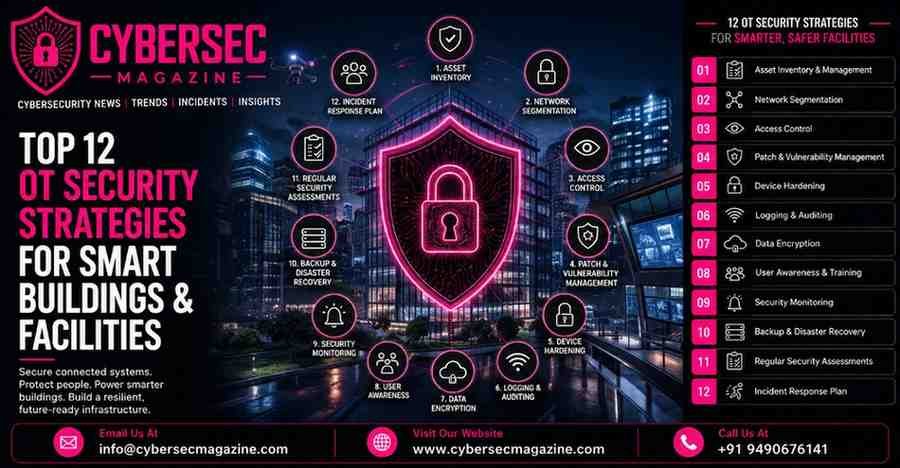
12 OT Security Strategies for Smart Buildings & Facilities
1. Discover and Map All Connected Building Automation Assets
Gaining absolute, real-time visibility into every connected device across a facility network serves as the foundational cornerstone of smart building cybersecurity. In dynamic commercial properties, new IoT sensors, smart thermostats, IP cameras, and lighting controllers are added frequently by contractors and tenants without central IT oversight. Traditional active IT network scanning tools can easily crash sensitive, legacy serial-to-Ethernet gateways or disrupt proprietary building protocols like BACnet and Modbus. Facilities must instead deploy passive network monitoring and specialized OT discovery tools that safely listen to communication patterns, cataloging every asset footprint without interfering with mechanical operations. This comprehensive inventory must capture critical metadata, including hardware manufacturers, firmware versions, active IP addresses, and open communication ports. By maintaining a centralized, real-time map of all building assets, security teams can accurately evaluate their true attack surface and spot rogue legacy endpoints before attackers exploit them.
2. Enforce Strict Network Micro-Segmentation Across Facilities
Flat network architecture remains one of the most dangerous vulnerabilities in modern smart building design, allowing an attacker who breaches a guest Wi-Fi network or smart coffee machine to pivot directly into core HVAC and elevator controls. Building management systems must never share the same network segment as corporate guest networks, tenant enterprise IT infrastructure, or external web portals. Facility engineers must implement rigorous network micro-segmentation, isolating different operational subsystems into distinct virtual local area networks (VLANs) and zones. Utilizing software-defined perimeters and industrial firewalls ensures that communication between zones is restricted by strict, rule-based policies. If a threat actor manages to compromise a low-security smart lighting interface, micro-segmentation acts as an internal firewall barrier, preventing lateral movement and protecting critical safety systems from collateral operational disruption.
3. Secure Building Protocols and Implement Open Standard Governance
Smart buildings rely heavily on industrial and automation communication protocols-such as BACnet, Modbus, LonWorks, and MQTT-many of which were originally designed decades ago with zero built-in encryption or authentication capabilities. This means anyone with physical or remote access to the network wire can easily eavesdrop on traffic, inject malicious commands, or spoof controller responses. Facility managers must audit their communication pathways and transition toward secure protocol variants, such as BACnet/SC (Secure Connect), which provides robust cryptographic message framing and certificate-based authentication. Furthermore, building owners should avoid closed, proprietary vendor silos that obscure security vulnerabilities, favoring open, interoperable architectures that allow security teams to inspect traffic flows, apply consistent access controls, and prevent vendor lock-in while maintaining total system transparency.
4. Deploy Advanced Identity and Access Management (IAM) for Operators
Human error, weak passwords, and shared administrative credentials continue to represent the primary entry vectors for smart building cyber breaches. Many building management workstations and facility control panels still rely on factory default usernames and hardcoded administrative passwords that are rarely changed after initial installation. Organizations must enforce strict Identity and Access Management (IAM) protocols, eliminating all shared accounts and mandating multi-factor authentication (MFA) for every human operator accessing building control systems. Service accounts, vendor API keys, and automated script tokens must be treated as privileged assets, complete with regular password rotation cycles and robust activity logging. By enforcing role-based access control (RBAC), facility managers can ensure that contract technicians and junior operators possess permissions strictly limited to their immediate scope of work.
5. Establish Rigorous Third-Party Vendor and Integrator Governance
Smart building infrastructure is rarely installed, maintained, or monitored exclusively by in-house personnel; rather, facilities rely extensively on a complex web of third-party vendors, mechanical contractors, and specialized integrators. These external partners often require remote maintenance access channels-such as virtual private networks (VPNs) or remote desktop utilities-to calibrate equipment, troubleshoot system errors, or push updates. If an external vendor’s corporate network is compromised upstream, malicious actors can exploit those trusted remote channels to slip directly into internal building control loops undetected. Facility operators must institute a comprehensive Third-Party Risk Management (TPRM) framework, mandating rigorous security audits, strict SLA compliance, and zero standing privileges for external contractors. All vendor remote sessions must be monitored, time-bound, and protected via encrypted multi-factor tunnels.
6. Implement AI-Driven Behavioral Anomaly Detection for BAS
Because smart building environments handle thousands of predictable, routine mechanical actions every hour-such as cycling chillers, adjusting dampers, and reading temperature sensors-they establish highly stable operational baselines. Traditional signature-based security tools often miss novel, low-and-slow cyberattacks that disguise themselves as normal traffic. Modern facilities are increasingly deploying artificial intelligence (AI) and machine learning-powered behavioral anomaly detection platforms to monitor their OT networks in real time. These intelligent systems continuously study normal device communication patterns, packet sizes, and polling frequencies across all automation controllers. The moment a controller exhibits irregular behavior-such as an air handler control unit suddenly transmitting bulk data externally or executing unusual write commands-the AI platform triggers an immediate alert, enabling security operators to isolate the anomaly instantly.
7. Optimize Lifecycle Management and Secure Firmware Patching
Building automation hardware, Programmable Logic Controllers (PLCs), and environmental sensors often remain deployed in active service for fifteen to twenty years, long after manufacturers have ceased releasing official software updates or security patches. Operating aging, unpatched firmware exposes smart facilities to known exploits that threat actors actively target across public vulnerability databases. Facility managers must design an ongoing device lifecycle management program that catalogues asset ages, tracks manufacturer end-of-life notices, and establishes risk-based remediation schedules. When direct patching is impossible due to operational constraints or proprietary software limitations, teams must utilize compensating controls, such as network-layer intrusion prevention systems (IPS) and virtual patching, to neutralize known vulnerabilities without risking mechanical downtime.
8. Establish Resilient Backup, Recovery, and Manual Override Workflows
When a sophisticated ransomware attack, firmware corruption, or destructive malware outbreak successfully bypasses perimeter defenses, the ability to recover quickly determines whether a building remains functional or grinds to a complete halt. Smart building control databases, controller logic files, and configuration backups must be captured regularly, encrypted, and stored in immutable, air-gapped repositories that cannot be altered or deleted by malicious actors. Furthermore, because a major cyber incident can knock building management software offline for days, facility teams must maintain rigorously tested physical disaster recovery plans. This includes ensuring that building operators are fully trained in manual mechanical overrides, physical key execution, and analog fail-safes, allowing critical life-safety systems, smoke evacuation vents, and door locks to operate safely during a digital blackout.
9. Integrate Physical Security Operations with IT and OT Cybersecurity
In many commercial facilities, physical security departments-managing electronic door locks, badge readers, CCTV surveillance cameras, and perimeter intrusion alarms-operate in a completely isolated silo separate from IT and OT cybersecurity teams. However, modern physical security systems run entirely on IP networks and IoT architectures, making them prime targets for threat actors looking to compromise a building’s physical integrity to gain deeper access to internal OT backbones. Convergence is essential; organizations must unify physical security operations with digital cybersecurity task forces. Establishing a unified security operations center (SOC) allows teams to correlate physical access logs with network anomalies, ensuring that a compromised badge reader or hacked security camera immediately triggers digital network containment protocols before intruders compromise the wider facility.
10. Implement Continuous Vulnerability Management and Configuration Audits
The cybersecurity threat landscape evolves at a relentless pace, rendering static annual security audits and manual compliance checklists completely obsolete for modern smart buildings. Facilities must transition to continuous vulnerability management programs that routinely cross-reference active hardware and software inventories against global threat feeds, vendor advisories, and the Cybersecurity and Infrastructure Security Agency (CISA) Known Exploited Vulnerabilities (KEV) catalog. Additionally, configuration drift is a pervasive issue in building automation, where technicians make temporary manual adjustments that permanently weaken security controls. Automated configuration monitoring tools must be deployed to scan BAS controllers and network switches continuously, flagging unauthorized baseline changes, open ports, or weak cipher suites so that remediation teams can act instantly.
11. Design Resilience for Smart Grid and Energy Management Integrations
Modern smart buildings do not operate in a vacuum; they interact dynamically with utility grids, microgrids, electric vehicle (EV) charging stations, and renewable energy solar arrays to optimize power distribution and reduce operational costs. While these advanced energy management integrations maximize efficiency, they also open direct digital communication pipelines between external utility infrastructure and internal building automation loops. A cyberattack targeting a building’s smart energy management system could cause erratic power draws, overload local electrical substations, or disrupt grid stability on a wider geographic scale. Facilities must implement rigorous cryptographic validation, secure API gateways, and strict traffic filtering for all external energy grid touchpoints, ensuring that utility interactions cannot be leveraged as an open backdoor into the building’s core operational network.
12. Cultivate a Specialized Security Culture Among Facility Personnel
Despite deploying advanced micro-segmentation, AI-driven anomaly detection, and cryptographic protocols, human behavior remains a critical vulnerability in smart building security. Facility managers, maintenance engineers, and administrative staff are prime targets for highly targeted spear-phishing campaigns designed to steal administrative credentials or inject malware via unverified corporate laptops. Because facility teams are focused primarily on mechanical maintenance and physical comfort rather than digital defense, standard enterprise cybersecurity training often fails to resonate. Organizations must design specialized, context-aware cybersecurity awareness programs tailored directly to the operational realities of building engineers and property management teams. Training must focus on identifying social engineering tactics, recognizing suspicious control console alerts, and following strict protocol when handling third-party maintenance devices. By fostering a collaborative culture where every facility worker views physical and digital security as an integrated priority, smart buildings can successfully defend their infrastructure against the next generation of cyber threats.
Conclusion: Securing the Future of Intelligent Facilities
As smart buildings continue to evolve into highly integrated, hyper-connected digital ecosystems, the traditional boundaries separating physical asset management from advanced cybersecurity have effectively dissolved. Operational technology within facilities is no longer protected by obscurity or physical air-gaps; instead, building automation systems face a relentless barrage of sophisticated ransomware attacks, supply chain exploits, and targeted intrusions. Protecting modern commercial real estate, hospitals, and corporate campuses requires a decisive shift away from reactive posture management toward a proactive, resilient security framework.
By successfully implementing comprehensive asset discovery, strict micro-segmentation, AI-driven behavioral monitoring, rigorous vendor governance, and continuous vulnerability tracking, facility operators can effectively mitigate emerging cyber risks without compromising human safety or operational uptime. Ultimately, the long-term success of smart building innovation relies on a unified commitment from IT professionals, facility engineers, and executive leadership to treat cybersecurity as a core pillar of building design. Organizations that prioritize these foundational strategies will secure not only their digital networks and valuable physical assets, but also the enduring trust of the occupants who live and work inside them every day.