Top 12 Criteria to Evaluate an OT MDR Provider
In 2026, the industrial landscape is no longer defined by air-gapped systems or isolated silos. The rapid integration of IIoT, cloud-connected analytics, and converged IT/OT networks has fundamentally shifted the risk profile for manufacturing, energy, and critical infrastructure sectors. Traditional Managed Detection and Response (MDR) services, designed primarily for enterprise IT environments, often fall short here. While IT security prioritizes the Confidentiality and Integrity of data, OT environments demand Availability, Reliability, and Safety above all else. A misconfigured security scan or an automated isolation protocol-standard in IT-can trigger a catastrophic process failure in a refinery or power grid. Consequently, organizations must pivot toward specialized OT MDR providers that view security through the lens of industrial operational continuity rather than just digital data protection.
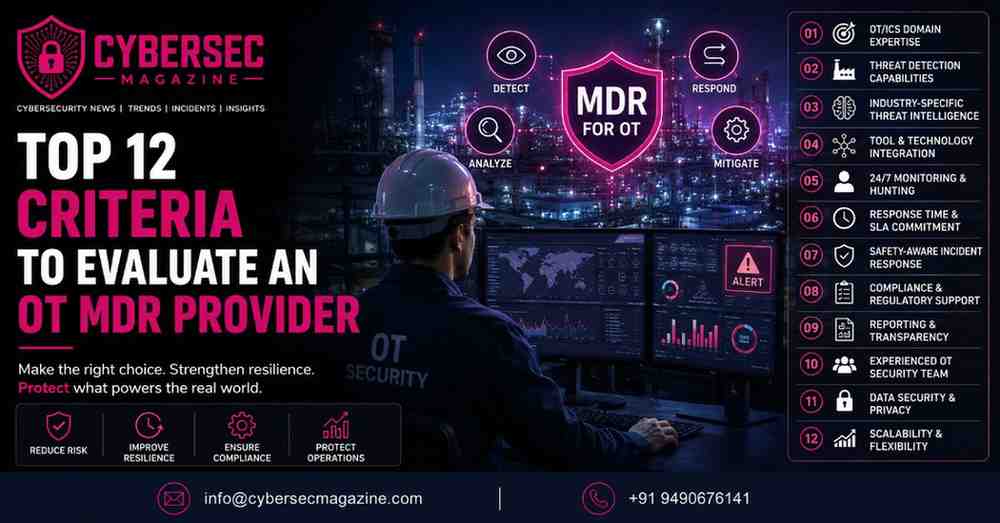
The 12 Benchmarks for OT MDR Evaluation
1. Deep-Dive ICS/OT Protocol Proficiency
An effective MDR provider must speak the native languages of your plant floor. Generic security analysts are experts in Windows and Linux event logs, but they often struggle to interpret the nuances of industrial communication protocols like Modbus, DNP3, PROFINET, or BACnet. Your partner must be able to distinguish between a routine engineering workstation command and an adversary attempting to manipulate a Programmable Logic Controller (PLC). This domain-specific expertise ensures that the “threat” alerts you receive are relevant to the physical process, preventing the “alarm fatigue” that often plagues teams relying on IT-centric security platforms.
2. Process-Aware Threat Detection Models
Unlike IT environments where an anomaly usually signals malware, an OT anomaly might signal a dangerous mechanical imbalance or an unsafe state in a production line. The ideal MDR provider utilizes process-aware detection, integrating baseline behavioral analytics with knowledge of your specific physical processes. By understanding the typical pressure levels, valve states, or turbine speeds of your equipment, the provider can identify subtle, cyber-physical threats that evade traditional signature-based detection. This approach transforms security from a reactive net into a proactive guardian of your physical infrastructure’s integrity and safety.
3. Safety-First Incident Response Playbooks
In the world of OT, “isolation” is not always a viable remediation strategy. If an infected endpoint is critical to an ongoing batch process, shutting it down could cause millions in waste or physical equipment damage. When evaluating a provider, demand to see their “Safety-First” response playbooks. They should demonstrate a clear, documented framework for how they coordinate with your on-site engineering team before taking any action. A premium provider will offer tiered response strategies-prioritizing manual verification, deferred containment, or graceful degradation-to ensure that security actions never inadvertently compromise the safety of the plant floor.
4. Passive Asset Visibility and Monitoring
You cannot protect what you cannot see, but you also cannot risk crashing fragile legacy controllers with active vulnerability scanners. A leading OT MDR provider must prioritize passive network monitoring, utilizing SPAN ports, TAPs, or data diodes to collect traffic without introducing latency or injecting packets into your sensitive control networks. By mirroring traffic at the switch level, they gain full visibility into your asset inventory-including firmware versions and hardware models-without ever touching the devices themselves. This method is the “gold standard” for maintaining operational stability while achieving total network transparency.
5. Context-Rich Asset DNA Profiles
Knowing an IP address is meaningless in an industrial environment; you need the full “DNA” of the device. An elite MDR provider doesn’t just show you a list of connected devices; they provide comprehensive context, such as the specific rack, slot, and module configuration of your PLCs or the patch levels of your Human Machine Interfaces (HMIs). This context is critical when a vulnerability is disclosed, as it allows your team to prioritize patching based on the actual risk to the physical process. They must be able to correlate asset identity with its criticality, ensuring your limited resources are directed at the most dangerous exposure points.
6. Open Ecosystem and Stack Integration
Avoid providers that demand a “rip and replace” of your existing security infrastructure. Your chosen MDR partner should act as a force multiplier, not an isolated island. Look for providers that offer API-first architectures, allowing them to ingest telemetry from your existing firewalls, industrial IDSs, and endpoint protection platforms. They should enrich this data with their own proprietary threat intelligence to provide a unified “single pane of glass” view. This integration ensures that your investments in other security tools are maximized rather than rendered obsolete by the new service.
7. Industrial-Specific Threat Intelligence
Threat actors targeting critical infrastructure-ranging from nation-state groups to specialized ransomware syndicates-operate with different tactics, techniques, and procedures (TTPs) than typical cyber-criminals. Your MDR provider must possess dedicated ICS threat intelligence teams that track adversary campaigns against specific industrial hardware and protocols. Instead of generic indicators of compromise (IOCs) like file hashes, they should focus on the “behaviors” and “campaigns” that define industrial espionage and sabotage. This intelligence should be proactive, feeding into your detections to stop threats at the earliest stages of the kill chain.
8. Cross-Trained 24/7 OT-SOC Coverage
Your operations run around the clock, and your security coverage must be equally relentless. Ensure the MDR provider offers a dedicated, 24/7 Security Operations Center (SOC) staffed by analysts who are cross-trained in both cybersecurity and industrial process operations. During a midnight alert, you need to speak with a professional who understands that the “out-of-range” telemetry on your centrifuge is a potential high-severity event, not just a network hiccup. This human-led, expert-driven model is essential for the rapid, accurate decision-making required to avoid downtime during a high-stakes security incident.
9. Alignment with ISA/IEC 62443 Standards
Compliance is not just a regulatory box to check; it is a framework for operational resilience. Your MDR provider should demonstrate deep alignment with the ISA/IEC 62443 standards, which are the industry benchmark for securing Industrial Automation and Control Systems (IACS). By mapping their service delivery, reporting, and response processes to these requirements, they ensure your security posture is always audit-ready. This alignment provides a common language for reporting risk to your executive leadership and regulatory bodies, demonstrating that your security measures meet globally accepted best practices.
10. Rapid-Deployment Incident Response (IR) Retainers
MDR is primarily about monitoring and triage, but you must have a “break-glass” plan for when a crisis occurs. Evaluate whether the provider includes or offers a high-priority Industrial Incident Response (IR) retainer. In the event of a full-scale ransomware attack, you need an on-call team that specializes in OT forensics and recovery. This team should be familiar with your architecture and ready to deploy-either remotely or on-site-to coordinate with your engineers, manage forensic evidence, and accelerate your path to recovery while maintaining system safety.
11. Distributed Scalability for Multi-Site Ops
Many industrial organizations manage a fragmented footprint of remote substations, processing plants, and localized edge facilities. A provider that relies on a centralized “hub-and-spoke” model with heavy hardware requirements at every location will likely struggle with your geography. Ensure the provider offers a lightweight, scalable, multi-tenant architecture that can unify visibility across distributed sites without requiring a massive infrastructure footprint at each location. This ensures you can maintain a consistent security policy across your entire enterprise, from the corporate office to the most remote industrial edge.
12. Actionable, Metric-Driven Reporting
Finally, move beyond reports that only list the “number of threats blocked.” You need metrics that prove security is actively reducing operational risk. Your provider should deliver transparent, meaningful reports based on Key Performance Indicators (KPIs) such as Mean Time to Detect (MTTD), Mean Time to Respond (MTTR), and progress against the MITRE ATT&CK for ICS framework. These reports should provide actionable insights, such as specific vulnerabilities or configuration gaps that, if addressed, would have the largest impact on your overall security maturity and operational resilience.
Conclusion: Prioritizing Resilience
The selection of an OT MDR provider is a high-stakes decision that echoes far beyond the IT department. In 2026, the convergence of cyber and physical risk means that your security partner must be as concerned with the longevity of your hardware as they are with the security of your data. By applying these 12 criteria, you move past the “vendor noise” and identify a partner capable of safeguarding not just your network, but your organization’s core mission. Choose a partner that respects the reality of the plant floor, understands the nuances of ICS protocols, and treats your operational safety as their primary objective.