Top 10 Ways Vendors Undermine OT Security (And Vital Management Strategies)
Are your third-party vendors the weakest link in your industrial security? Learn how they inadvertently compromise OT/ICS and how to mitigate these risks.
The modern industrial environment is no longer an isolated, air-gapped sanctuary. To stay competitive, companies rely on a complex web of Original Equipment Manufacturers (OEMs), Managed Service Providers (MSPs), and maintenance contractors to keep systems operational. However, this ecosystem brings significant risk. When you grant a third party access to your Operational Technology (OT) or Industrial Control Systems (ICS), you are extending your attack surface beyond your own perimeter. In 2026, threat actors are increasingly targeting these “trusted” connections as a primary pivot point to bypass traditional IT security and gain deep access to critical infrastructure. If your vendor management strategy is still based on “handshake trust,” you are likely leaving the door wide open for sophisticated cyber threats.
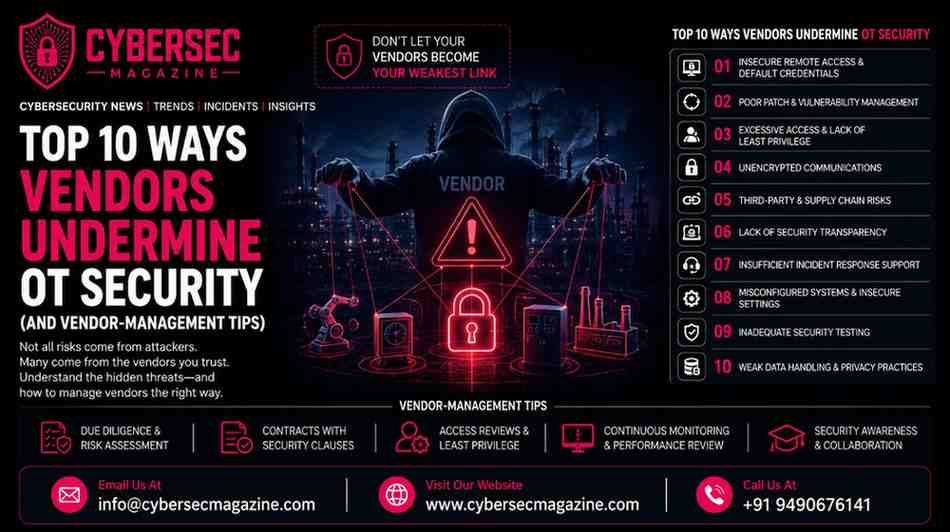
10 Ways Vendors Inadvertently Undermine Your OT Security
1. Persistent Unrestricted VPN Access
Many vendors demand permanent VPN tunnels to “troubleshoot” equipment remotely, creating a perpetual open door into your control network. These connections are often left active 24/7, even when no maintenance is scheduled, giving attackers an idle pathway to exploit. Because these tunnels often bypass internal firewalls, an adversary who compromises a vendor’s laptop can move laterally into your most sensitive PLC or HMI subnets without tripping traditional alarms.
2. Failure to Apply Critical Security Patches
Industrial vendors frequently prioritize uptime over security, leading them to delay or entirely skip patching the software or hardware they manage. By failing to update firmware or security patches on the devices they support, they leave known vulnerabilities exposed for months or even years. These “forgotten” unpatched assets become low-hanging fruit for automated ransomware that scans for legacy vulnerabilities within your OT infrastructure.
3. Use of Shared or Weak Administrative Credentials
In the interest of efficiency, vendors often share generic administrative credentials across multiple technicians or use the same default passwords for all their clients. If one of these shared accounts is compromised-either via a phishing attack or a breach at the vendor’s firm-the attacker gains instant, ready-to-use access to your environment. This practice negates the effectiveness of individualized user tracking and makes it nearly impossible to hold specific users accountable for unauthorized changes.
4. Bypassing Multi-Factor Authentication (MFA)
Some legacy industrial tools or proprietary vendor software are not compatible with modern Multi-Factor Authentication, leading vendors to request “exceptions” to your security policy. By allowing these MFA-less bypasses, you remove the most effective barrier against credential-based attacks. An attacker who gains a password doesn’t have to worry about a second authentication step, allowing them to log in as a “trusted vendor” with ease.
5. Inadequate Security on Vendor-Owned Endpoints
When vendors connect their own laptops or tablets to your network, you are trusting their security posture as much as your own. If that device is infected with malware from a previous job at a different site, it will inevitably spread that infection to your OT environment upon connection. Without endpoint inspection or stringent device-trust policies, you are effectively letting an unverified “Trojan horse” directly into your most sensitive control logic zones.
6. Shadow OT and Unauthorized Remote Tools
Technicians sometimes introduce their own “convenience” tools, such as unauthorized TeamViewer sessions or peer-to-peer file sharing, without notifying your IT/OT security team. This “Shadow OT” creates blind spots that your centralized monitoring solutions cannot see or protect. These unauthorized tools lack the encryption, auditing, and central control required for secure industrial operations, effectively creating a parallel, invisible network that is completely unmanaged.
7. Lack of Granular Access Control (Least Privilege)
Vendors often request “full administrative access” to troubleshoot issues, even if their specific task only requires access to a single controller or server. By granting this excessive privilege, you maximize the potential blast radius of a single compromised session. If an attacker gains that vendor’s account, they aren’t just limited to one machine-they have keys to the entire production floor, allowing them to manipulate processes or shut down operations at will.
8. Inconsistent Incident Disclosure Policies
When a vendor experiences a breach or detects suspicious activity, they may fail to notify their downstream customers due to legal or reputational concerns. This lack of transparency leaves your security team in the dark, unable to proactively revoke access or monitor for related indicators of compromise. Without a contractual requirement for immediate, transparent disclosure, you remain vulnerable to a breach that you didn’t even know was happening in your supply chain.
9. Poor Management of Maintenance “Backdoors”
To simplify remote diagnostics, some vendors hardcode “backdoor” accounts or maintenance hooks into the software they provide. These accounts are often undocumented, rarely changed, and known to be common targets for threat actors who research specific industrial vendor software. If these backdoors are not identified and disabled during the procurement or installation phase, they provide attackers with a permanent, clandestine method of access.
10. Lack of Cross-Organizational Incident Drills
Security is a team sport, yet most organizations never conduct joint incident response exercises with their primary vendors. If a vendor is not accustomed to your organization’s specific emergency response protocols, they will likely panic and make mistakes during a real breach. Without shared playbooks and regular tabletop exercises, the communication between your security team and the vendor during a crisis will be inefficient, increasing the duration and impact of the disruption.
Strategic Vendor Management Tips for 2026
To regain control, you must shift from a model of blind trust to a Zero Trust architecture regarding all third-party access.
- Enforce Just-in-Time (JIT) Access: Never leave VPNs or remote portals open. Require vendors to request access for a specific window of time and for a specific task, closing the connection automatically when the task is complete.
- Implement Identity-Based Microsegmentation: Use tools that restrict a vendor’s access to only the specific assets they are contracted to manage, preventing them from “poking around” the rest of your industrial network.
- Mandate Unified Logging and Auditing: Require that all vendor activity-keystrokes, commands, and file transfers-be recorded and stored in your own centralized logging solution for audit and forensics.
- Standardize Security Audits: Don’t just rely on questionnaires. Conduct periodic, objective security assessments of your vendors’ remote access security and patch management practices.
- Establish a Shared Incident Response Plan: Include specific clauses in your service level agreements (SLAs) regarding mandatory breach notification timelines and joint participation in annual security drills.