Top 10 Vendor Partnerships That Improve OT Security (Ecosystem Plays)
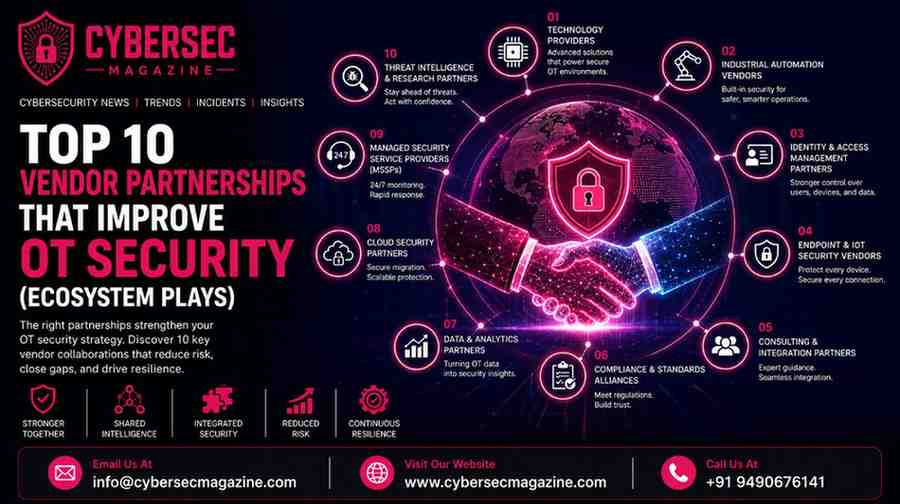
Discover how top-tier vendor partnerships are redefining OT/ICS security in 2026. Learn how ecosystem integrations drive resilience against evolving cyber threats.
In the landscape of modern industrial operations, the siloed approach to security is effectively obsolete. As Information Technology (IT) and Operational Technology (OT) converge to drive Industry 4.0, the attack surface has expanded exponentially. Threat actors are no longer just targeting enterprise IT; they are aggressively pivoting into OT environments to disrupt production, hold infrastructure for ransom, or steal proprietary intellectual property. Today, defending these complex Cyber-Physical Systems (CPS) requires a unified defense strategy. This is where vendor partnerships-often referred to as “ecosystem plays”-become the cornerstone of a mature cybersecurity posture. By integrating specialized OT security tools with broader enterprise security platforms, organizations can achieve the visibility and automated response necessary to combat sophisticated, AI-enhanced threats that bypass legacy perimeter defenses.
The Strategic Shift: Why Partnerships Matter
The complexity of contemporary industrial environments makes it nearly impossible for a single vendor to provide a comprehensive, “silver bullet” solution. Instead, leading organizations are curating an ecosystem of best-of-breed technologies that share data and context seamlessly. These partnerships allow security teams to correlate alerts from diverse sources-such as network switches, firewalls, and industrial sensors-into a single, actionable identity for every asset. When these platforms communicate, they move from being reactive, isolated tools to a proactive, cohesive defense network that can automatically stop lateral movement before an adversary reaches critical controllers. This interconnected approach not only improves detection accuracy but also reduces operational downtime, as security policies can be enforced without disrupting the delicate timing required for industrial processes.
Top 10 Vendor Partnerships Driving OT Resilience
1. Claroty and ServiceNow: Unified Asset Management
The partnership between Claroty and ServiceNow is foundational for large enterprises struggling with asset visibility and workflow automation. By pushing deep, protocol-specific asset data from Claroty into the ServiceNow Configuration Management Database (CMDB), organizations gain a real-time, accurate picture of their entire IT/OT environment. This integration ensures that security teams don’t just see a device; they understand its criticality, risk profile, and its role within the production workflow. When vulnerabilities are detected, the system can automatically trigger ServiceNow ticketing workflows, ensuring that maintenance and patching are prioritized based on actual operational risk, significantly reducing the “mean time to repair.”
2. Nozomi Networks and Palo Alto Networks: Network-Wide Enforcement
Nozomi Networks brings industry-leading AI-powered threat detection and visibility to the table, which, when paired with Palo Alto Networks’ Next-Generation Firewalls (NGFW), creates a powerful enforcement duo. In this partnership, Nozomi identifies anomalous behaviors or threats within the OT network and automatically shares this context with Palo Alto firewalls to adjust segmentation policies in real-time. This dynamic capability stops an attacker from traversing from an infected workstation into a sensitive PLC subnet. It is a prime example of turning “visibility” into “action,” ensuring that threats are contained at the network edge before they can cause catastrophic physical disruption.
3. Dragos and CrowdStrike: The Intelligence-Led Approach
For organizations facing the highest levels of persistent threats, the integration between Dragos and CrowdStrike offers a fusion of IT and OT threat intelligence. Dragos provides unparalleled, specialized knowledge of industrial protocols and adversary behavior, while CrowdStrike Falcon provides elite endpoint protection across the IT and remote workforce. By correlating telemetry from both environments, security teams can trace an attack as it moves from an enterprise email account or laptop directly into the industrial control logic. This unified visibility enables rapid incident response, allowing teams to isolate compromised endpoints before they become a bridge for malware to reach the plant floor.
4. Elisity and Cisco: Identity-Based Microsegmentation
Elisity has redefined microsegmentation by leveraging existing network infrastructure rather than forcing the deployment of cumbersome new hardware or agents in fragile OT environments. Through their partnership with Cisco, Elisity uses the built-in switching capabilities of Catalyst and Nexus hardware to enforce identity-based policies. This means that access to a PLC or a Human Machine Interface (HMI) is granted based on user and device identity, not just IP address. This ecosystem play allows massive industrial sites to implement Zero Trust architecture, effectively neutralizing lateral movement risks without the fear of causing costly, non-disruptive production shutdowns.
5. Armis and Microsoft: Cloud-Scale CPS Security
The collaboration between Armis and Microsoft integrates agentless asset intelligence with the massive analytical power of the Microsoft security stack. Armis continuously monitors the environment for new or rogue devices, feeding that intelligence into Microsoft Sentinel and Defender for IoT. This allows for a holistic security operation center (SOC) view where industrial asset telemetry is treated with the same priority as IT infrastructure. For enterprises already standardized on the Microsoft ecosystem, this partnership provides a natural, scalable path to extending enterprise-grade security policies into the deepest levels of the plant floor without requiring a complete infrastructure overhaul.
6. Tenable and Siemens: Securing the Industrial Lifecycle
Tenable, known for its expertise in vulnerability management, partners with Siemens to address the specific lifecycle risks of industrial hardware. This partnership allows organizations to scan Siemens’ industrial equipment for vulnerabilities while understanding the specific firmware and operational context of those devices. Unlike generic IT scanners that might crash an older controller, this integrated approach understands how to scan safely in an OT environment. It gives engineers and security teams a unified dashboard to manage the risk of their control systems, helping to prioritize firmware updates and patches during planned maintenance windows to avoid unexpected outages.
7. Fortinet and OT-Native Analytics: Industrial Zoning
Fortinet’s approach to OT security focuses on robust, ruggedized hardware that can withstand harsh environments, often partnered with specialized OT analytics engines to bridge the visibility gap. By integrating their industrial-grade NGFWs with specialized OT visibility vendors, Fortinet enables the creation of distinct industrial security zones (ISA-95 compliant). This partnership ensures that traffic between the enterprise and the shop floor is strictly controlled and inspected for known industrial exploits. It is a highly effective ecosystem play for organizations that need to balance high-speed production demands with the strict segmentation required to maintain a secure posture.
8. Microsoft and Rockwell Automation: Connected Enterprise Security
This partnership focuses on the integration of cloud-based digital transformation with physical production safety. By leveraging Microsoft’s cloud-native security capabilities to monitor Rockwell Automation’s massive install base of controllers and drives, the two companies are helping manufacturers build “securely connected enterprises.” This ecosystem play is particularly valuable for remote monitoring use cases. It allows operators to gain insights into the health of their assets from anywhere in the world, while simultaneously ensuring that the connection back to the plant remains encrypted, authenticated, and hardened against unauthorized access.
9. Darktrace and Industrial Infrastructure Vendors: Self-Learning Defense
Darktrace’s autonomous “immune system” approach is increasingly integrated directly with core industrial network switches and gateways. By learning the “pattern of life” for every machine and sensor, Darktrace can detect subtle anomalies that signature-based tools often miss. When it detects an unauthorized command-perhaps a PLC receiving an unusual firmware update request at 3 AM-it can autonomously initiate a response. This partnership-driven model works because it doesn’t rely on known threats; it relies on detecting the abnormal, providing a critical layer of defense against zero-day exploits and sophisticated insider threats.
10. ServiceNow and Security Operations Ecosystems: The Centralized Brain
While mentioned earlier with Claroty, ServiceNow’s role in the broader ecosystem is so critical it stands alone as the central orchestrator. By partnering with vendors like CrowdStrike, Tenable, and Palo Alto, ServiceNow acts as the “brain” of the industrial security operation. It ingests alerts from the network (Palo Alto), the endpoints (CrowdStrike), and the controllers (Tenable/Claroty), creating a single source of truth for the entire organization. This allows the CISO to report on OT risk alongside IT risk, fostering better communication between the board, the IT department, and the plant floor managers.
Conclusion: Building a Future-Proof Strategy
In 2026, the question is no longer whether an organization should secure its OT environment, but how to do it without disrupting the vital operations that keep the business running. The ecosystem plays outlined above represent the shift toward intelligent, automated, and collaborative security. By selecting vendors that play well together, organizations can avoid the “alert fatigue” and fragmentation that plague many security programs. Start by auditing your current stack-where are your gaps? Which of your current platforms could be better utilized through these existing integrations? By moving toward a connected ecosystem, you are not just buying tools; you are building a resilient, defensible infrastructure that can adapt to the threats of tomorrow while keeping your production lines moving today.