Top 10 Secure Remote Access Tools for OT
Top 10 Secure Remote Access Tools for OT (VPN Alternatives in 2026)
The era of the “air-gapped” industrial network is over. Driven by the demands of Industry 4.0, predictive maintenance, and a globalized workforce, Operational Technology (OT) and Industrial Control Systems (ICS) are more connected than ever. Original Equipment Manufacturers (OEMs), third-party vendors, and remote engineers require continuous access to PLCs, HMIs, and SCADA systems to keep critical infrastructure running smoothly.However, this connectivity has introduced a massive vulnerability
For years, VPNs were the undisputed standard for remote access. But in an industrial context, deploying a standard IT VPN is akin to giving a guest the master key to your entire facility just so they can check a single pressure valve. The threat landscape has evolved, with ransomware gangs and state-sponsored actors actively targeting remote access gateways to pivot into critical infrastructure.
In this comprehensive guide, we will explore the background of OT remote access, break down exactly why VPNs are no longer sufficient, and detail the top 10 Secure Remote Access (SRA) and Zero Trust Network Access (ZTNA) solutions purpose-built for the unique demands of industrial environments.
The Demise of the Industrial Airgap and the Rise of SRA
Historically, OT networks relied on the Purdue Enterprise Reference Architecture (PERA), creating rigid boundaries between IT (Levels 4 and 5) and OT (Levels 0 through 3). Security was achieved through physical isolation-the legendary “airgap.”
Today, business operations require data from the shop floor to flow into enterprise ERP and cloud platforms. Furthermore, the specialized nature of industrial equipment means that the engineers who service a turbine in Texas might be sitting in a control room in Germany.
When operators realized they needed remote access, they naturally reached for the tool they already knew: the VPN. But VPNs operate on a “castle-and-moat” philosophy. Once an identity is verified at the perimeter, the user is inside the network, often granted broad IP subnet access.
Why Traditional VPNs Fail in OT Environments
- Over-Privileged Access (Network vs. Asset Level): VPNs connect a user to a network. If a vendor needs to update a specific Siemens PLC, a VPN typically gives them visibility into the entire plant floor network. If the vendor’s laptop is compromised with malware, that malware can now freely traverse your OT environment.
- Lack of Identity Context and Granularity: Standard VPNs do not understand industrial protocols (Modbus, DNP3, CIP). They cannot restrict a user to “read-only” access on a specific HMI.
- The Third-Party Risk Blindspot: Managing VPN credentials for dozens of transient third-party vendors is an administrative nightmare. Orphaned accounts are frequently exploited by threat actors.
- No Session Monitoring: If a contractor makes a catastrophic error (or intentionally sabotages a process), standard VPNs rarely provide the keystroke logging or video session recording required for forensic analysis.
Enter Zero Trust and Purpose-Built OT SRA
To combat these vulnerabilities, the industry is shifting toward Zero Trust Network Access (ZTNA) and Secure Remote Access (SRA) solutions tailored specifically for ICS.
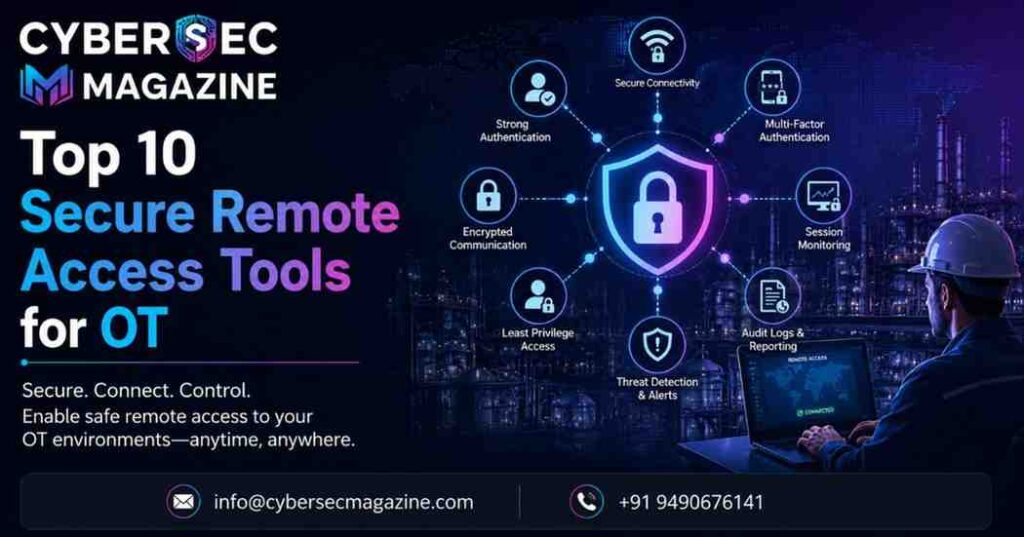
These modern tools operate on the principle of “never trust, always verify.” They connect users directly to specific applications or assets-never the underlying network. They require Just-In-Time (JIT) approvals, enforce Multi-Factor Authentication (MFA) even on legacy systems, and provide over-the-shoulder monitoring and full session recording.
If you are looking to replace your outdated VPN architecture, here are the top 10 Secure Remote Access tools purpose-built (or highly adapted) for OT environments.
Top 10 Secure Remote Access Tools for OT
1. Claroty xDome Secure Access (Formerly SecurEquipment)
Claroty is a titan in the OT cybersecurity space, and their xDome Secure Access is widely considered a gold standard for industrial SRA. Unlike IT-repurposed tools, Claroty built this solution from the ground up for the plant floor.
- Why it beats a VPN: It provides asset-level access rather than network access. It integrates deeply with Claroty’s asset discovery engine, meaning you can grant access based on the exact profile of the machinery.
- Key OT Features: It understands industrial protocols natively. Administrators can enforce granular policies, such as allowing an engineer to view an HMI but blocking their ability to push a new logic configuration to the PLC. It also features robust session recording and workflow approvals tailored for shift supervisors.
2. Cyolo PRO (Privilege Remote Operations)
Cyolo has made massive waves in the OT space by offering a true, identity-based Zero Trust solution that thrives in completely offline or hybrid environments.
- Why it beats a VPN: Cyolo does not require inbound ports to be opened on your firewall. It uses an outbound-only connection model, making your OT assets “invisible” to the public internet.
- Key OT Features: Cyolo PRO excels in environments with legacy tech. Can’t install an agent on a Windows XP machine running a critical SCADA interface? Cyolo handles it agentlessly. It also allows local plant managers to physically approve remote access requests (via a digital “four-eyes” principle) before a third party can connect.
3. Xage Security Fabric
Xage takes a fundamentally different, highly innovative approach by utilizing a decentralized, identity-based security fabric.
- Why it beats a VPN: Traditional VPNs have a single point of failure (the VPN gateway). Xage distributes access control across the environment. If one node goes down, the system remains secure and operational.
- Key OT Features: Xage is exceptionally good at “identity masking.” It authenticates the remote user using modern MFA (like Okta or Azure AD), but then interacts with the legacy OT asset using its native, often unsecure, local credentials. The user never sees the actual password for the PLC, eliminating credential theft.
4. Dispel
Dispel is heavily adopted by government agencies, utilities, and critical manufacturing. They utilize Moving Target Defense (MTD) to secure remote access.
- Why it beats a VPN: While VPN infrastructure is static and easily mapped by attackers, Dispel creates single-use, continuously changing virtual machines and encrypted pathways. Once the vendor logs off, the infrastructure used for the connection is destroyed.
- Key OT Features: Dispel provides isolated virtual desktop environments. This means the vendor’s physical laptop-which might be infected with malware-never actually touches your OT network. They simply stream the pixels of the virtual desktop, preventing any lateral movement or file-based malware transfer.
5. CyberArk Vendor Privileged Access Manager
CyberArk is the undisputed leader in IT Privileged Access Management (PAM), but their remote access capabilities have been heavily adapted to serve OT environments, specifically addressing the third-party vendor problem.
- Why it beats a VPN: It eliminates the need for VPN clients, directory agents, or complex credential management for outsiders.
- Key OT Features: It utilizes biometric authentication via a smartphone app. An external OEM engineer doesn’t need a VPN client or a company laptop; they authenticate via their phone’s biometrics, and CyberArk brokers an agentless, fully recorded web-based session into the target OT system.
6. BeyondTrust Privileged Remote Access (PRA)
BeyondTrust provides a robust SRA solution that bridges the gap between IT and OT, making it highly attractive for converged environments.
- Why it beats a VPN: It effectively extends PAM into the OT space without requiring broad network access. It centralizes the management of both IT admins and OT operators into a single pane of glass.
- Key OT Features: BeyondTrust PRA is renowned for its session management capabilities. Plant managers can join active sessions in real-time, monitor what a vendor is doing, and instantly terminate the connection if suspicious activity occurs. It works seamlessly with legacy protocols like RDP, SSH, and VNC without opening firewall ports.
7. Cisco Secure Equipment Access (SEA)
Cisco has leveraged its massive footprint in industrial networking to create SEA, embedding Zero Trust capabilities directly into the industrial edge.
- Why it beats a VPN: Instead of deploying a separate software overlay, Cisco SEA allows you to utilize existing Cisco industrial routers (like the Catalyst IE series) as your Zero Trust gateways.
- Key OT Features: It provides clientless, web-based access to specific industrial assets. Because it is hardware-backed at the edge, it is incredibly resilient. It allows operators to securely access web-based HMIs or terminal interfaces without routing traffic back through an enterprise data center.
8. OPSWAT MetaDefender Secure Access
OPSWAT approaches OT remote access with a heavy emphasis on data sanitization and threat prevention, making it ideal for environments where file transfers (like firmware updates or logic files) are common.
- Why it beats a VPN: A standard VPN encrypts the tunnel, but if a vendor sends a malicious file through that tunnel, the VPN won’t stop it. OPSWAT ensures that the device connecting is compliant and the files being transferred are safe.
- Key OT Features: OPSWAT integrates Deep Content Disarm and Reconstruction (CDR). If a remote engineer uploads a new project file to an engineering workstation, OPSWAT actively scans, disarms any hidden malware payloads, and reconstructs a safe version of the file before it crosses the IT/OT boundary.
9. Zscaler Private Access (ZPA) for OT
Zscaler, a pioneer of ZTNA, has aggressively expanded into the OT space, adapting its cloud-delivered security architecture for manufacturing and critical infrastructure.
- Why it beats a VPN: ZPA completely decouples application access from network access. It operates on an “inside-out” connection model using lightweight connectors, meaning your OT network remains completely hidden from the internet.
- Key OT Features: Zscaler provides exceptional scalability for multi-site global manufacturing. Administrators can manage access policies for thousands of remote workers and third-party vendors from a unified cloud console, routing traffic through Zscaler’s massive global security edge to ensure high performance and minimal latency.
10. Fortinet (FortiPAM & FortiSASE)
Fortinet’s approach to SRA involves integrating Privileged Access Management (FortiPAM) within its broader Security Fabric, appealing to organizations already utilizing FortiGate industrial firewalls.
- Why it beats a VPN: It natively integrates Zero Trust principles with existing network infrastructure, providing a smooth transition path away from traditional IPsec or SSL VPNs.
- Key OT Features: Fortinet provides specialized hardware appliances that are ruggedized for harsh environments (dust, temperature, vibration). When coupled with FortiPAM, it offers strict JIT access, credential vaulting, and deep integration with the Purdue Model, ensuring that remote traffic strictly adheres to zone and conduit restrictions.
Key Considerations When Choosing an OT SRA Solution
Migrating away from VPNs is a significant architectural shift. When evaluating the tools listed above, cybersecurity leaders must consider several critical factors specific to industrial environments:
- Frictionless Vendor Onboarding: The tool must make it easy to onboard and offboard third-party vendors. If the process is too complex, vendors will find workarounds, defeating the purpose of the security tool. Look for clientless/browser-based access options.
- Support for Legacy Technology: Your SRA must be able to securely interact with end-of-life operating systems (Windows XP, Windows 7) without requiring local agents to be installed on those fragile systems.
- Integration with Asset Management: The best SRA tools integrate with OT visibility platforms (like Nozomi Networks, Dragos, or Claroty’s CTD). You cannot secure access to an asset if you don’t know it exists.
- Local Survivability: If the internet connection to the cloud drops, plant floor operators must still be able to manage local machiner
- Compliance Alignment: Global regulations are tightening. Solutions must help you align with frameworks like IEC 62443, the NIS2 Directive in Europe, and TSA Security Directives in the US, all of which mandate strict access controls, MFA, and continuous monitoring.
Conclusion
The convenience of traditional IT VPNs is vastly outweighed by the existential risk they pose to critical infrastructure and industrial operations. By granting broad network access and lacking protocol-level visibility, VPNs have inadvertently become the preferred entry point for modern industrial cyberattacks.
Transitioning to a purpose-built OT Secure Remote Access solution is no longer an optional upgrade; it is a fundamental requirement for securing the modern, hyper-connected plant floor. Whether you prioritize identity masking, virtualized environments, or file sanitization, the tools listed above provide robust, Zero Trust alternatives that protect your critical assets while empowering your remote workforce.