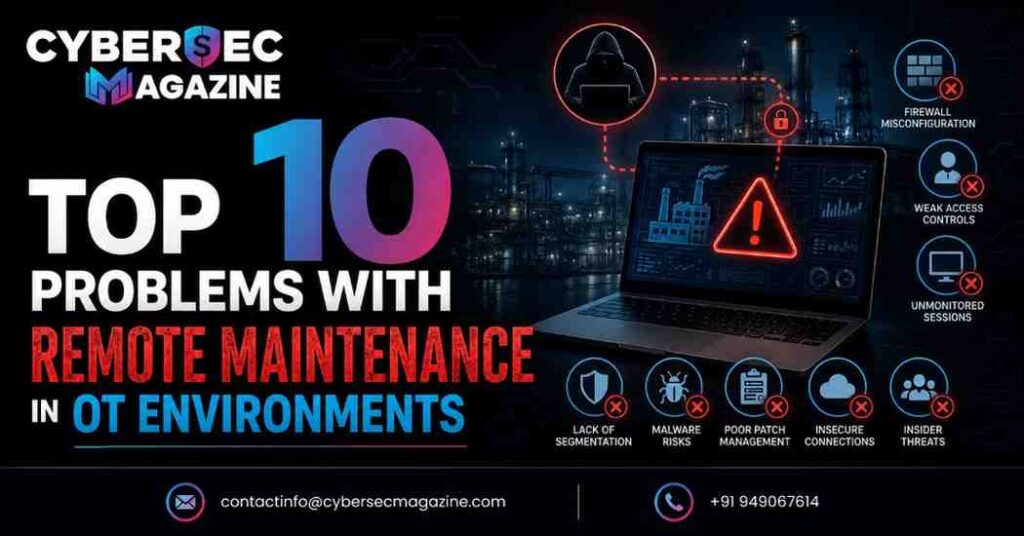
Top 10 Problems with Remote Maintenance in OT Environments
The convergence of Information Technology (IT) and Operational Technology (OT) is no longer a theoretical roadmap; it is the operational reality of the modern industrial sector. Driven by the need for efficiency, predictive maintenance, and the lingering operational shifts of the post-pandemic world, remote access to the plant floor has transitioned from an emergency workaround to a standard business requirement.
However, opening the digital gates to industrial control systems (ICS) fundamentally alters a facility’s threat landscape. For decades, OT environments relied on the “air gap”-a physical isolation from external networks-as their primary defense mechanism.
Today, Original Equipment Manufacturers (OEMs), third-party vendors, and off-site engineers require real-time access to programmable logic controllers (PLCs), human-machine interfaces (HMIs), and supervisory control and data acquisition (SCADA) systems.
While the business case for remote maintenance is undeniable, the security implications are profound. Traditional IT security tools frequently fail when applied to legacy OT systems, and the stakes in industrial cybersecurity transcend data loss; they encompass environmental disasters, catastrophic equipment failure, and risks to human safety.
For security leaders and plant managers, understanding the vulnerabilities introduced by remote access is the first step toward securing the perimeter. Below, we break down the top ten critical problems associated with remote maintenance in OT environments and the structural challenges they pose to industrial operations.
1. The Evaporation of the Purdue Model
The Purdue Enterprise Reference Architecture (PERA) has long been the gold standard for segmenting industrial networks, creating structured tiers between corporate IT networks (Levels 4 and 5) and the physical plant floor (Levels 0 through 3).
The Problem: Unregulated remote maintenance frequently bypasses this segmented architecture. When an engineer or vendor sets up a direct VPN connection from the internet directly to a Level 1 PLC or Level 2 HMI for emergency troubleshooting, they effectively collapse the Purdue Model. This creates a “flat network” scenario where a compromised remote endpoint provides a threat actor with a direct, unobstructed highway to critical control infrastructure, bypassing firewalls and demilitarized zones (DMZs).
2. Blind Spots in OT Asset Discovery
You cannot secure what you cannot see. Unlike IT environments with standardized operating systems and automated inventory tools, OT environments are notoriously opaque.
The Problem: Remote maintenance often targets specific devices, but without a robust, continuous OT asset discovery mechanism, security teams lack context about what exactly is sitting on the other end of that remote connection. When undocumented legacy devices, unauthorized modems, or “shadow OT” assets are connected remotely, defenders are blind to the communication flows. This lack of visibility means anomalous behavior generated by a compromised remote session can easily blend in with normal industrial traffic.
3. Exploitation of Insecure-by-Design ICS Protocols
Industrial protocols such as Modbus/TCP, DNP3, and EtherNet/IP were engineered decades ago for reliability and speed, not security. They lack basic encryption and authentication mechanisms, operating implicitly on trust.
The Problem: Exposing these protocols over a remote connection-even a theoretically secure one-amplifies their inherent vulnerabilities. If an attacker manages to piggyback on a legitimate remote maintenance session, they can directly inject malicious commands into the ICS protocols. Because the protocols themselves cannot distinguish between a legitimate vendor command and a malicious payload, the equipment will dutifully execute actions that could halt production or damage physical assets.
4. The Third-Party Vendor Supply Chain Threat
Modern industrial facilities rely on a complex ecosystem of OEMs and systems integrators to maintain specialized equipment.
The Problem: Granting remote access to third-party vendors introduces severe supply chain risks. Plant operators rarely have visibility into the cybersecurity posture of their vendors’ networks. If a vendor’s corporate network is compromised by ransomware or a sophisticated Advanced Persistent Threat (APT) group, the attacker can use the vendor’s legitimate remote access credentials as a Trojan horse to infiltrate the target OT environment. The remote maintenance link becomes a sanctioned backdoor.
5. Lack of Granular, Zero-Trust Access Control
In IT, the principle of least privilege ensures that a user only has access to the specific files and systems required for their job. In OT, this granularity is often missing.
The Problem: When an engineer logs in remotely for maintenance, they are frequently granted broad, network-wide access rather than being restricted to a specific asset. This “all-or-nothing” access model violates the core tenets of Zero Trust architecture. If that remote session is hijacked, the threat actor is not contained to a single robotic arm or turbine; they have the keys to the entire plant floor, allowing for rapid lateral movement across the ICS network.
6. Critical Gaps in Vulnerability Management
Vulnerability management in OT is a delicate balancing act. Unlike IT systems that can be patched over the weekend, taking an OT system offline for a software update requires scheduled downtime, intense testing, and meticulous coordination to avoid disrupting 24/7 production cycles.
The Problem: Because patching is delayed-often for months or years-OT environments are rife with known CVEs (Common Vulnerabilities and Exposures). Remote maintenance connections act as a conduit to these highly vulnerable systems. An exposed, unpatched remote desktop protocol (RDP) or VPN gateway provides attackers with a direct exploitation vector into a network that is structurally unprepared to defend against modern malware.
7. Inadequate Authentication Mechanisms and Shared Credentials
Identity and Access Management (IAM) is notoriously difficult to implement in legacy industrial environments. Many HMIs and engineering workstations were designed for shared operator access, not individualized digital identities.
The Problem: Remote maintenance sessions are often secured using shared, static passwords that are passed around among shift workers and vendors. Furthermore, implementing Multi-Factor Authentication (MFA) on older OT systems can break applications or cause unacceptable latency. The reliance on weak, shared credentials without MFA makes remote access points highly susceptible to brute-force attacks and credential stuffing.
8. Absence of Session Logging and Forensics
When a failure occurs on the plant floor, root cause analysis is critical. Was it a mechanical failure, an operator error, or a cyberattack?
The Problem: Traditional remote access tools used in OT (like standard VPNs or TeamViewer) do not offer the granular session logging required for industrial forensics. They may log when a connection occurred, but they do not record exactly what commands were executed during the session. Without keystroke logging, protocol-level visibility, or session recording, security teams cannot audit vendor activity or definitively trace the origin of a malicious industrial command.
9. IT/OT Cultural and Operational Clashes
The responsibility for securing remote access often falls to corporate IT teams, who may lack a deep understanding of OT engineering requirements.
The Problem: Applying IT-centric remote access tools to the plant floor often leads to operational disruption. An IT team might deploy an automated active scanning tool across a remote connection, inadvertently crashing a fragile legacy PLC. Alternatively, stringent session-timeout policies designed for corporate laptops can sever a critical remote connection during a delicate industrial recalibration process. This clash creates friction, leading engineers to deploy unsanctioned, “shadow” remote access tools (like hidden cellular modems) to bypass IT security controls entirely.
10. Regulatory and Compliance Nightmares
Governments and regulatory bodies worldwide are tightening the screws on industrial critical infrastructure. Frameworks like the NIS2 Directive in Europe, TSA security directives in the US, and the global IEC 62443 standard demand strict accountability.
The Problem: Undocumented, poorly secured remote maintenance connections are a direct violation of modern compliance frameworks. Failing to monitor and control third-party access, lacking an accurate asset inventory, and exposing critical systems to the internet without proper segmentation can result in severe financial penalties, legal liabilities, and the loss of operating licenses.
Conclusion: Rethinking Remote Operations
The era of trusting the “air gap” is over, but blindly adopting IT remote access solutions for the plant floor is a recipe for disaster. As industrial facilities continue to modernize, the focus must shift from merely enabling remote maintenance to securing it through an OT-specific lens.
Securing remote access requires a fundamental shift in strategy: moving toward Zero Trust Network Access (ZTNA) designed specifically for ICS environments, prioritizing deep asset discovery to illuminate blind spots, and implementing secure, ephemeral access that grants vendors exactly the privileges they need, only for the time they need them. By acknowledging and addressing these top 10 problems, industrial leaders can reap the operational benefits of connectivity without sacrificing the safety, reliability, and security of their most critical assets.