
Top 10 OT Security Priorities for Airports (Baggage & APM systems)
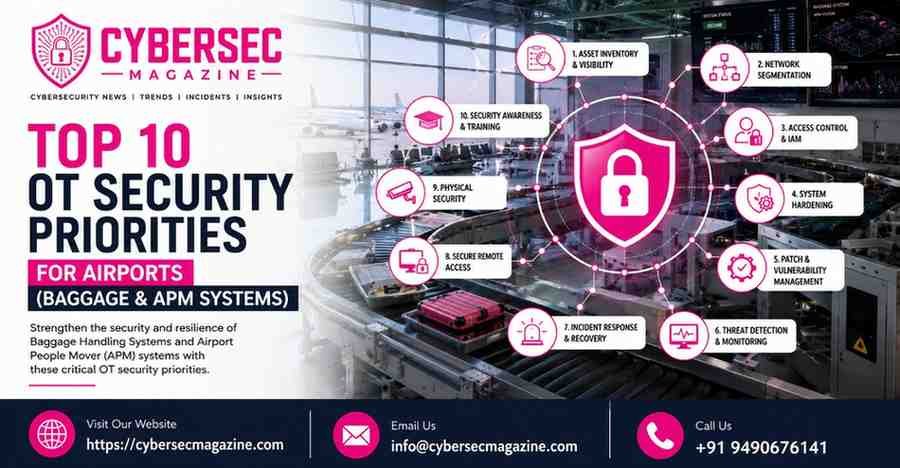
Explore top 10 OT security priorities for airports. Secure baggage handling systems (BHS) and automated people movers (APMs) against cyber threats.
The Evolution and Convergence of Airport Operational Technology
Modern airports function as hyper-connected smart cities, moving millions of passengers and baggage units daily through a dense web of automation, IoT devices, and cyber-physical systems. Critical internal functions-ranging from complex Baggage Handling Systems (BHS) and Automated People Mover (APM) transit networks to building management systems, fueling arrays, and runway lighting-rely heavily on integrated Operational Technology (OT) and Industrial Control Systems (ICS). Historically, these industrial environments operated in functional isolation, utilizing proprietary communication protocols and closed-loop networks that were physically separated from corporate enterprise IT infrastructure. However, the commercial push toward passenger self-service, real-time data exchange, predictive maintenance, and seamless multi-modal logistics has entirely dissolved the traditional air gap, creating expansive convergence points between airport business systems and operational infrastructure.
Top 10 OT Security Priorities for Airports
1. Comprehensive Passive Asset Discovery for Baggage and Transit Networks
Achieving complete and accurate visibility into every connected device across airport baggage handling systems and automated people mover networks is the foundational baseline of any effective aviation cybersecurity program. Unlike standard corporate environments where active network scanning is standard practice, probing industrial airport networks with active queries can overload delicate baggage diverters and disrupt critical transit communications. Airport security teams must deploy passive network monitoring tools and deep packet inspection modules that quietly map out PLCs, SCADA servers, and human-machine interfaces without impacting live operations. Maintaining an exact, real-time inventory of all hardware models, firmware versions, and communication links ensures that security analysts can instantly detect unauthorized devices or rogue diagnostic laptops plugged into critical operational lines.
2. Enforcing Strict ISA/IEC 62443 Network Segmentation Between IT and OT
The convergence of corporate enterprise IT networks with physical terminal automation has created dangerous pathways for attackers to pivot from administrative email gateways directly into baggage control rooms. To prevent lateral movement, airports must implement rigid network segmentation based on the ISA/IEC 62443 zone and conduit model, ensuring physical separation between business functions and operational environments. By deploying industrial-grade firewalls, virtual local area networks, and unidirectional security gateways, operators can isolate individual baggage sortation lines and APM signaling loops from general corporate traffic. Well-defined conduits regulate all authorized communication streams, ensuring that data flows strictly according to operational necessity while blocking unauthorized external access completely.
3. Protecting Legacy Baggage Control Workstations via Virtual Patching
Baggage handling systems frequently rely on legacy engineering workstations and control computers running older operating systems that cannot be updated or patched without voiding vendor support agreements or breaking proprietary software packages. Leaving these unpatched systems exposed creates permanent vulnerabilities that can be easily exploited by modern ransomware strains targeting industrial infrastructure. To neutralize this risk without risking system reboots or downtime, airports must deploy inline network security appliances that provide virtual patching. These devices inspect industrial protocols at wire speed, identifying and blocking known exploit attempts before malicious packets ever reach the vulnerable endpoint operating system.
4. Securing Automated People Mover (APM) Signaling and Telemetry Links
Automated People Mover systems transport passengers between terminals and remote parking structures at high speeds, relying on continuous, highly precise wireless telemetry and wayside signaling controllers. Because these transit networks often utilize wireless communication channels and exposed outdoor access points, they are vulnerable to radio-frequency interference, unauthorized device association, and packet injection attacks. Securing APM infrastructure requires implementing robust cryptographic authentication for all command-and-control messages, continuous wireless intrusion detection, and isolated communication channels. Protecting these transit control loops prevents malicious actors from manipulating train routing, door operations, or speed thresholds.
5. Managing Secure Remote Vendor Access for Maintenance Contractors
Airport baggage systems and transit networks are heavily dependent on specialized third-party equipment vendors who require remote access for routine calibration, software updates, and diagnostic troubleshooting. Allowing external contractors direct, unmonitored VPN access into the core operational network introduces massive security exposure and creates untracked entry points for malicious actors. Airports must replace legacy remote access methods with zero-trust network access frameworks, enforcing multi-factor authentication, session-based time limits, and encrypted jump hosts. Every third-party remote session must be fully recorded, logged, and subjected to real-time behavioral monitoring to guarantee complete operational accountability.
6. Hardening Cleanroom and Terminal Maintenance USB Media Entry Points
Despite strong perimeter firewalls, airport maintenance personnel frequently need to transfer firmware updates, diagnostic logs, and configuration files to isolated baggage PLCs using removable USB storage media. Unsanitized flash drives brought onto the airfield or baggage basement from external environments represent a primary vector for introducing malware and zero-day exploits into air-gapped systems. Airports must deploy centralized kiosk inspection stations at critical maintenance control points to automatically scan, sanitize, and verify every removable device before it interacts with operational hardware. Enforcing strict chain-of-custody logging ensures complete traceability over all physical media utilized across the facility.
7. Implementing Real-Time Behavioral Anomaly Detection for BHS Logic
Static perimeter defenses and periodic compliance checks are entirely insufficient for identifying sophisticated, persistent cyber threats attempting to manipulate high-throughput baggage sorting lines. Airport security operations centers must deploy advanced industrial threat detection platforms that utilize machine learning to establish behavioral baselines for normal conveyor movement and sortation timing. These systems continuously analyze industrial network traffic to flag anomalous deviations-such as unexpected script executions on a baggage sorting controller or unauthorized parameter changes-empowering security teams to intercept disruptions before passenger luggage routing fails.
8. Establishing Immutable Backup and Rapid Disaster Recovery Protocols
Even with comprehensive preventive security measures in place, airports must maintain robust, tested disaster recovery plans to recover swiftly from severe ransomware infections, hardware failures, or catastrophic data corruption. A resilient security strategy requires maintaining secure, immutable, and offline backups of all critical BHS PLC logic, SCADA configurations, and APM routing databases. Backup integrity must be regularly verified through controlled restoration drills to ensure that systems can be brought back online without data loss. Furthermore, operations teams must maintain clear, documented manual fallback procedures to keep passenger bags moving if core automation networks are temporarily severed.
9. Enforcing Granular Role-Based Access Control and Least Privilege
Identity and access management across airport terminal automation must move far beyond shared administrative passwords and unmonitored local user accounts on engineering terminals. Implementing strict role-based access control ensures that baggage handlers, maintenance technicians, and system engineers possess only the absolute minimum permissions required to perform their specific duties. Centralized identity providers should manage all authentication requests across operational workstations, enforcing multi-factor authentication and maintaining immutable audit trails for every user session. Restricting administrative privileges prevents internal credential misuse and limits the potential blast radius of a compromised user account.
10. Aligning Aviation OT Security with Regulatory Directives and Governance
Cybersecurity resilience across airport baggage and transit systems cannot be treated as an isolated IT project; it must be governed as an integrated, continuously evolving enterprise risk program. Airport authorities must align their operational security frameworks with mandatory aviation directives issued by government security agencies and international transport bodies. Leadership teams must integrate rigorous cybersecurity requirements directly into procurement contracts with equipment manufacturers, mandating secure-by-design principles for all future terminal expansions. Regular cross-functional tabletop exercises involving IT security personnel, OT engineers, and terminal operators ensure that incident response procedures remain synchronized and fully optimized to protect critical transport infrastructure.
Conclusion
Securing the complex operational technology that powers airport baggage handling and automated transit systems is vital to maintaining global supply chain integrity and passenger trust. As airports rapidly modernize to accommodate surging travel volumes, expanding the digital attack surface without adequate industrial cybersecurity leaves critical infrastructure exposed to devastating disruptions. By implementing these ten essential OT security priorities-ranging from passive asset discovery and virtual patching to strict network segmentation and behavioral monitoring-aviation operators can effectively neutralize modern threats. Investing in proactive, resilient OT defense ensures that airports protect their vital physical assets, maintain strict regulatory compliance, and guarantee safe, uninterrupted journeys for millions of travelers worldwide.