Fortifying the Future: Top 12 OT Risk Reduction Steps for Pharmaceutical Manufacturing
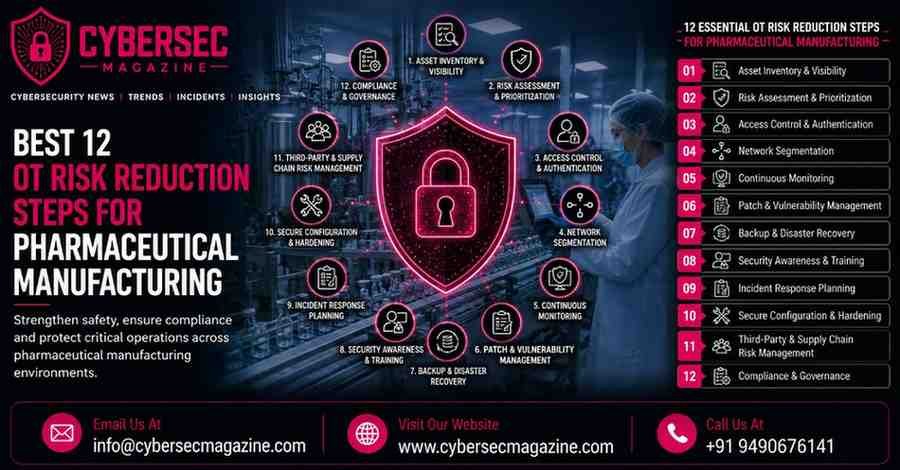
Secure your pharma production with these 12 expert OT risk reduction strategies. Enhance resilience, ensure data integrity, and meet 2026 compliance standards.
The New Frontier: Why Pharma OT Security is Critical in 2026
In the rapidly evolving pharmaceutical landscape of 2026, the convergence of IT and Operational Technology (OT) has become a double-edged sword. While interconnected systems facilitate real-time supply chain visibility and AI-driven predictive maintenance, they have also transformed pharmaceutical plants into high-value targets for cybercriminals. Unlike standard IT environments where data confidentiality is paramount, pharmaceutical OT-encompassing SCADA systems, programmable logic controllers (PLCs), and laboratory automation-prioritizes process availability, safety, and, crucially, data integrity under strict regulatory frameworks like 21 CFR Part 11. As ransomware groups increasingly target manufacturing for maximum operational disruption, pharmaceutical leaders must treat OT security not merely as an IT task, but as an essential component of quality assurance and patient safety.
1. Comprehensive Asset Discovery and Inventory
You cannot protect what you cannot see. In a complex pharma facility, OT environments are often riddled with “ghost” devices, legacy PLCs, and unmanaged IoT sensors that exist outside traditional IT oversight. Maintaining a dynamic, real-time inventory of all connected industrial assets is the foundational step in identifying vulnerable hardware and software versions. By utilizing passive monitoring tools, organizations can gain deep visibility into the communication flows between devices without risking performance degradation on sensitive production lines. This granular asset map serves as the single source of truth for both security teams and maintenance engineers, ensuring that every connected node is accounted for and risk-profiled.
2. Implement ISA/IEC 62443 Zone and Conduit Architecture
Moving away from flat, “air-gapped” networks-which are often a myth in modern digital plants-is non-negotiable. Applying the ISA/IEC 62443 standard, specifically the “zones and conduits” model, allows you to segment your production environment into logical, secure enclaves. By isolating critical laboratory equipment, filling lines, and sterilization units into distinct security zones, you limit the lateral movement of potential threats. Communication between these zones must be strictly controlled through hardened “conduits” (typically industrial firewalls or data diodes), ensuring that a compromise in the corporate office or a vendor workstation does not automatically cascade into the core manufacturing floor.
3. Deploy OT-Specific Anomaly Detection
Traditional IT security solutions like signature-based antivirus are largely ineffective in an OT environment, where they can interfere with proprietary industrial protocols and crash sensitive controllers. Instead, modern pharmaceutical facilities must deploy OT-aware monitoring systems that understand the specific language of industrial controllers, such as Modbus, CIP, or PROFINET. These systems establish a “baseline” of normal operational behavior and alert security teams to subtle, malicious changes-such as unauthorized PLC logic uploads or unusual communication patterns-that signal an impending attack. Early detection of these anomalies is the difference between a minor diagnostic investigation and a facility-wide production shutdown.
4. Enforce Zero-Trust Remote Access
The reliance on third-party vendors for specialized equipment maintenance is a major security loophole. Direct VPN access to the plant floor for contractors should be strictly prohibited in favor of zero-trust, identity-based remote access solutions. Every remote session must be authenticated with Multi-Factor Authentication (MFA), limited to the specific system being serviced, and strictly time-bound. By recording all privileged sessions and enforcing least-privilege access, pharma companies can ensure that maintenance tasks are performed safely without creating a permanent, exploitable backchannel into the heart of their production environment.
5. Harden Legacy Systems Through Compensating Controls
Many pharmaceutical facilities operate critical machinery that is decades old and cannot be patched or upgraded due to rigid regulatory validation protocols. When you cannot patch a legacy system, you must surround it with compensating security controls that mitigate the vulnerability. This might include wrapping the legacy device in an industrial firewall, disabling unused ports and services, or isolating the asset within a heavily restricted micro-segment of the network. By shifting the focus from “patching the endpoint” to “securing the network path,” organizations can keep legacy equipment running safely until it can be retired and replaced during major maintenance cycles.
6. Establish a Unified Incident Response Plan
In the event of a breach, the disconnect between IT and OT teams can lead to catastrophic delays. Pharmaceutical manufacturers must develop a unified, cross-functional incident response plan that specifically accounts for the unique requirements of production lines, such as temperature-controlled storage and batch integrity. This plan must define clear roles for OT engineers, quality assurance managers, and IT security personnel, ensuring that response actions-like network isolation or emergency shutdowns-do not inadvertently compromise product quality or patient safety. Regular, high-fidelity drills that simulate OT-specific scenarios are essential for building the muscle memory required to respond under pressure.
7. Prioritize Data Integrity and ALCOA+ Alignment
In pharma, the integrity of the batch record is as important as the security of the hardware. Cybersecurity controls must be mapped directly to ALCOA+ data integrity principles, ensuring that data generated by OT systems is Attributable, Legible, Contemporaneous, Original, and Accurate. Security measures should include robust, immutable audit trails for every configuration change made to an automation controller. By ensuring that security logs are treated as part of the formal quality system, manufacturers can demonstrate to regulators that their systems are not only secure from cyber threats but also compliant with the stringent requirements of drug manufacturing.
8. Secure the Supply Chain and Third-Party Dependencies
Pharmaceutical manufacturing is highly dependent on a web of upstream material suppliers and service contractors. Attacks targeting the software and firmware supply chains of these partners can easily propagate into your facility. Manufacturers should mandate security requirements in all service-level agreements (SLAs) and perform rigorous security assessments of critical vendors. This includes demanding transparency into the vendor’s own patch management practices and ensuring that any software or updates delivered by them are verified, tested in a sandbox, and signed before being introduced into the live production environment.
9. Foster Cross-Functional Security Culture
OT security is often siloed within the IT department, yet the plant floor operators are the ones on the front lines. A successful security program requires an enterprise-wide culture where production staff and maintenance engineers are trained to identify and report suspicious activities, such as an unfamiliar USB drive or an unusual error message on an HMI. By providing role-based training that translates abstract cyber threats into tangible operational impacts, organizations can transform their workforce into a powerful, human-centric sensor network capable of catching risks before they escalate into full-blown incidents.
10. Implement Robust Backup and Recovery Strategies
When ransomware strikes, the ability to restore operations without paying a ransom is your ultimate insurance policy. Given the complexity of OT systems, traditional IT backups are insufficient; you must have verified, offline, and immutable backups of PLC logic, HMI configurations, and critical process parameters. These backups must be regularly tested to ensure that the restoration process actually works and can be executed within the tight recovery time objectives (RTOs) required to keep a pharma plant viable. If a system is compromised, having a clean, validated baseline ready to load ensures that you can return to production without re-validating the entire process from scratch.
11. Minimize Internet Exposure
The convenience of “always-on” remote monitoring should never outweigh the security risks of exposing sensitive control systems to the public internet. Organizations should aggressively identify and remove any OT-related interfaces, web portals, or management consoles that are accessible from the open web. If remote visibility is required, it should be mediated through secure gateways that hide the underlying infrastructure and require advanced authentication. By shrinking your internet-facing footprint, you drastically reduce the number of paths that an adversary can use to scan for, identify, and exploit your industrial infrastructure.
12. Align Security Investments with Risk-Based Assessment
Not all production lines carry the same risk profile. A manufacturer should conduct a regular, risk-based assessment that prioritizes security spending on the assets that are most critical to patient health and regulatory compliance. By focusing resources on “crown jewel” systems-such as those involved in life-saving biologics or high-volume vaccine production-companies can maximize their security return on investment. This approach ensures that you are not chasing every theoretical vulnerability but are instead building a robust, layered defense that protects the processes most vital to your business and your patients.
Conclusion: A Resilient Path Forward
The journey toward a secure pharmaceutical manufacturing environment is an ongoing commitment to vigilance, process integrity, and operational resilience. By integrating cybersecurity into the fabric of your quality management systems and adopting a proactive, standard-aligned architecture like IEC 62443, your organization can effectively mitigate the risks of 2026 and beyond. Remember that in the pharmaceutical industry, security is synonymous with the safety and trust you deliver to patients worldwide. Start by assessing your current posture, addressing the most critical vulnerabilities, and fostering a culture of collaboration across IT, OT, and quality teams to ensure your production lines remain both efficient and ironclad.