Best 15 OT Security Use Cases for Chemical Plants
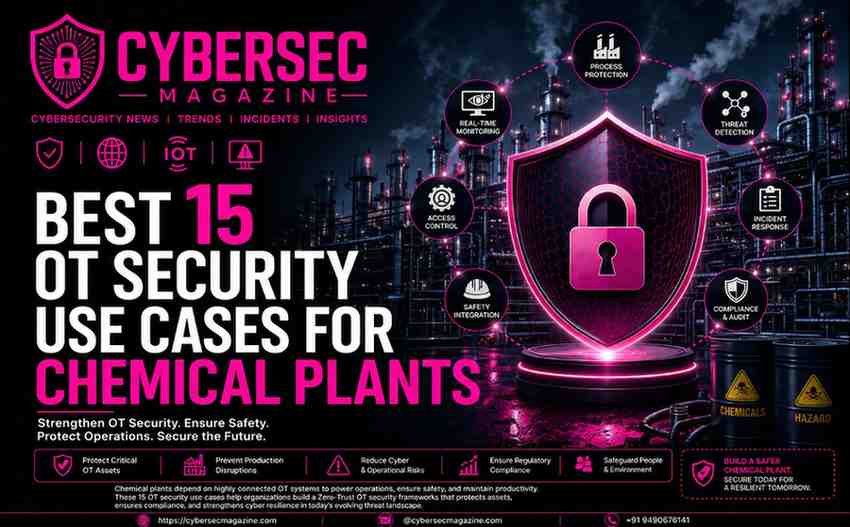
Explore 15 critical OT security use cases for chemical plants in 2026. Learn how to protect hazardous processes, ensure safety, and maintain uptime.
The Evolution of Industrial Cybersecurity in Chemical Manufacturing
In 2026, the chemical manufacturing industry stands at a high-stakes crossroads. As facilities move away from air-gapped legacy systems toward hyper-connected environments-integrating IIoT sensors, cloud-based analytics, and remote maintenance-the attack surface has expanded exponentially. Unlike standard IT environments, a breach in a chemical plant doesn’t just threaten data privacy; it jeopardizes physical safety, environmental integrity, and operational continuity. Threat actors, increasingly utilizing agentic AI and automated probing, now target the “uptime” of production lines, understanding that even a brief outage grants them significant bargaining power. For the modern chemical enterprise, cybersecurity is no longer an auxiliary IT task; it is a fundamental pillar of process safety and operational resilience.
Top 15 OT Security Use Cases
1. Real-Time Asset Discovery and Inventory
Chemical plants often rely on legacy controllers and proprietary devices that have been in operation for decades. Maintaining a live, automated inventory of all OT, IoT, and IIoT assets-including firmware versions and network connections-is the foundational use case for any security program. Without knowing what is on your network, you cannot protect it, especially when hidden or “dark” assets are frequently targeted by adversaries looking for unpatched entry points.
2. Network Micro-segmentation
By dividing the flat, legacy networks common in chemical manufacturing into smaller, isolated zones, operators can prevent the lateral movement of threats. Micro-segmentation ensures that if a workstation or a compromised IIoT sensor is breached, the attacker cannot pivot to the HMI or the PLC controlling the chemical mixing process. This “moat-and-castle” approach is vital for containing damage and protecting safety-critical systems.
3. Secure Remote Access Management
Maintenance and vendor support often require remote access to sensitive control systems. Implementing a “just-in-time” access model with multi-factor authentication (MFA) and session recording ensures that third-party contractors can only access specific assets when necessary. This eliminates the risk of permanent, unmonitored VPN tunnels that often serve as high-value targets for attackers seeking to manipulate process parameters.
4. Continuous Threat Monitoring for OT Protocols
Chemical environments use specialized industrial protocols like Modbus, DNP3, and PROFINET that standard IT firewalls cannot inspect. Deep Packet Inspection (DPI) allows security platforms to analyze these industrial communications for anomalies, such as an unauthorized “stop” command or a sudden change in temperature setpoints. This visibility is essential for detecting malicious intent disguised as legitimate operational traffic.
5. Vulnerability and Exposure Management
Chemical plants frequently run systems that cannot be easily patched due to stability risks. Exposure management involves identifying these vulnerabilities and applying “compensating controls”-such as virtual patching or enhanced monitoring-to mitigate risk without forcing an unplanned production shutdown. This allows plants to maintain security compliance while prioritizing remediation based on actual process impact.
6. Incident Response and Automated Containment
In the event of a breach, seconds matter. Automating the isolation of a compromised segment or a rogue device can prevent a cyberattack from escalating into a physical safety incident. By integrating incident response playbooks with your network security infrastructure, you can ensure that the plant automatically enters a “safe state,” protecting both the workforce and the environment from hazardous releases.
7. Safety Instrumented System (SIS) Protection
The SIS is the last line of defense in a chemical plant, designed to trigger emergency shutdowns in hazardous conditions. Protecting these systems is a specialized use case that requires total isolation from the broader network. Monitoring the integrity of SIS communications ensures that an attacker cannot disable alarms or override emergency protocols, which is a common tactic in high-impact cyber-physical attacks.
8. Behavioral Baselining and Anomaly Detection
Every chemical process has a “normal” operational rhythm. By baselining the typical traffic patterns and command sequences, security systems can alert operators to subtle deviations, such as an HMI communicating with an unauthorized external IP or an unusual spike in data transmission. These alerts often reveal insider threats or long-term persistent attackers long before a full-scale disruption occurs.
9. Supply Chain and Third-Party Integrity
Chemical manufacturers rely on a complex ecosystem of suppliers and service providers. A security use case focused on supply chain integrity involves vetting the cybersecurity posture of all vendors who interact with your OT systems. By mandating security requirements in service agreements and monitoring third-party connections, you close the gap where a breach in a partner’s network could propagate into your own facility.
10. Regulatory Compliance and Audit Readiness
With executive liability increasing in 2026, plants must demonstrate adherence to standards like IEC 62443 or NIS2. Continuous monitoring provides the documentation required for compliance audits, turning a manual, periodic chore into an automated, ongoing process. This ensures that the plant is always audit-ready, reducing the burden on engineering teams and minimizing the risk of regulatory fines.
11. Endpoint Hardening for HMIs and Workstations
Human-Machine Interfaces (HMIs) and engineering workstations are common targets for ransomware. Using application whitelisting and disabling unnecessary services (like Telnet or FTP) on these endpoints reduces the available attack surface. Ensuring that only authorized software runs on these critical interfaces prevents the unauthorized execution of code that could compromise process control.
12. Insider Threat Detection
Not all threats come from outside the perimeter; malicious or negligent insiders can cause significant damage. Monitoring user behavior-such as attempts to access unauthorized controllers or unusual changes to logic files-helps identify insider activity. By mapping user roles to specific access rights, you can detect when an internal user is operating outside of their standard operational scope.
13. Data Diodes for Sensitive Monitoring
For the most critical processes, unidirectional gateways (data diodes) provide a hardware-enforced barrier. They allow operational data to flow out to a centralized monitoring or analytics platform without providing a return path for external traffic. This ensures that the control network remains physically incapable of receiving external commands, providing the ultimate defense for highly sensitive chemical processes.
14. OT-Specific SIEM Integration
Integrating OT alerts into a centralized Security Information and Event Management (SIEM) system allows for a unified view of the entire enterprise. When security teams can correlate an alert from the IT network with a suspicious command on the plant floor, they can identify complex, multi-stage attacks. This convergence of data enables a faster, more coordinated response to threats.
15. Employee Cybersecurity Awareness
The final pillar of security is the human element. Tailored training programs that teach operators, engineers, and plant managers how to recognize social engineering, phishing, and the dangers of “shadow IT” are crucial. When the entire workforce understands the physical implications of a cyber breach, they become an active, vigilant part of the plant’s overall defense strategy.