Best 12 Ways to Negotiate OT Vendor Contracts for Security Guarantees
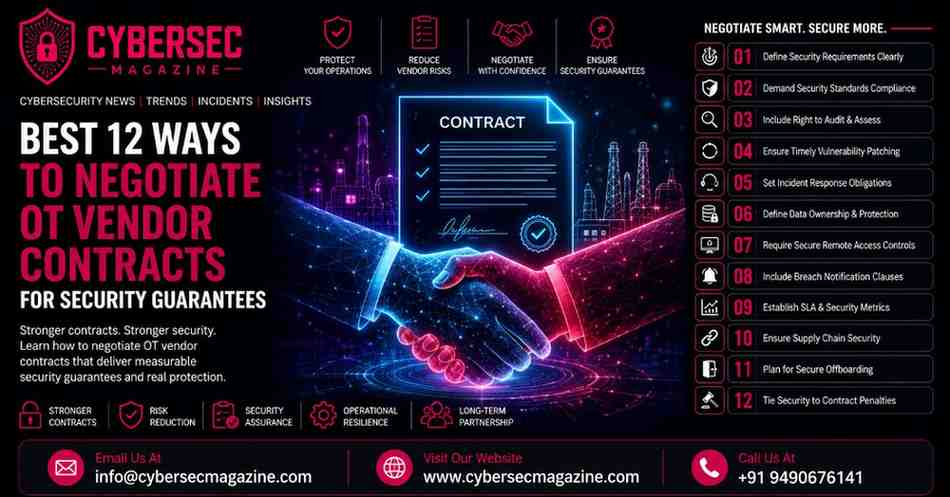
Protect your critical infrastructure. Discover the best 12 ways to negotiate OT vendor contracts for robust, legally enforceable cybersecurity guarantees.
The Evolving Landscape of Industrial Supply Chain Risk
For decades, Operational Technology (OT) and Industrial Control Systems (ICS) operated under the comforting-yet fundamentally flawed-premise of the “air gap.” Physical isolation was the primary defense mechanism protecting programmable logic controllers (PLCs), human-machine interfaces (HMIs), and supervisory control and data acquisition (SCADA) systems from external cyber threats.
However, the rapid convergence of IT and OT networks, driven by the demands of Industry 4.0, predictive maintenance, and enterprise resource planning, has permanently dissolved that boundary. Today, industrial environments are highly interconnected, rendering legacy assets incredibly vulnerable to cyberattacks that often originate in enterprise IT networks and move laterally into sensitive control layers.
Compounding this risk is the modern industrial ecosystem’s heavy reliance on third-party vendors, original equipment manufacturers (OEMs), and integrators who require persistent remote access to monitor and maintain plant infrastructure. Threat actors frequently exploit these trusted third-party conduits to bypass perimeter defenses, turning a vendor’s compromised support portal into a direct gateway to a factory floor or power grid.
Furthermore, shifting international regulatory frameworks-such as Europe’s NIS2 Directive, NERC CIP mandates in North America, and CISA’s “Secure by Demand” initiatives-are transferring unprecedented liability onto asset owners and operators. In this hyper-connected, highly regulated landscape, standard IT boilerplate contracts are completely inadequate. Securing critical infrastructure now requires organizations to aggressively negotiate OT-specific cybersecurity guarantees directly into their procurement agreements and Master Service Agreements (MSAs).
Top 12 Strategies for Negotiating Security Guarantees in OT Contracts
1. Mandate Comprehensive Software Bill of Materials (SBOM) Delivery
Negotiators must require vendors to provide a granular, machine-readable Software Bill of Materials (SBOM) for all software, firmware, and embedded components using standards like CycloneDX or SPDX. This clause must dictate that the SBOM be updated with every major and minor release, patch, or hotfix to maintain a reliable, continuous view of third-party or open-source dependencies. By embedding this requirement into the contract, asset owners can proactively scan for newly discovered vulnerabilities (such as Log4j-style flaws) within proprietary vendor code without waiting for the OEM’s slow internal assessment. Furthermore, the contract should penalize non-compliance or failure to disclose nested third-party vulnerabilities within a specified window, giving your security operations center (SOC) the visibility required to apply proper compensating controls.
2. Establish Granular Remote Access Governance and Multi-Factor Authentication
Boilerplate vendor contracts frequently demand unrestricted, persistent Virtual Private Network (VPN) or Remote Desktop Protocol (RDP) access to simplify their maintenance routines, which creates a massive backdoor into your control network. Contracts must explicitly reject blanket access, instead mandating compliance with a “least-privilege, zero-trust” remote access architecture that interfaces seamlessly with your corporate Multi-Factor Authentication (MFA). The agreement should dictate that all vendor sessions be time-limited, explicitly approved by a designated internal plant operator, and restricted solely to the specific assets requiring service. Additionally, stipulate that all remote actions must be cryptographically logged, recorded, and subject to immediate termination by the asset owner if anomalous behavioral patterns or unauthorized configuration changes are detected.
3. Define Dedicated OT Patching SLA Cascades and Regression Indemnification
Unlike traditional IT environments where security patches are pushed rapidly, patching a PLC or an engineering workstation requires rigorous physical safety testing and scheduled production shutdowns to prevent catastrophic downtime. Contracts must contain strict Service Level Agreements (SLAs) forcing vendors to test, validate, and release critical security patches within a designated time frame (e.g., 72 hours for critical exploits) specifically for your system configuration. Crucially, negotiate a regression indemnification clause stating that if a vendor-supplied patch or update breaks a physical industrial process, causes operational downtime, or compromises a Safety Instrumented System (SIS), the vendor absorbs the financial liability. If a patch cannot be safely deployed due to legacy system limitations, the vendor must be legally obligated to provide documented, validated compensating architectural controls.
4. Enforce “Secure-by-Design” and “Secure-by-Default” Protocols
Asset owners should integrate CISA’s Secure-by-Design principles directly into their procurement language, forcing the vendor to legally attest that cybersecurity was a core consideration throughout the product lifecycle. The contract must stipulate that the delivered hardware and software ship in a “secure-by-default” configuration, meaning all unnecessary logical ports are disabled, unused protocols are deactivated, and legacy default passwords are completely eliminated. It should be explicitly written that any commissioning or calibration software provided by the vendor does not rely on outdated, insecure protocols like clear-text HTTP or unauthenticated Telnet. Forcing the vendor to sign off on these engineering baselines shifts the financial burden of hardening the newly integrated assets from your internal security engineering team back to the OEM.
5. Require Enforceable Incident Notification Windows and Joint Playbooks
When an industrial vendor suffers a breach within their corporate network or supply chain, their delayed disclosure can directly endanger your downstream operational environments. Contract negotiations must establish an aggressive, legally binding incident notification window-ideally requiring the vendor to notify your Chief Information Security Officer (CISO) within 12 to 24 hours of detecting a suspected or confirmed breach. The clause should clarify that this notification mandate applies if the breach impacts the vendor’s corporate network, their code repositories, or any remote tools utilized to connect to your facility. Beyond mere notification, the contract should compel the vendor to participate in annual joint incident response tabletop exercises, ensuring that both parties know exactly how to isolate connections if a ransomware event strikes.
6. Solidify the Right to Audit, Asset Discovery, and Independent Pentesting
Vendors often push back against external scrutiny of their proprietary intellectual property, but asset owners must fiercely defend their contractual “Right to Audit” the vendor’s developmental and operational environments. The contract should guarantee your organization-or a certified third-party auditor-the right to conduct annual security assessments of the vendor’s manufacturing facilities, secure coding practices, and cloud-hosted support infrastructure. Furthermore, explicitly state that your internal cybersecurity team has the right to run passive asset discovery tools and non-disruptive vulnerability scanners across the vendor’s deployed equipment without voiding active warranties. It is also wise to require the vendor to provide executive summaries of their own annual, independent network and application penetration tests, alongside certified proof of remediation for high-severity findings.
7. Secure Asset Lifecycle Longevity and Legacy Support Guarantees
Industrial assets routinely remain operational on a plant floor for 15 to 30 years, outliving traditional IT lifecycles by orders of magnitude, yet vendors frequently end-of-life software support after just 5 years. Contract negotiations must include long-term product longevity clauses that legally bind the OEM to provide cybersecurity support, vulnerability tracking, and critical security patches for an extended operational window. If the vendor decides to deprecate a platform or stop developing security updates for an integrated asset, the contract should trigger an automatic “source code escrow” release or free migration path to a supported system. This ensures that you are not left operating a critical, unpatchable legacy Windows platform or firmware strain that exposes your entire segmented Purdue Model architecture to lateral exploitation.
8. Cap Renewal Rate Escalations Relative to Security Maintenance Quality
Procurement teams are highly attuned to price gouging, but they often fail to link subscription or maintenance contract pricing explicitly to the vendor’s continuous delivery of cybersecurity value. Negotiate language that caps annual contract renewal rate increases (e.g., a maximum of 3% to 5% annually) while making that cap strictly contingent on the vendor fulfilling all security commitments. If the vendor fails to meet patch delivery SLAs, suffers a major unmitigated supply chain breach, or fails to maintain relevant security certifications (like IEC 62443 or ISO 27001), the renewal rate should drop automatically. This financial mechanism aligns the vendor’s recurring revenue goals directly with your facility’s risk reduction objectives, ensuring they treat operational security as an ongoing service rather than a one-time sales pitch.
9. Delineate Liability Allocations for Operational Downtime and Physical Safety
The core divergence between IT and OT cybersecurity is that a failure in the industrial space doesn’t just result in data theft-it can cause physical destruction, environmental disasters, and loss of human life. Traditional vendor contracts completely disclaim consequential damages, which shields the vendor from liability if their faulty software halts your multimillion-dollar utility or assembly line. You must negotiate custom liability caps that carve out specific exceptions for gross negligence regarding cybersecurity practices or failures originating from compromised vendor software updates. Ensure the contract clearly defines the vendor’s financial responsibility for production losses, environmental cleanup costs, and regulatory fines if an incident is traced back to an unpatched, known vulnerability the vendor failed to disclose.
10. Mandate Compatibility with Enterprise Identity and Access Management (IAM)
Many specialized OT devices rely on hardcoded local user accounts and rigid, local authentication mechanisms that make centralized credential management and employee offboarding a complete nightmare for security teams. Contracts should legally mandate that all vendor interfaces, workstations, and engineering software natively support integration with enterprise identity standards, such as SAML 2.0, OIDC, or secure LDAP. The text should guarantee that the system allows for the strict enforcement of Role-Based Access Control (RBAC), enabling your plant to separate engineering privileges from basic operator viewing permissions. Vendors must also contractually certify that their systems support long, complex passphrases and do not contain hidden, unchangeable “backdoor” accounts hardcoded into the firmware for OEM troubleshooting purposes.
11. Enforce Vendor Supply Chain Risk Management and Fourth-Party Attestations
Your industrial vendor does not operate in a vacuum; they rely heavily on sub-contractors, component manufacturers, and open-source software libraries, introducing deep “fourth-party” risks into your operational environment. Contractual clauses must require the primary vendor to enforce the exact same baseline cybersecurity standards on all of their sub-contractors and component suppliers that you enforce on them. The contract should obligate the vendor to continuously audit their own upstream supply chain and provide written certifications of compliance upon request. If a critical hardware component sourced by the vendor from a sub-supplier is found to contain malicious hardware implants or unpatchable firmware flaws, the primary vendor must bear the full cost of replacement and engineering remediation.
12. Draft Clear Exit Strategies, Data Portability, and Firmware Sovereignty
Vendor lock-in is a potent weapon that OEMs use to force compliance, often making it legally or technically impossible to transition to a competitor without losing your operational data history. Ensure your contract contains an explicit, detailed exit clause that defines how data portability, system configuration ownership, and firmware sovereignty will be handled upon contract termination. The agreement must state that all operational telemetry, historical industrial data, and configuration files remain your exclusive intellectual property and must be delivered in a standard, open format. Additionally, ensure the vendor cannot remotely brick, disable, or legally restrict the operation of the physical equipment or local control loops if a contract dispute arises or when the service agreement expires.