Best 12 Ways MSPs Can Add OT Security Services to Their Portfolio
Scale your MSP by securing OT environments. Discover 12 strategic, high-value services to protect industrial infrastructure and drive recurring revenue in 2026.
In 2026, the boundary between Information Technology (IT) and Operational Technology (OT) has effectively vanished. As manufacturing, utilities, and energy sectors embrace Industry 4.0, Managed Service Providers (MSPs) face a massive opportunity. Clients no longer view cybersecurity as an IT-only concern; they require a unified strategy that protects the physical processes powering their businesses. However, OT is not just “IT with different protocols.” It requires a shift in mindset-from prioritizing data confidentiality to ensuring physical safety and continuous operational uptime.
Transitioning into the OT security market is a strategic move that elevates an MSP from a support provider to a critical business partner. Organizations are desperate for help navigating complex regulatory landscapes like NIS2 and NERC CIP. By integrating OT security into your portfolio, you offer the “broad coverage” clients now expect, moving beyond standard endpoint management into the realm of mission-critical industrial resilience.
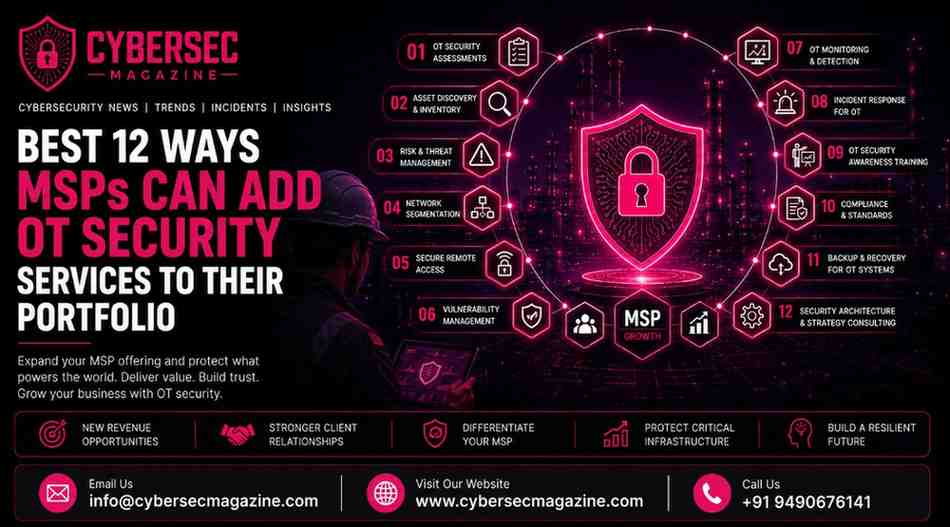
Best 12 Ways MSPs Can Add OT Security Services
1. Passive Asset Discovery & Inventory
The foundation of any security program is visibility. In OT, active scanning can crash sensitive PLCs, making passive discovery essential. Implement tools that mirror network traffic to identify devices by their behavior and protocol headers without ever touching the end asset. By offering a continuous, real-time “Asset Registry,” you solve the client’s most fundamental pain point: they cannot secure what they do not know exists. This proactive visibility layer acts as the “source of truth” for all subsequent security efforts, enabling you to map vulnerabilities, track configuration changes, and ensure compliance with industrial standards without disrupting the delicate timing of the plant floor or risking the operational integrity of legacy controllers that were never built to withstand standard IT scans.
2. OT-Specific Vulnerability Management
Standard IT vulnerability scanners are dangerous in an industrial setting. You must offer a managed service that identifies vulnerabilities specifically relevant to OT firmware and ICS protocols. Instead of “patch everything,” your service should focus on “risk-based remediation,” leveraging virtual patching or compensating controls to secure systems that cannot be taken offline, thereby respecting the operational constraints of the plant. By translating raw CVE data into “process risk” scores, you provide plant managers with actionable insights that prioritize patches for the most critical bottlenecks, significantly reducing the surface area for lateral movement while ensuring the production schedule remains the highest priority for the facility’s leadership.
3. Secure Remote Access Management
Remote access is the leading cause of OT breaches. MSPs should replace brittle VPNs and open RDP ports with secure, vendor-neutral “Jump Hosts” or Identity-Aware Proxies. Offer a service that provides time-bound, audited access for third-party vendors and maintenance staff. By logging every session and requiring Multi-Factor Authentication (MFA), you turn a dangerous backdoor into a controlled, visible, and secure operational pathway. This service not only simplifies compliance for your clients but also provides them with a granular audit trail that identifies exactly who accessed which controller, at what time, and what specific commands were executed during their maintenance window, effectively preventing unauthorized, shadow-IT remote connections from becoming a catastrophic security event.
4. Network Micro-Segmentation
Flat networks are a relic of the past, but “zoning” a factory is a complex engineering task. Package a micro-segmentation service that logically separates production lines from the corporate network. By enforcing “conduits” of communication between these zones, you limit the blast radius of a potential ransomware infection, preventing an IT-based attack from pivoting into the sensitive Level 1/Level 2 control environment. Utilizing your expertise, you can design these network architectures to mirror the Purdue Model, ensuring that data flows from the controller level up to the enterprise level are strictly filtered and validated, thereby containing threats to their point of origin and protecting the physical safety of the facility even if a peripheral IT device is compromised.
5. OT-Native Incident Response Playbooks
When a security alert triggers on the plant floor, the response cannot be “shutdown and reboot.” Develop and offer OT-specific incident response playbooks that prioritize process safety. Your MSP team should be trained to work alongside plant engineers to determine if an anomaly is a cyber threat or an operational error. This domain-specific expertise is what separates a generic MSP from a true industrial security partner. By creating automated workflows that trigger notifications to the correct physical safety officers rather than just IT staff, you ensure that every response action-such as manual override procedures or safe-state shutdowns-is handled with the necessary caution, maintaining the physical safety of employees while simultaneously mitigating the digital threat effectively.
6. Managed SIEM for IT/OT Convergence
Clients need a “single pane of glass” to correlate events across their IT and OT environments. Integrate industrial telemetry into your existing SIEM (Security Information and Event Management) platform to detect cross-domain threats. A correlated alert-such as an unauthorized login in the corporate network followed by a suspicious configuration change in a PLC-is the key to identifying sophisticated, multi-stage industrial attacks. By using AI-driven correlation engines, you can effectively silence the noise of thousands of operational data points and highlight only those sequences that indicate an active threat, enabling your SOC team to focus on meaningful alerts rather than false positives, thereby shortening the time-to-detect and preventing potential damage before it impacts production.
7. Supply Chain & SBOM Verification
Security is now a prerequisite for vendor procurement. Offer a service that audits the Software Bill of Materials (SBOM) for industrial equipment before the client buys it. By acting as the “security gatekeeper” during the procurement phase, you help clients avoid inheriting legacy vulnerabilities or “insecure-by-default” hardware, positioning your MSP as a strategic advisor long before a single device is connected. This proactive service model turns your MSP into a gatekeeper for the client’s supply chain, allowing you to provide a “Cyber-Health Certificate” for all incoming equipment, which gives them the confidence that their procurement decisions are not inadvertently introducing unknown zero-day risks into their newly upgraded, hyper-connected production environment.
8. Continuous Compliance Reporting
Regulatory frameworks like NIS2 and IEC 62443 are becoming mandatory for industrial firms. Package compliance not as a one-time project, but as a recurring service. By providing monthly “Compliance Health Checks” that map your monitoring activities directly to regulatory controls, you turn a burdensome compliance requirement into a predictable, high-value recurring revenue stream for your MSP business. This service model allows your clients to offload the stress of ongoing audits and regulatory reporting, as you provide them with the standardized, audit-ready documentation they need to prove security maturity to regulators and boards, ultimately ensuring their operational licenses remain valid while you maintain a consistent, long-term relationship with their executive leadership.
9. Industrial Behavioral Analytics
OT networks are typically static-they follow predictable communication patterns. Market a behavioral analytics service that learns the “normal” traffic flow of a production line. When a PLC suddenly begins communicating with an external IP or a new, unauthorized gateway appears on the network, your platform should flag it immediately. This “anomaly detection” is the most effective way to catch zero-day exploits in an industrial environment. By establishing a baseline of “normal” behavior, you can detect subtle deviations that traditional signature-based tools would miss entirely, empowering you to identify not just malicious external actors, but also potentially dangerous internal misconfigurations or unauthorized process changes that could have physical consequences if left unattended.
10. Managed Physical Security Integration
Industrial cybersecurity extends to the physical layer. Expand your service to monitor and secure physical access points, such as smart cameras or badge readers, that connect back to the network. By treating physical entry as a component of the digital security perimeter, you provide a truly comprehensive “Defense-in-Depth” strategy that protects both the hardware in the cabinet and the facility itself. Integrating these feeds into your security dashboard allows you to provide a holistic view where a badge-in event at a sensitive server room door can be correlated with server activity, ensuring that you are protecting the “bricks and clicks” of the entire industrial facility against both digital and physical intrusion.
11. Managed Firmware Lifecycle Services
OT assets often run for 20 years, making manual firmware tracking impossible. Offer a managed service that tracks EoL (End-of-Life) dates and firmware versions for every controller in the client’s inventory. Your team becomes responsible for identifying available security patches and coordinating with plant managers to schedule updates during planned maintenance windows, ensuring the systems stay current without sacrificing uptime. This service relieves the client of the constant administrative burden of tracking vendor bulletins and scheduling risky updates, allowing them to rely on your expertise to identify which updates are mission-critical and how they can be deployed with the absolute minimum impact on production schedules.
12. OT Security Awareness Training
The human element is just as vulnerable on the shop floor as it is in the office. Develop a training module specifically for industrial operators that covers the risks of USB drives, shared passwords, and “Shadow OT.” By educating the staff on how their actions impact cyber-physical safety, you build a “Human Firewall” that acts as your first and most effective line of defense against social engineering. Providing this specialized education ensures that your client’s employees understand that cybersecurity is a collective responsibility, effectively turning your MSP into an organizational educator that fosters a culture of security awareness across every level of the industrial company, from the front office to the factory floor.
Conclusion: The Strategic MSP Advantage
As we look ahead, the MSPs that will dominate the 2026 market are those that stop viewing OT as a peripheral challenge and start treating it as the core of their value proposition. The opportunities for recurring revenue and long-term client retention are immense, but success requires moving away from fragmented, “tool-heavy” approaches and toward integrated, process-aware operations. By adopting these 12 strategies, you don’t just secure your clients’ networks-you ensure their physical and operational survival in an increasingly digital world. The future of MSPs lies in becoming the bridge between the digital and physical realms, providing the steady, expert hand that allows industrial clients to innovate confidently without fearing that their physical safety or operational uptime will be compromised by an evolving cyber threat landscape.