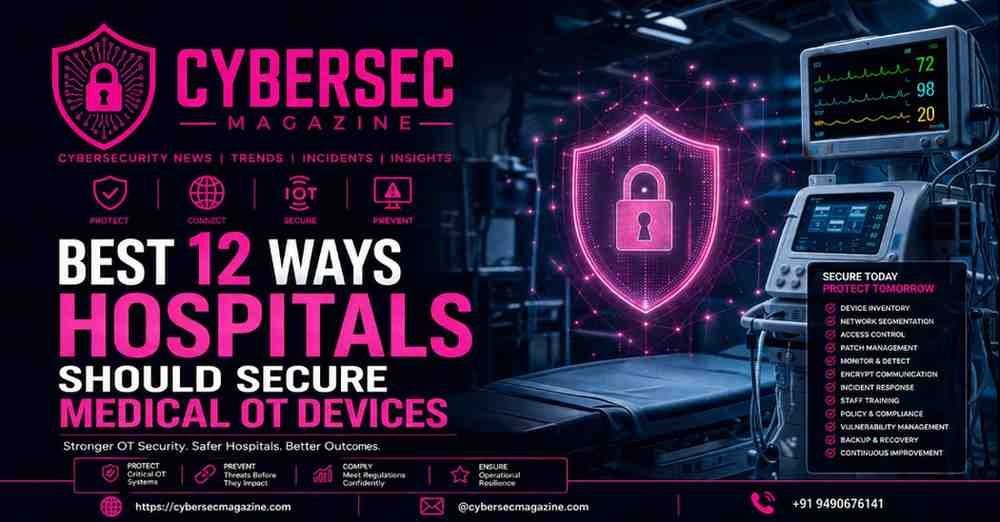
Best 12 Ways Hospitals Should Secure Medical OT Devices
The Invisible Attack Surface of Modern Healthcare
The modern hospital is no longer just a sanctuary of clinical expertise; it is a hyper-connected, high-stakes operational ecosystem driven by technology. Behind every electronic health record, smart infusion pump, and automated diagnostic machine lies a complex web of Operational Technology (OT) and the Internet of Medical Things (IoMT). While these connected innovations have revolutionized patient care, drastically reduced diagnosis times, and streamlined hospital workflows, they have simultaneously expanded the cyber threat landscape to unprecedented proportions. Unlike standard IT infrastructure-where data confidentiality takes center stage-medical OT environments deal directly with physical safety, where a cyber disruption can immediately translate into delayed treatments, compromised patient data, or halted surgical procedures.
Historically, medical equipment was built with a singular focus on reliability, functionality, and longevity, often leaving cybersecurity as an afterthought. Many legacy clinical devices run on outdated operating systems, utilize unencrypted proprietary protocols, or feature hardcoded default credentials that cannot be easily patched without voiding manufacturer certifications. Compounding this vulnerability is the heavy reliance on third-party vendors, remote maintenance access channels, and complex supply chain networks. Cybercriminals and nation-state threat actors have recognized these blind spots, turning healthcare organizations into primary targets for ransomware campaigns and data extortion. Securing medical OT and IoT assets is no longer a standard regulatory compliance checkbox; it is an urgent, mission-critical imperative for protecting human lives and maintaining operational continuity across global healthcare networks.
1. Implement Comprehensive Automated Asset Discovery and Dynamic Mapping
Gaining absolute visibility into every connected asset across a hospital network serves as the foundational bedrock of any robust medical OT security strategy. In dynamic healthcare environments, new biomedical equipment, smart monitors, and diagnostic tools are plugged into the network daily-often without the direct knowledge or authorization of the internal IT and security teams. Traditional IT asset discovery tools often fail or crash when scanning sensitive medical devices because active probing can disrupt clinical workflows or interfere with delicate life-support equipment. To counter this, hospitals must deploy passive and advanced network discovery solutions that safely listen to network traffic, inspect communication patterns, and catalog every device footprint. This automated inventory process should capture critical granular data, including device manufacturer details, model numbers, firmware and software versions, active IP addresses, MAC addresses, and open communication ports. By maintaining a real-time, centralized inventory map, security operations teams can accurately evaluate their true attack surface, identify unmanaged or rogue legacy systems, and prioritize remediation protocols based on clinical risk exposure and active threat intelligence feeds.
2. Enforce Strict Micro-Segmentation Across Clinical and Operational Networks
Flat network architectures are among the most dangerous structural flaws in modern hospital IT and OT engineering, as they allow malware or ransomware to easily move laterally from a compromised administrative workstation straight into critical clinical units. Medical OT devices-ranging from MRI machines and laboratory analyzers to patient telemetry monitors-should never reside on the same broadcast domain as corporate email servers, guest Wi-Fi networks, or general-purpose office computers. Hospitals must design and enforce rigorous network micro-segmentation strategies, dividing the infrastructure into isolated zones based on device criticality, operational function, and clinical department. By implementing software-defined networking (SDN) and advanced firewall policies, security architects can establish strict baseline communication rules that dictate precisely which systems are permitted to talk to one another. If an attacker manages to compromise a low-security administrative endpoint or an IoT-enabled HVAC system, micro-segmentation acts as an impenetrable internal barrier, effectively containing the threat, stopping lateral movement, and safeguarding life-critical medical equipment from collateral damage.
3. Establish a Robust Third-Party Risk Management (TPRM) and Vendor Governance Framework
The healthcare sector relies heavily on external manufacturers, software developers, clinical service providers, and maintenance contractors, making third-party ecosystems one of the most frequently exploited entry vectors for cybercriminals. Medical equipment is frequently serviced remotely by external technicians who require direct access to internal hospital networks for diagnostics, calibration, and software updates. Unfortunately, if a vendor’s corporate network is breached upstream, threat actors can piggyback on those trusted maintenance channels to infiltrate hospital environments undetected. Hospitals must institute a proactive Third-Party Risk Management (TPRM) framework that begins well before any vendor contract is signed. This governance model requires conducting comprehensive security posture assessments, evaluating third-party compliance with recognized frameworks like NIST and HIPAA, and mandating that all external remote access sessions utilize secure, encrypted tunnels coupled with multi-factor authentication. Furthermore, hospitals should enforce strict access expiration policies, ensuring that vendor accounts are active only during scheduled service windows and are continuously monitored for anomalous behavior.
4. Deploy Advanced Runtime Exploit Prevention and Compensating Controls for Unpatchable Legacy Devices
One of the greatest operational dilemmas facing biomedical engineering teams is the reality that many life-saving medical devices cannot be patched, rebooted, or updated easily due to strict FDA regulatory certifications, proprietary software limitations, or the risk of clinical downtime. When a critical vulnerability is disclosed by a device manufacturer, hospitals often face a prolonged window of exposure where traditional patching is completely unfeasible. To protect these legacy assets without interrupting patient care, organizations must implement advanced runtime exploit prevention technologies and compensating security controls. Unlike traditional endpoint security solutions that require frequent signature updates or system reboots, runtime protection operates at the binary level, hardening the device memory and blocking unauthorized code execution attempts even if the underlying vulnerability remains unpatched. Additionally, hospitals can use virtual patching techniques at the network layer, configuring intrusion prevention systems (IPS) to inspect and drop malicious packets destined for vulnerable legacy medical ports, thereby building a resilient protective shield around aging clinical infrastructure.
5. Mandate Comprehensive Software Bill of Materials (SBOM) Tracking and Integration
Understanding the complex software components embedded within modern medical devices has transformed from a mere regulatory compliance exercise into an absolute operational necessity. Modern medical OT and IoT systems are rarely built from scratch; instead, they integrate countless third-party software libraries, open-source modules, and commercial code packages that can harbor hidden vulnerabilities. When a zero-day vulnerability or a widespread code flaw is discovered in an underlying component-such as an open-source networking stack-hospitals need to know instantly if their deployed fleet of infusion pumps or imaging systems is affected. Healthcare procurement teams must mandate that all medical device manufacturers provide a comprehensive, machine-readable Software Bill of Materials (SBOM) as a mandatory prerequisite for purchase. By integrating SBOM data into centralized vulnerability management platforms, security teams can proactively track component lifecycles, cross-reference software manifests against emerging threat disclosures, and collaborate with vendors on rapid mitigation strategies long before an active exploit can jeopardize clinical safety.
6. Implement Zero Trust Architecture (ZTA) and Rigorous Identity and Access Management (IAM)
The traditional security model of trusting anything inside the corporate network perimeter is fundamentally broken, particularly in complex hospital environments where unmanaged medical devices and human error frequently collide. Adopting a Zero Trust Architecture (ZTA) requires hospitals to operate under the strict mantra of “never trust, always verify,” treating every user, application, and connected device as a potential threat until proven otherwise. For human users accessing clinical systems, hospitals must enforce robust Identity and Access Management (IAM) protocols, including mandatory multi-factor authentication (MFA), hardware security keys, and role-based access controls (RBAC) that limit administrative privileges to only what is strictly necessary for daily job functions. For non-human entities-such as medical IoT sensors, automated carts, and laboratory robots-Zero Trust policies dictate that devices authenticate cryptographically before communicating across the network, limiting their operational scope to specific, pre-approved destinations. By coupling strict identity verification with continuous behavioral monitoring, hospitals can effectively neutralize credential theft, insider threats, and lateral movement attempts.
7. Leverage AI-Driven Behavioral Anomaly Detection for Real-Time Threat Intelligence
With cyberattacks growing increasingly sophisticated and autonomous, human security analysts alone cannot keep pace with the sheer volume of alerts generated across a massive hospital network. Standard signature-based security tools often fail to catch novel malware variants or zero-day exploits that lack historical precedents. To bridge this gap, modern healthcare institutions are turning to artificial intelligence (AI) and machine learning-driven behavioral anomaly detection platforms. These advanced analytical engines study normal operational baselines for every single medical OT device-observing standard communication frequencies, data packet sizes, destination IP addresses, and operational workflows. The moment a device begins exhibiting abnormal behavior-such as an infusion pump suddenly attempting to query an external database or a patient monitor transmitting massive volumes of data to an unknown overseas server-the AI platform flags the anomaly in real time. This rapid detection capability enables security operations centers (SOC) to isolate compromised endpoints within seconds, mitigating operational damage before patient care is disrupted.
8. Establish Resilient Incident Response Playbooks and Comprehensive Offline Clinical Workflows
Despite deploying world-class preventive controls and cutting-edge security architecture, no healthcare organization can claim absolute immunity against sophisticated cyber threats. When a ransomware attack or a destructive malware outbreak strikes a hospital, every second counts, and generalized IT incident response plans are rarely sufficient for managing physical medical equipment. Hospitals must design specialized, medical OT-tailored incident response (IR) playbooks in close collaboration with biomedical engineering staff, clinical directors, and hospital legal teams. These playbooks must outline precise containment procedures that prioritize patient safety above all else, ensuring that life-support systems and critical monitoring equipment are isolated safely without causing sudden mechanical failures. Furthermore, because a major cyber incident can knock electronic health records and connected devices offline for weeks, hospitals must maintain rigorously tested, paper-based offline clinical workflows and manual workarounds. Conducting regular tabletop exercises and multi-departmental simulation drills ensures that medical staff are well-trained to transition smoothly to emergency procedures during a crisis.
9. Optimize Medical Device Lifecycle Management and Secure Decommissioning Protocols
Every medical device possesses a finite operational lifecycle, beginning with initial procurement and secure onboarding, moving through active clinical utilization and maintenance, and concluding with final retirement. Security risks frequently spike at both ends of this spectrum-during the rapid, unverified deployment of brand-new IoT devices and during the improper disposal of aging equipment. Hospitals must implement a comprehensive device lifecycle management program that embeds security requirements into procurement contracts, enforces secure configuration standards before a device ever touches the clinical floor, and tracks performance metrics throughout its operational life. Equally critical is the secure decommissioning phase. When older medical OT assets reach the end of their operational usefulness, they are often discarded or resold without proper data sanitization, leaving sensitive patient records, configuration files, and network credentials exposed to data scavengers. Hospitals must establish strict, verifiable data destruction protocols-including certified degaussing, cryptographic erasure, and physical destruction of storage media-ensuring that retired medical assets do not become a secondary source of data breaches.
10. Foster Cross-Functional Collaboration Between IT, Biomed, and Clinical Leadership
One of the most persistent operational hurdles in hospital cybersecurity is the historical cultural divide between Information Technology (IT) teams, Biomedical Engineering (Biomed) professionals, and clinical staff. While IT security professionals focus heavily on network hardening, data protection, and policy enforcement, Biomed teams prioritize physical device maintenance, equipment calibration, and clinical availability, often viewing aggressive cybersecurity measures as a direct impediment to patient care. Bridging this gap is paramount for building a resilient defense posture. Hospital leadership must foster formal cross-functional governance structures that bring IT security experts, biomedical engineers, and clinical department heads together into unified task forces. By working collaboratively on asset discovery, risk assessment, and change management workflows, these teams can ensure that security controls are engineered to respect clinical realities. When security policies are co-developed with clinical input, hospitals can successfully protect medical OT assets without introducing friction into critical patient treatment workflows.
11. Implement Continuous Vulnerability Management and Real-Time Compliance Monitoring
Cyber threat intelligence and vulnerability landscapes evolve at a relentless pace, rendering static, annual security assessments and periodic compliance audits completely obsolete. Hospitals operate in a dynamic regulatory environment governed by strict frameworks such as HIPAA, HITECH, and CISA performance goals, requiring constant proof of security due diligence. To maintain a resilient security posture, healthcare organizations must transition from reactive scanning to continuous vulnerability management and real-time compliance monitoring. This involves utilizing automated security orchestration platforms that continuously cross-reference the hospital’s live asset inventory against global vulnerability databases, CISA’s Known Exploited Vulnerabilities (KEV) catalog, and manufacturer advisory feeds. By automating continuous risk scoring and compliance tracking, security teams can instantly identify which devices require urgent mitigation, generate automated audit reports for regulatory bodies, and ensure that security baselines are maintained across every department without manual administrative overhead.
12. Cultivate a Resilient Cybersecurity Culture Through Specialized Staff Education
Despite deploying advanced firewalls, AI-driven anomaly detection, and strict zero-trust controls, human error remains one of the single greatest vulnerabilities in the healthcare cybersecurity equation. Phishing campaigns, social engineering attacks, and accidental misconfigurations by well-meaning clinical or administrative personnel continue to serve as the primary entry points for catastrophic ransomware outbreaks. Because hospital staff work in high-stress, fast-paced environments where they are constantly bombarded with digital communications, general cybersecurity awareness training is rarely enough. Hospitals must design engaging, specialized cybersecurity education programs tailored specifically to the unique operational realities of clinical workers, nurses, doctors, and administrative staff. These training modules should focus heavily on recognizing sophisticated phishing attempts, understanding the security risks associated with unverified mobile devices, and knowing precisely who to contact when suspicious system behavior is observed. By cultivating a proactive, blame-free security culture where every employee views themselves as an active defender of patient safety, hospitals can successfully fortify their human firewall against evolving cyber threats.