Best 10 Ways to Protect Process Control Systems in Refining
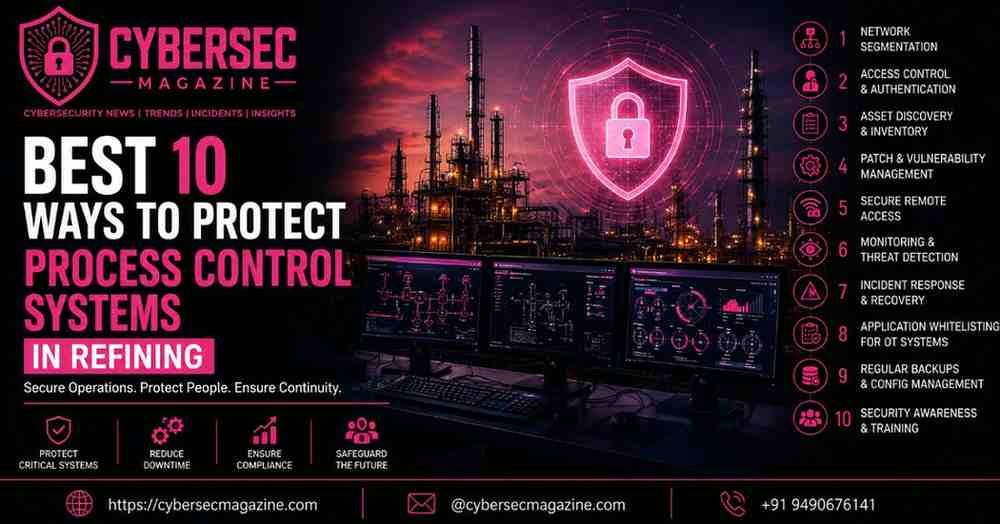
Discover top 10 OT security ways to protect process control systems in refining. Learn how oil and gas plants defend critical ICS infrastructure.
Introduction to Process Control Security in Petroleum Refining
Petroleum refining represents one of the most complex, hazardous, and vital sectors within global critical infrastructure, relying on continuous, highly automated physical processes to convert crude oil into refined petroleum products. For decades, the process control systems (PCS) managing fluid catalytic cracking, distillation columns, hydrotreaters, and safety instrumented systems (SIS) operated behind air-gapped perimeters. These distributed control systems (DCS) and programmable logic controllers (PLCs) prioritized uninterrupted uptime, precise thermal regulation, and worker safety above all else, utilizing proprietary serial communication lines that were physically isolated from the outside world.
However, the rapid acceleration of digital transformation, industrial IoT (IIoT) integration, and IT-OT convergence has completely dismantled these traditional air-gapped boundaries. Modern refineries now leverage interconnected business intelligence networks to monitor yields, optimize catalytic output, and streamline supply chain logistics in real time. Unfortunately, this hyper-connected operational architecture has also exposed refining process control systems to advanced cyber-physical threats, ranging from sophisticated ransomware syndicates to targeted state-sponsored espionage. Because a compromised refining loop can trigger catastrophic environmental disasters, toxic releases, or multi-million-dollar production outages, establishing robust, purpose-built cybersecurity defenses for process control systems is an absolute operational necessity.
Best 10 Ways to Protect Process Control Systems in Refining
1. Establishing Comprehensive Asset Discovery and Visibility
Securing a modern petroleum refinery requires complete, granular visibility into every hardware component, firmware version, and communication pathway residing within the process control network. Many refining facilities struggle with inaccurate or outdated asset inventories, leaving unmanaged legacy controllers and forgotten engineering workstations completely exposed to internal lateral movement. Passive, OT-aware asset discovery platforms must be deployed to map out all DCS nodes, controllers, and field sensors safely without disrupting fragile control loops. Maintaining a dynamic asset repository allows security teams to track hardware lifecycles, identify unauthorized modifications instantly, and prioritize vulnerability remediation effectively.
2. Enforcing Strict Purdue Model Segmentation and Micro-Zoning
A foundational architectural vulnerability in refining operations is the presence of flat networks that permit unhindered communication between corporate IT systems and core process control loops. Implementing rigorous network segmentation based on the Purdue Reference Model and IEC 62443 standards creates impenetrable firewall barriers between enterprise layers and critical refining units. Organizations must deploy industrial-grade stateful firewalls, data diodes, and dedicated DMZs to inspect, filter, and restrict all data traffic moving across the IT-OT boundary. Micro-segmentation around individual refining process cells ensures that any initial security breach remains contained and cannot paralyze adjacent production units.
3. Deploying Protocol-Aware Behavioral Anomaly Detection
Traditional signature-based IT endpoint protection tools fail to safeguard refining environments because they cannot interpret specialized industrial communication protocols like Modbus, OPC UA, and Profibus. Cyber adversaries frequently disguise their malicious command-and-control traffic by blending it seamlessly with legitimate refinery telemetry, evading standard detection mechanisms completely. Deploying OT-specific network detection solutions equipped with deep packet inspection tailored for refining automation establishes precise behavioral baselines of normal control operations. When an unauthorized register write or irregular controller command occurs, the security platform instantly alerts operators to mitigate potential physical threats.
4. Hardening Identity and Access Management (IAM) Controls
Compromised user credentials remain one of the most reliable entry vectors for threat actors targeting oil and gas infrastructure, making robust identity governance non-negotiable. Refining operators must eliminate shared administrative passwords, enforce phishing-resistant multi-factor authentication (MFA) for all high-risk accounts, and adopt strict Zero Trust principles across the control network. Privileged access management (PAM) solutions should govern every administrative interaction with DCS engineering workstations and safety systems. Regular, automated access reviews ensure that former contractors or transferred personnel immediately lose their standing privileges within critical refining networks.
5. Implementing Risk-Based Vulnerability and Patch Management
Managing software vulnerabilities in a petroleum refinery is exceptionally challenging because traditional IT patching cycles can trigger unexpected controller reboots and dangerous operational shutdowns. Refining facilities must adopt a risk-based vulnerability management strategy that evaluates software flaws through the lens of potential safety impact and active exploitability. When direct patching of legacy DCS controllers is impossible due to hardware limitations, security teams must deploy compensating controls such as application allowlisting and strict network filtering. Prioritizing remediation efforts on internet-facing assets and critical engineering jump hosts minimizes overall systemic risk.
6. Securing Remote Vendor Access and Third-Party Integrators
Refining facilities rely heavily on external vendors, system integrators, and specialized engineering contractors who require periodic digital access to service complex distillation and cracking units. Unfortunately, unsecured vendor VPN tunnels and compromised third-party credentials frequently serve as open backdoors for sophisticated ransomware syndicates targeting industrial plants. Organizations must mandate secure jump hosts, multi-factor authentication, and real-time session recording for every third-party maintenance interaction. Implementing strict time-bound access windows and least-privilege policies ensures external partners can only access designated refining subsystems.
7. Establishing Immutable, Air-Gapped Backup and Recovery
The ultimate leverage held by cybercriminals attacking refining operations is the threat of permanent data destruction and prolonged, catastrophic production downtime. Resilient defense requires maintaining comprehensive, immutable, and offline backups that encompass more than enterprise data, including complete PLC logic, DCS configurations, and HMI project files. Refining plants must enforce strict backup schedules following the 3-2-1 rule, storing critical recovery images on air-gapped media that network ransomware cannot encrypt. Regular, scheduled disaster recovery drills verify that system images can be restored cleanly within acceptable operational timeframes.
8. Hardening Safety Instrumented Systems (SIS) and Emergency Shutowns
Safety Instrumented Systems (SIS) represent the absolute last line of defense in a petroleum refinery, designed to prevent catastrophic overpressurization, explosions, or toxic leaks. Because SIS networks operate independently from basic process control systems, they require specialized, highly rigorous security hardening and physical segregation. Organizations must ensure that safety logic solvers, emergency shutdown valves, and override switches are completely shielded from corporate IT connectivity and general administrative traffic. Continuous integrity monitoring of safety logic ensures that malicious interference or unauthorized firmware tampering is detected immediately.
9. Cultivating Cybersecurity Culture and Workforce Training
Human error and social engineering remain significant vulnerabilities across industrial facilities, making a security-conscious workforce an essential line of defense. Refining operators, control room engineers, and plant personnel must receive tailored cybersecurity awareness training that addresses real-world industrial threats rather than generic office scenarios. Training programs should emphasize how to identify plant-targeted phishing attempts, encourage a blame-free reporting culture for unusual system behavior, and outline clear protocols for handling unexpected control anomalies. Empowering every employee to prioritize security vigilance strengthens the human firewall protecting critical refining processes.
10. Aligning OT Defenses with Global Standards and Regulations
Navigating the complex threat landscape of modern petroleum refining requires benchmarking security postures against established international standards and regulatory frameworks. Aligning industrial control security programs with IEC 62443, NIST SP 800-82, and local critical infrastructure mandates provides a structured methodology for measuring risk and closing security gaps. Adopting these recognized frameworks helps refining leadership secure necessary capital investment, streamline cross-functional risk governance, and demonstrate proactive compliance to insurers and government authorities. Structured compliance ensures that defensive investments continuously cover all critical layers from physical edge sensors to enterprise supervisory servers.
Conclusion
Securing process control systems in petroleum refining requires an aggressive, multi-layered defense strategy that moves far beyond traditional perimeter walls and air-gap assumptions. As digital transformation and IT-OT convergence deepen across the oil and gas sector, refining facilities face sophisticated cyber threats that threaten both financial stability and physical human safety. By enforcing comprehensive asset visibility, strict Purdue model segmentation, protocol-aware anomaly detection, and rigorous identity controls, refining organizations can successfully safeguard their critical infrastructure. Prioritizing these essential security measures ensures continuous operational resilience, environmental protection, and uninterrupted production across the entire downstream value chain.