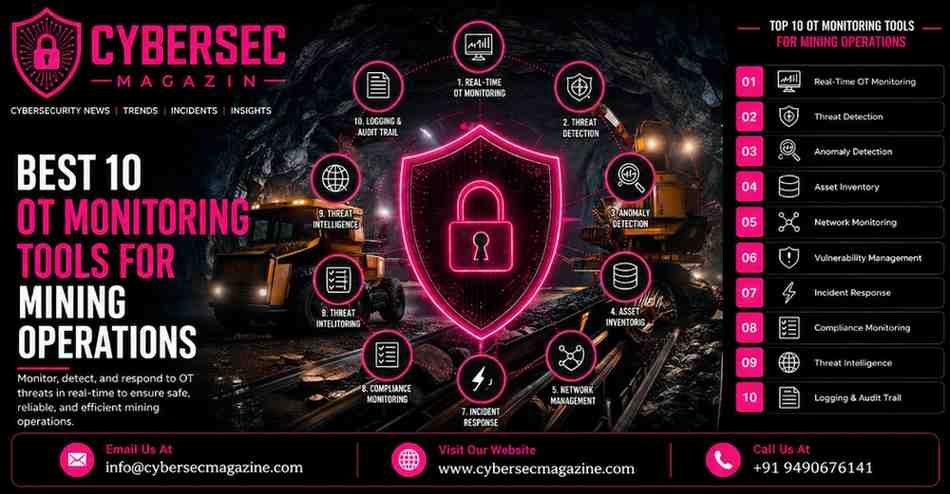
Best 10 OT Monitoring Tools for Mining Operations
The Digital Transformation and Cyber Risk of Modern Mining
Modern mining operations have evolved far beyond traditional subterranean excavation and manual extraction methods. Today, smart mines utilize highly automated, data-driven ecosystems characterized by autonomous haul trucks, remote-controlled drilling rigs, IoT-enabled conveyor networks, and centralized SCADA control rooms. While this aggressive digital integration significantly boosts mineral throughput, optimizes resource allocation, and improves worker safety in hazardous zones, it has simultaneously exposed the mining sector to severe industrial cybersecurity threats. State-sponsored threat actors and cybercriminal syndicates frequently target mining infrastructure because resource extraction is a critical pillar of global supply chains and national economies.
Securing mining Operational Technology (OT) and Industrial Control Systems (ICS) presents unique engineering challenges compared to standard enterprise IT environments. Mining sites are typically located in remote, geographically isolated regions with intermittent satellite connectivity, harsh physical conditions, and extended equipment lifecycles where legacy Programmable Logic Controllers (PLCs) operate continuously for decades. Furthermore, because control loops directly govern heavy physical machinery-such as ventilation fans, slurry pumps, and crushing systems-disruptions can lead to catastrophic environmental accidents or loss of life. Deploying specialized OT monitoring tools is no longer optional; it is an absolute requirement to maintain visibility, detect anomalous behavior, and ensure operational resilience across harsh extraction assets.
10 OT Monitoring Tools for Mining Operations
1. Dragos Platform
The Dragos Platform stands as a premier purpose-built industrial cybersecurity solution tailored specifically to address the complex threat landscapes found in heavy resource industries like mining. It combines passive network monitoring with advanced threat intelligence derived from deep research into named adversary groups targeting industrial control systems. For mining operations distributed across isolated geographic areas, Dragos provides specialized site sensors that map intricate field communications without disrupting fragile control networks. The platform excels at translating raw packet data into actionable insights, identifying known malware, and highlighting protocol anomalies unique to SCADA and distributed control environments. By integrating world-class threat hunting capabilities with robust incident response playbooks, Dragos empowers security teams to mitigate risks before physical extraction processes are impacted.
2. Claroty Platform (xDome and CTD)
Claroty offers one of the most comprehensive cyber-physical systems (CPS) protection platforms on the market, making it an ideal choice for sprawling, multi-site mining enterprises. Its architecture spans flexible deployment models, including cloud-delivered SaaS via xDome and on-premises continuous threat detection through CTD, adapting seamlessly to hybrid mining IT-OT infrastructures. The platform delivers deep asset discovery, vulnerability management, and secure remote access capabilities that cover everything from enterprise systems down to the deepest operational levels. For mining operators managing diverse equipment vendors and legacy assets, Claroty provides granular visibility into unmanaged IIoT devices and specialized field controllers. Its advanced exposure management features help security teams prioritize remediation based on actual clinical or operational risk rather than theoretical vulnerability scores.
3. Nozomi Networks (Guardian and Vantage)
Nozomi Networks delivers industry-leading, scalable OT and IoT visibility backed by sophisticated artificial intelligence and automated anomaly detection engines. In massive surface and underground mining operations where thousands of connected sensors, haulage trackers, and automation nodes operate simultaneously, Nozomi scales effortlessly to map the entire network. Its Guardian physical and virtual sensors perform deep packet inspection to establish precise behavioral baselines of normal operational traffic across proprietary mining protocols. When subtle deviations occur-such as an unauthorized configuration change on a crushing plant controller or anomalous communication from a remote slurry pump-the platform instantly alerts operators. Centralized management through the cloud-native Vantage console allows security teams to maintain unified oversight across multiple global mining sites from a single pane of glass.
4. Tenable OT Security
Tenable OT Security extends traditional vulnerability management into the complex world of industrial control systems, providing deep asset discovery and threat detection tailored for heavy industry. For mining companies that already utilize Tenable for corporate IT vulnerability assessment, integrating Tenable OT Security bridges the notorious organizational gap between enterprise IT and operational technology. The platform utilizes a combination of passive traffic monitoring and secure active querying designed specifically to respect the operational constraints of fragile legacy PLCs and RTUs. It identifies hidden security risks, tracks firmware version discrepancies, and cross-references asset inventories against global threat feeds and known vulnerability databases. This comprehensive approach allows mining engineers to maintain continuous compliance with industrial safety frameworks while proactively eliminating pathways for lateral movement.
5. Microsoft Defender for IoT
Microsoft Defender for IoT provides agentless, robust monitoring and threat detection capabilities that integrate natively with the broader enterprise security ecosystem. Mining enterprises heavily invested in Azure cloud infrastructure and Microsoft security tooling can leverage Defender for IoT to achieve unified visibility across corporate networks and remote operational sites. The platform automatically discovers all connected industrial assets, maps communication flows, and evaluates vulnerabilities across SCADA systems, remote telemetry units, and IIoT devices. By harnessing threat intelligence powered by global data optics, it detects advanced malware, unauthorized remote access sessions, and suspicious lateral movements between IT boundaries and operational zones. Its seamless integration with SIEM and SOAR platforms streamlines incident response workflows for lean mining security teams.
6. Forescout Vistaro
Forescout Vistaro delivers comprehensive cyber-physical risk management and continuous OT network monitoring designed to secure complex, heterogeneous industrial environments like modern smart mines. The platform offers flexible deployment options, supporting cloud-native management, on-premises physical appliances, and containerized sensors capable of operating efficiently in air-gapped or remote locations. Vistaro utilizes agentic artificial intelligence to continuously analyze asset intelligence, evaluate exposure shifts, and correlate threat context across IT, OT, IoT, and building automation systems. For mining operations struggling with unpatched legacy equipment and fragmented asset visibility, Forescout provides deep packet inspection and active querying to track every device footprint. Its integrated secure remote access controls ensure that third-party maintenance contractors connect only through governed, policy-enforced pathways.
7. TXOne Networks EdgeIPS and Industrial Security Solutions
TXOne Networks specializes in operational technology security designed explicitly to safeguard mission-critical industrial environments where traditional IT security tools fail. In mining operations, where shutting down machinery for patching is often financially devastating, TXOne provides robust network segmentation and runtime intrusion prevention tailored for harsh operational constraints. Its hardware-accelerated inspection firewalls and network segmentation gateways sit directly in front of vulnerable legacy controllers, inspecting industrial protocols and blocking malicious packets before they reach sensitive PLCs. The platform offers reliable cyber defense for unpatchable assets, safeguarding specialized mining machinery against emerging zero-day exploits and malware variants. By enforcing granular trust boundaries at the edge, TXOne ensures that localized operational disruptions cannot propagate across the broader mining network.
8. Armis Centrix for OT/IoT Security
Armis Centrix provides cloud-native, agentless asset intelligence and security monitoring that excels at discovering unmanaged devices across complex enterprise and industrial ecosystems. Mining operations frequently deploy thousands of unmanaged IIoT sensors, environmental monitors, automated vehicles, and smart logistics tags that traditional asset tracking tools completely overlook. Armis continuously monitors network traffic passively, building a comprehensive inventory and profiling every device behavior without sending intrusive probes that could disrupt delicate mining processes. The platform cross-references device profiles against an extensive cloud-based asset database to identify behavioral anomalies, missing security patches, and risky communication attempts. Its rapid deployment model allows mining organizations to gain immediate visibility across dispersed remote extraction sites with minimal administrative overhead.
9. Palo Alto Networks Industrial IoT Security
Palo Alto Networks provides enterprise-scale industrial cybersecurity through its robust portfolio of Next-Generation Firewalls (NGFW) and cloud-delivered security services. For large mining conglomerates seeking to unify their corporate IT security posture with rigorous operational technology protection, Palo Alto offers powerful network segmentation and deep protocol inspection. Its Industrial IoT security service utilizes machine learning to automatically discover, classify, and assess the risk profile of every connected operational device in real time. By integrating threat detection directly into the network infrastructure, the platform identifies unauthorized remote connections, protocol violations, and malware proliferation across remote mining sites. Centralized policy enforcement ensures that security rules are consistently applied across all regional facilities, reducing administrative complexity.
10. Fortinet FortiGuard Industrial Security Service
Fortinet delivers an integrated approach to operational technology security by combining high-performance FortiGate industrial firewalls with specialized FortiGuard OT threat intelligence services. Designed to withstand harsh industrial operating conditions, Fortinet appliances provide deep packet inspection for hundreds of industrial protocols commonly utilized in mining automation and SCADA systems. The platform enforces strict network segmentation, isolating sensitive extraction controllers from corporate IT networks and guest access points. Fortinet’s centralized management framework allows security teams to monitor network traffic, identify protocol anomalies, and deploy automated response playbooks across geographically dispersed mining operations. By combining robust network security hardware with continuous threat updates, Fortinet helps mining organizations achieve regulatory compliance and uninterrupted operational uptime.
Conclusion: Securing the Future of Connected Mining Operations
As the mining industry accelerates its digital transformation through autonomous machinery, remote monitoring, and advanced industrial IoT integration, the cyber threat landscape expands in parallel. Operational technology within extraction sites is no longer protected by geographical isolation or traditional air-gaps; instead, smart mines face sophisticated ransomware campaigns, supply chain intrusions, and targeted cyber-attacks. Safeguarding these high-stakes environments requires a decisive transition from reactive security measures toward proactive, continuous OT monitoring and resilient infrastructure design.
By successfully deploying advanced asset discovery platforms, enforcing strict network segmentation, leveraging AI-driven anomaly detection, and maintaining rigorous third-party governance, mining operators can effectively mitigate emerging cyber risks without compromising human safety or production uptime. Ultimately, the long-term success of modern mining innovation relies on a unified commitment from executive leadership, IT security professionals, and operational engineers to treat cybersecurity as an essential pillar of asset management. Organizations that prioritize these foundational monitoring strategies will secure not only their valuable physical machinery and digital networks, but also the continuous economic viability of global resource supply chains.