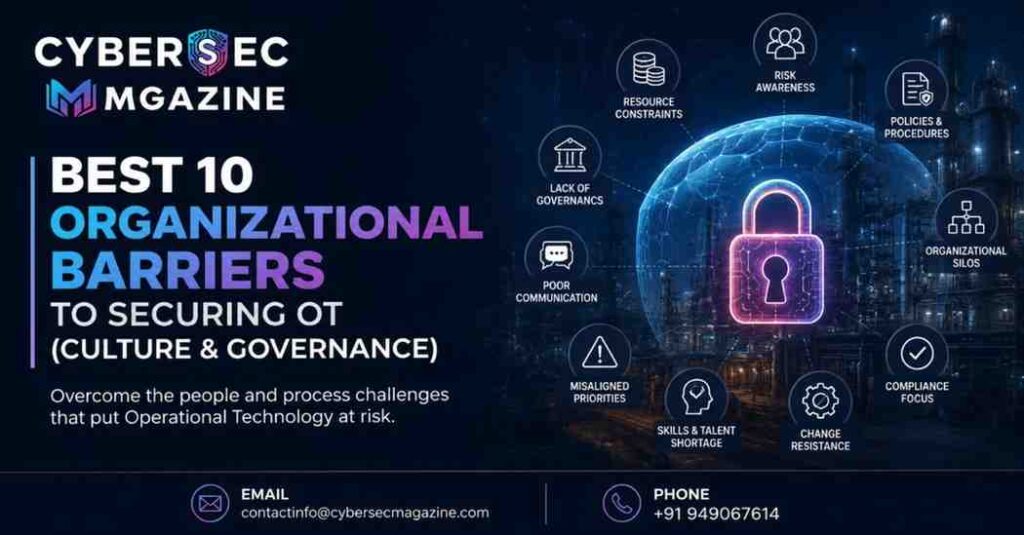
Best 10 Organizational Barriers to Securing OT: Culture & Governance
Why Organizational Factors Matter More Than Ever
Historically, OT environments were designed for reliability, safety, and operational continuity-not cybersecurity.
Many industrial control systems were deployed decades before cyber threats became a strategic concern. As a result, organizations often face a difficult balancing act between:
- Maintaining production uptime
- Protecting worker safety
- Meeting regulatory requirements
- Enabling digital transformation
- Managing cybersecurity risks
Technology alone cannot solve these challenges.
Successful OT cybersecurity programs require executive support, cross-functional collaboration, governance frameworks, and a culture that recognizes cybersecurity as a business risk rather than an IT issue.
1. Lack of Executive Ownership of OT Cybersecurity
One of the most common barriers is the absence of clear executive accountability.
In many organizations, OT cybersecurity falls into a gray area between:
- CIOs
- CISOs
- Plant Managers
- Engineering Leaders
- Operations Directors
When ownership is unclear, security initiatives often stall, budgets become fragmented, and accountability disappears.
Why It Matters
Cybersecurity decisions affecting industrial operations can impact:
- Production output
- Safety systems
- Environmental compliance
- Revenue generation
- Business continuity
Without executive sponsorship, OT security programs rarely receive the resources necessary to succeed.
How to Overcome It
Organizations should establish clear executive ownership and define responsibility for OT cyber risk management at the leadership level.
2. Persistent IT and OT Silos
The divide between IT and OT remains one of the largest obstacles in industrial cybersecurity.
Traditionally:
- IT focuses on confidentiality and data protection.
- OT prioritizes availability and operational continuity.
These differing priorities often create conflict.
For example, an IT team may recommend immediate patching, while OT engineers may fear downtime and production disruptions.
Consequences
- Delayed security projects
- Poor visibility of industrial assets
- Misaligned risk management
- Inconsistent security policies
Best Practice
Organizations should establish joint governance committees that include:
- Security teams
- Operations personnel
- Engineering leaders
- Plant managers
- Executive stakeholders
Collaboration is essential for securing converged environments.
3. Viewing Cybersecurity as an IT Problem
Many industrial organizations continue to treat cybersecurity as solely the responsibility of the IT department.
This mindset creates dangerous blind spots.
Cyber threats targeting OT systems can affect:
- Safety Instrumented Systems (SIS)
- Distributed Control Systems (DCS)
- SCADA environments
- Programmable Logic Controllers (PLCs)
- Industrial IoT devices
These systems directly impact physical operations.
The Reality
A successful ransomware attack against a manufacturing plant can halt production, damage equipment, disrupt supply chains, and create safety risks.
Cybersecurity should therefore be viewed as an enterprise-wide operational risk.
4. Inadequate Security Awareness Within Operations Teams
Many OT operators, engineers, and maintenance personnel have limited cybersecurity training.
Historically, their responsibilities focused on:
- Process efficiency
- Equipment maintenance
- Safety compliance
- Operational performance
Today, these teams are increasingly targeted by sophisticated cyber adversaries.
Common Risks
- Phishing attacks
- Credential theft
- Unauthorized USB usage
- Weak password practices
- Unsafe remote access behavior
Recommended Approach
Organizations should implement role-specific OT cybersecurity awareness programs rather than relying solely on generic corporate security training.
Training should address real industrial attack scenarios and operational impacts.
5. Resistance to Change in Industrial Environments
Operational environments are naturally conservative.
Engineers often follow the principle:
“If it isn’t broken, don’t fix it.”
While this mindset supports operational stability, it can slow cybersecurity improvements.
Examples
- Delayed patching
- Legacy system retention
- Refusal to deploy monitoring tools
- Resistance to network segmentation
This reluctance can leave critical assets exposed to known vulnerabilities for years.
Solution
Security leaders should communicate cybersecurity initiatives in terms of:
- Reliability
- Safety
- Production continuity
- Regulatory compliance
Aligning security goals with operational objectives helps reduce resistance.
6. Weak OT Governance Frameworks
Many organizations lack formal governance structures for OT cybersecurity.
As a result:
- Security policies vary between facilities
- Asset management remains inconsistent
- Risk assessments are irregular
- Security responsibilities are unclear
Signs of Weak Governance
- No OT security strategy
- Lack of asset inventories
- Undefined cybersecurity roles
- Limited board-level reporting
Recommended Frameworks
Organizations should align with recognized standards such as:
- ISA/IEC 62443
- National Institute of Standards and Technology
- National Institute of Standards and Technology
These frameworks provide structured governance models for industrial environments.
7. Shortage of OT Cybersecurity Talent
The industrial sector faces a significant skills shortage.
OT cybersecurity requires expertise across multiple domains:
- Industrial control systems
- Engineering operations
- Networking
- Threat detection
- Incident response
- Regulatory compliance
Professionals with deep knowledge of both OT and cybersecurity remain scarce.
Business Impact
Organizations often struggle with:
- Security monitoring
- Risk assessments
- Architecture reviews
- Incident investigations
Long-Term Solution
Companies should invest in:
- Cross-training programs
- Security certifications
- Internal talent development
- OT-focused cyber academies
Building internal expertise is often more sustainable than relying solely on external consultants.
8. Poor Asset Visibility and Ownership
You cannot secure what you cannot see.
Many industrial organizations still lack accurate inventories of:
- PLCs
- HMIs
- SCADA servers
- Engineering workstations
- Remote access gateways
- Industrial IoT devices
Governance Challenge
Asset ownership is frequently unclear.
Questions such as:
- Who manages firmware updates?
- Who approves changes?
- Who owns cyber risk?
often go unanswered.
Best Practice
Implement continuous asset discovery and establish clear ownership responsibilities for every critical OT asset.
9. Cybersecurity Metrics That Don’t Reflect Operational Risk
Many organizations measure success using traditional IT metrics such as:
- Number of patches applied
- Vulnerabilities closed
- Antivirus coverage
While useful, these metrics may not accurately represent industrial risk.
OT-Focused Metrics Should Include
- Critical asset exposure
- Safety-impacting vulnerabilities
- Unauthorized remote connections
- Mean time to detect industrial threats
- Asset inventory accuracy
- Segmentation effectiveness
Boards and executives need operationally relevant cybersecurity insights.
10. Lack of Incident Response Integration
Many industrial organizations maintain separate incident response processes for IT and OT.
This separation can create confusion during a cyber crisis.
Common Problems
- Delayed decision-making
- Conflicting priorities
- Poor communication
- Unclear escalation procedures
In an industrial incident, every minute matters.
A ransomware attack affecting production systems requires coordinated action between:
- Security teams
- Operations teams
- Engineering personnel
- Executive leadership
- Legal departments
- External responders
Recommended Strategy
Develop integrated cyber incident response plans that include OT-specific scenarios and conduct regular tabletop exercises involving all stakeholders.
Emerging Governance Challenges for 2026 and Beyond
As industrial environments continue to modernize, new governance challenges are emerging.
These include:
AI Adoption in Industrial Operations
Organizations are increasingly deploying AI-driven monitoring, predictive maintenance, and automation tools. Governance models must address AI-related cyber risks and decision accountability.
Expansion of Industrial IoT
Thousands of connected sensors and smart devices are expanding attack surfaces across manufacturing and critical infrastructure environments.
Supply Chain Cybersecurity
Third-party vendors, contractors, and service providers continue to represent significant OT cyber risk.
Regulatory Pressure
Governments worldwide are introducing stricter cybersecurity regulations for critical infrastructure sectors, requiring stronger governance and board-level oversight.
Organizations that fail to address these governance challenges may face increased operational, regulatory, and financial risks.
Building a Security-First OT Culture
Technology can detect threats.
People and governance determine whether those threats are effectively managed.
Organizations that achieve OT cybersecurity maturity typically share several characteristics:
- Strong executive sponsorship
- Cross-functional collaboration
- Clear governance structures
- Continuous workforce education
- Defined accountability
- Regular risk assessments
- Security integrated into operational decision-making
The goal is not merely to deploy security technologies but to create an environment where cybersecurity becomes a natural part of operational excellence.
Final Thoughts
The most dangerous vulnerabilities in OT environments are not always found in software, networks, or industrial devices. Often, they exist within organizational structures, leadership gaps, and cultural barriers that prevent effective cybersecurity practices from taking root.
As industrial organizations accelerate digital transformation and Industry 4.0 initiatives, overcoming these barriers will become increasingly critical.
The companies that successfully secure their OT environments will be those that recognize cybersecurity as a business, operational, and safety imperative-not simply a technical issue.
By addressing these ten organizational barriers, industrial leaders can build stronger governance, improve collaboration, enhance resilience, and better protect critical operations against the rapidly evolving threat landscape.