Best 10 Industrial PKI and Machine Identity Managers
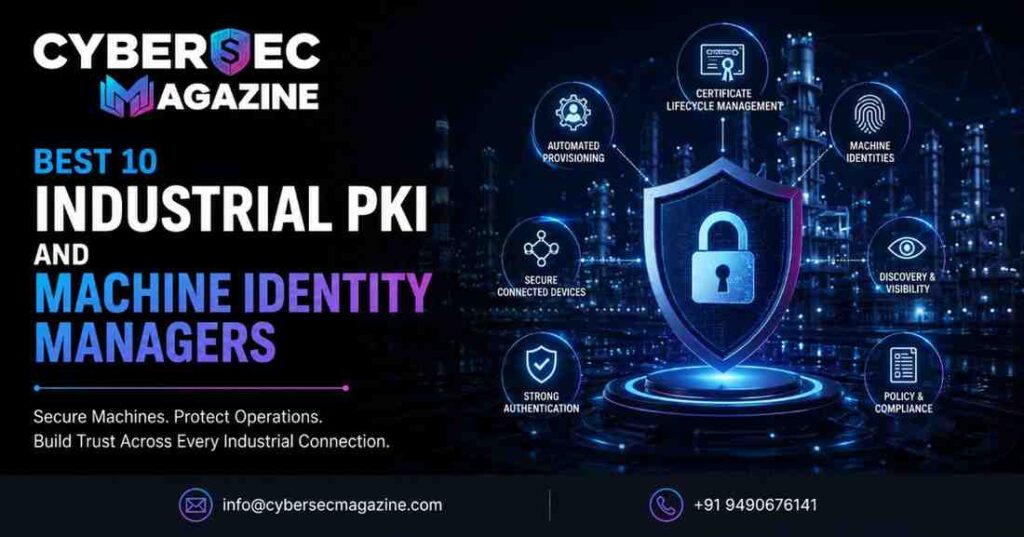
Industrial cybersecurity has changed. In OT, ICS, and IIoT environments, the biggest trust problem is no longer just “who can log in,” but “what can this device prove it is?” That is why PKI and machine identity management have become central to modern industrial security. NIST’s guidance on IoT onboarding says trust should be established before a device is given the credentials it needs to join a network, while its certificate-management glossary treats certificates as assets that must be generated, stored, protected, transferred, loaded, used, and destroyed across their lifecycle. IEEE 802.1AR defines a secure device identifier that is cryptographically bound to a device, and OPC UA relies on X.509 certificates for application security.
For industrial teams, that matters because the environment is rarely clean or uniform. A plant may have brownfield controllers, gateways, third-party maintenance tools, cloud-connected analytics, remote access pathways, and long-lived devices that stay in service for years. A good industrial PKI platform does more than issue certificates; it supports onboarding, renewal, revocation, discovery, auditability, and policy enforcement at scale. NIST’s TLS certificate management work also emphasizes that certificate-related incidents can be prevented, detected, and recovered from with a formal management program, which is exactly the kind of discipline OT and IIoT programs need.
Why industrial PKI matters now
Industrial PKI is no longer just a back-office security function. It is the mechanism that allows devices, workloads, services, and applications to trust each other without relying on static credentials or manual exceptions. Keyfactor’s industrial IoT guidance calls out legacy control systems, brownfield devices, and third-party operators as core complexity drivers, and notes that industrial deployments increasingly need PKI-based support for standards such as OPC UA, RFC 8995, and related device-trust workflows. That shift is why machine identity platforms have become a practical security control rather than a niche certificate tool.
Best 10 Industrial PKI and Machine Identity Managers
1) Keyfactor Command + EJBCA Enterprise
Keyfactor remains one of the strongest choices for industrial PKI because it combines certificate automation, discovery, and lifecycle governance with a PKI engine that is already positioned for IoT, manufacturing, and OT. Keyfactor says EJBCA Enterprise can issue and manage millions of certificates and is built for enterprise IT, multi-cloud, DevOps, IoT security, and manufacturing, while its industrial IoT page highlights support for OT/IIoT scenarios and emerging standards in connected infrastructure. For organizations that want a platform that can scale from factory devices to enterprise workloads, this is a top-tier option.
2) CyberArk Machine Identity Security
CyberArk’s machine identity offering deserves a place near the top because the platform is now positioned around the former Venafi capabilities. CyberArk says it manages and protects machine identities, including secrets, certificates, and workload identities, and its machine-identity pages emphasize certificate lifecycle automation and broad coverage across hybrid environments and the edge. That makes it especially relevant for industrial organizations that want a single identity-security vendor spanning people, machines, and infrastructure.
3) DigiCert Device Trust Manager
DigiCert’s Device Trust Manager is built for end-to-end IoT trust, with a clear lifecycle message: keep devices trusted and compliant from manufacturing through retirement. DigiCert says the platform secures devices across identity, certificates, compliance, and risk, and its industrial IoT pages emphasize flexible deployment models, including cloud, on-prem, and hybrid. For manufacturers and industrial operators that need trust from build-time to field operation, this is a strong fit.
4) AppViewX Certificate Lifecycle Management
AppViewX is a practical choice for teams that need certificate lifecycle management with strong automation and policy control. Its CLM platform explicitly focuses on discovering certificates and machine identities, automating issuance and renewal, managing public and private PKI certificates, enforcing cryptographic policies, and supporting crypto-agility and PQC readiness. That combination is attractive in industrial environments where visibility and renewal automation often matter more than adding yet another CA console.
5) Sectigo IoT Identity Management & Security Platform
Sectigo’s IoT platform is designed to simplify device authentication and certificate management for connected devices. Sectigo describes it as a way to manage certificates, secure devices, and streamline authentication, while also positioning the platform as scalable and easy to manage in multi-vendor ecosystems. That makes it a sensible option for industrial teams that want a straightforward path to certificate-based device identity.
6) GlobalSign IoT Identity Platform
GlobalSign’s IoT Identity Platform is a standards-based PKI platform focused on full device identity lifecycle management. The company says it provisions secure digital certificates, establishes trust between devices and services, and supports lifecycle functions such as enrollment, renewals, ownership transfer, revocation, and decommissioning. For industrial and IIoT programs that need a cloud-friendly but standards-driven identity layer, GlobalSign is a solid contender.
7) Entrust IoT Security
Entrust positions IoT Security as a way to secure IT and OT devices through scalable machine and user identity management. Its product material says it delivers high-assurance certificate-based identities and helps ensure that machines do not go unmanaged, while also linking device security to broader certificate visibility and lifecycle management. That makes Entrust especially relevant for industrial environments that want PKI tied closely to enterprise trust architecture.
8) Thales PKI and Credential Management
Thales is a strong option when PKI must sit inside a larger identity and credential-management program. Thales says its PKI and Credential Management portfolio helps organizations administer, monitor, and manage strong authentication deployments and digital signing, while its broader PKI guidance describes PKI as the set of technology and processes used to secure environments with high assurance. In industrial settings, that broader trust foundation can be valuable when device identity, signing, and hardware-backed key protection must all coexist.
9) AWS Private Certificate Authority
AWS Private CA is not a traditional industrial PKI vendor, but it matters because many modern OT/IIoT architectures now span cloud and edge. AWS says Private CA is a highly available certificate authority for securely issuing and managing private certificates for connected resources, and AWS IoT documentation shows that X.509 certificates are used to authenticate device connections. For industrial teams already building on AWS, this can be a practical PKI foundation for workloads, devices, and provisioning workflows.
10) Microsoft Active Directory Certificate Services
Microsoft AD CS remains foundational in many industrial and enterprise environments because it provides PKI services directly inside Windows Server. Microsoft describes AD CS as a Windows Server role for issuing and managing PKI certificates used in secure communication and authentication protocols, with enrollment web services that help users and computers request certificates over HTTPS. It is not the flashiest industrial platform on this list, but it is still a common building block in Windows-heavy plants and engineering environments.
What to look for before choosing a platform
The best industrial PKI platform is the one that fits your environment, not the one with the longest feature list. In practice, that means checking whether the platform supports discovery, automation, device onboarding, certificate renewal, revocation, audit logs, and integration with your current CA and HSM stack. NIST’s certificate-management guidance and IoT onboarding work both point in the same direction: mature certificate operations are a lifecycle program, not a one-time setup task.
For OT and ICS teams, protocol support is equally important. If your environment uses OPC UA, the platform should fit the certificate model used by OPC UA applications. If you are deploying secure device identifiers, alignment with IEEE 802.1AR-style device identity is useful. If you are onboarding large fleets, automation around issuance and trust establishment is not optional anymore. Those are the building blocks that make industrial PKI operationally usable rather than theoretically secure.
Final thoughts
Industrial PKI has become one of the most important trust layers in OT, ICS, and IIoT security. Devices need identities, identities need lifecycle control, and lifecycle control needs automation. Whether you choose Keyfactor, CyberArk, DigiCert, AppViewX, Sectigo, GlobalSign, Entrust, Thales, AWS, or Microsoft, the real goal is the same: make machine identity reliable enough to support secure industrial operations at scale.