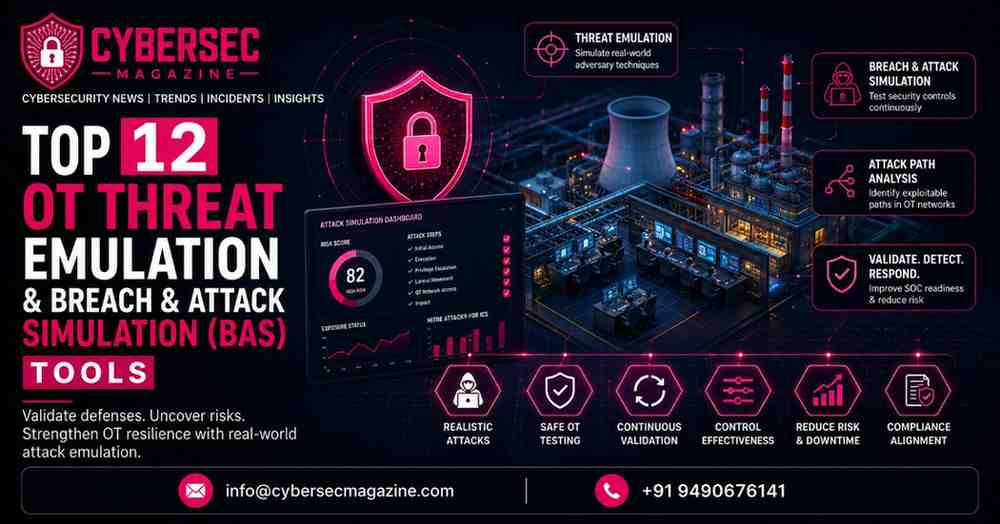
Top 12 OT Threat Emulation & Breach & Attack Simulation (BAS) Tools.
Operational Technology security has moved well beyond perimeter protection. NIST’s latest OT guidance says OT security has to account for performance, reliability, and safety requirements, and its third revision expands the scope from ICS to OT while updating risk management, recommended practices, architectures, and security tools. That shift matters because modern industrial environments are no longer isolated control networks; they are hybrid environments where business IT, remote access, engineering workstations, and production systems are tightly interconnected.
That is why threat emulation and Breach and Attack Simulation matter so much now. BAS platforms safely and continuously emulate adversary techniques to measure how security controls actually behave, while OT-focused validation platforms add safety-aware methods such as digital twins and production-safe attack-path testing. Picus, SCYTHE, and Frenos all position their platforms around continuous validation, safe execution, and evidence-based risk reduction rather than one-time testing.
For industrial teams, the practical goal is simple: prove what is reachable, what is blocked, what is detected, and what can be remediated without disrupting production. The tools below reflect the current market reality: some are pure BAS platforms, some are OT-native validation tools, some are attack-path management platforms, and some are managed BAS services that help teams get more value out of continuous testing.
Why OT validation is different from IT validation
OT environments are not just “another network.” Frenos points out that availability and safety dominate OT, that even benign scanning can disturb legacy devices and sensitive protocol stacks, and that real OT attack paths often start outside the control network and move in through engineering workflows, remote access, and shared trust relationships. That is why OT validation needs a safer, more contextual approach than ordinary IT testing.
BAS and AEV are part of that answer. Rapid7 says BAS continuously tests posture by emulating real-world techniques, while its AEV model validates exploitability across the environment on an ongoing basis. SCYTHE frames its AEV approach as continuous adversarial exposure validation that uses real adversary tradecraft and is designed to be production-safe, including in live OT environments.
Top 12 OT Threat Emulation & BAS Tools
1) SCYTHE OT/ICS Security Validation
SCYTHE is one of the clearest OT-focused platforms in this category. Its OT/ICS page says the platform delivers production-safe adversary emulation for industrial environments, with full kill-chain coverage from IT initial access through the OT convergence boundary. SCYTHE also says its validation aligns with frameworks such as NERC CIP, IEC 62443, and NIST CSF, which makes it especially relevant for critical infrastructure teams that need auditable evidence rather than point-in-time findings.
What makes SCYTHE attractive for industrial teams is the emphasis on repeatability. Instead of waiting for a yearly red-team exercise, teams can continuously emulate adversary behaviors, measure exposure, and see whether detections and response actions are improving over time. For OT organizations that want evidence without touching production systems, that is a strong fit.
2) Frenos OT Attack Path Validation
Frenos takes a different but highly relevant OT approach: attack-path validation using digital twins. The company says OT attack paths are different because safety and availability dominate, and it positions its platform around validating full attack paths without touching production PLCs, HMIs, or engineering infrastructure. Frenos also states that attack path validation tells teams what is reachable and consequential, which is exactly what industrial risk teams need to prioritize remediation.
This is valuable for OT because many “possible” paths on paper are not actually feasible, while some low-profile routes can lead straight to high-impact assets. Frenos’ model is useful when an organization wants safe, repeatable validation in an environment where live scanning or intrusive exploitation simply is not acceptable.
3) SafeBreach Integrated IT/OT BAS
SafeBreach explicitly markets an integrated IT/OT cybersecurity solution. Its current materials say the platform provides visibility into how an integrated IT/OT ecosystem responds at each stage of an attack, and that it can help secure production uptime, identify segmentation weaknesses, and validate firewall and lateral-movement paths between IT and OT. SafeBreach also says its BAS platform includes more than 30,000 attack methods.
For industrial defenders, SafeBreach is compelling because it connects the shop floor to the top floor. The platform is designed to show where spill-over between enterprise and OT networks can occur, which makes it useful for manufacturing, utilities, and other converged environments that need to validate the paths attackers actually use.
4) Picus Breach and Attack Simulation
Picus describes BAS as a technology that safely and continuously emulates real adversary techniques against security controls to measure how they perform. The platform says it helps teams see what EDR, SIEM, NGFW, WAF, email gateways, and other controls block, detect, log, or miss, and it emphasizes that validation can be done safely in production without disrupting users, systems, or business operations.
For OT organizations, that makes Picus a practical choice when the main question is control effectiveness. If your industrial program needs a continuous way to prove whether existing security stack components are actually catching the attack techniques that matter, Picus gives a broad validation layer that can complement OT-specific engineering controls.
5) AttackIQ CTEM Platform
AttackIQ’s current platform message is centered on CTEM: break critical attack paths, validate controls, reduce threat debt, and prove it with evidence. The company also says its platform maps the assets, identities, and threats that shape your environment and validates controls against the techniques adversaries actually use. That continuous, evidence-driven model makes AttackIQ a strong fit for teams that want a persistent validation program rather than periodic checks.
For industrial organizations, AttackIQ is most useful when the goal is to validate the IT side of the boundary and the attack paths that can eventually lead toward OT. It is not positioned as an OT-only product, but in a converged environment its CTEM workflow can help security teams reduce the exposure that commonly becomes the first step into industrial networks. This is an inference based on the platform’s emphasis on attack paths and continuous validation.
6) Cymulate Exposure Validation
Cymulate describes its platform as breach and attack simulation that automates real-world attack scenarios to assess security posture, identify weaknesses in controls, validate defenses against active threats, and run live-data exercises to test security operations response. That makes it a strong fit for organizations that want continuous, repeatable security validation tied to operational response.
For OT-adjacent environments, Cymulate is most useful where the industrial organization wants to stress-test the enterprise controls that protect identity, remote access, email, and the network paths leading to production. It is a solid example of how BAS can support broader exposure management programs that protect critical operations without replacing OT-specific engineering controls.
7) Keysight Threat Simulator
Keysight says its Threat Simulator software provides continuous BAS to validate existing cybersecurity controls by replicating real adversary behaviors across endpoint, network, and cloud layers. The product page also says it helps organizations measure and validate the effectiveness of production security tools safely and cost-effectively, while using historical visualized results to identify environmental drift.
That matters in industrial environments because drift is often where risk grows. Keysight also published a SCADAfence-and-Keysight solution brief specifically for IT-OT convergence, highlighting the threat exposure created when OT networks and business systems are combined. For industrial teams with mixed environments, that makes Threat Simulator a relevant choice for validating the protection layers around critical operations.
8) Horizon3.ai NodeZero
Horizon3.ai says NodeZero lets organizations test networks from an attacker’s perspective using autonomous pentesting, and its manufacturing use case says the platform helps organizations continuously assess themselves, discover critical issues, and validate security improvement over time. The company also emphasizes that NodeZero is not just a scanner; it is designed to show the real risk and impact on the business.
For industrial teams, NodeZero is especially useful in manufacturing and OT-adjacent estates where understanding what an attacker can actually do matters more than a static vulnerability list. It is a strong option when the focus is on proving exploitability and business impact in complex environments with identity, lateral movement, and segmentation concerns.
9) XM Cyber Continuous Exposure Management for OT
XM Cyber’s OT use case is built around attack graph analysis. The company says its platform gives end-to-end visibility into threats targeting critical assets, including OT systems, and visualizes how an attacker could pivot from IT assets into OT to compromise machinery, systems, or other sensitive equipment. XM Cyber also says the approach is non-intrusive, meaning it avoids invasive probes or scans that could impact uptime.
That makes XM Cyber a strong fit when an industrial organization wants to answer the question, “How do attackers get to OT from the enterprise network?” The platform’s emphasis on path prioritization and IT-to-OT visibility aligns with the reality that many industrial incidents start in business systems and only later reach production.
10) Rapid7 BAS and Adversarial Exposure Validation
Rapid7 defines BAS as continuously testing security posture by emulating real-world attack techniques to uncover vulnerabilities and improve response. Its AEV material goes a step further, saying AEV validates exposure exploitability across the environment on an ongoing basis and connects findings to outcomes, helping teams understand not just what exists, but what matters most right now.
For industrial organizations, Rapid7 is useful when the priority is to connect simulation results to remediation decisions across the enterprise layers that support OT. It is not OT-exclusive, but its continuous validation model can be valuable for the systems and identities that form the attack paths leading into industrial environments.
11) CyberProof BAS and Continuous Automated Red Teaming
CyberProof explains BAS as an automated way to simulate real-world cyberattacks, while its broader security-validation article says BAS is one component of a larger validation strategy that also includes red teaming, vulnerability scanning, configuration assessment, and compliance testing. The company also describes Continuous Automated Red Teaming, or CART, as an always-on method for simulating attacks and continuously probing infrastructure, applications, and networks for vulnerabilities.
For industrial teams, CyberProof is relevant as a service-led option when the organization wants both tool-driven validation and operational support. Its framing is particularly useful for teams that need to combine continuous attack simulation with SOC workflows, managed operations, and response improvement.
12) GuidePoint Security Breach & Attack Simulation as a Service
GuidePoint Security offers BAS as a service with experienced threat emulation operators, and says its team helps customers optimize their BAS program, customize simulation strategies to unique technology and threat intelligence, and support the full attack-analyze-remediate lifecycle. The company also says this approach helps organizations get the most value out of their BAS investments and improve ROI.
This is a good fit for industrial organizations that want BAS outcomes but do not have enough in-house operators to manage the platform day to day. In OT-heavy environments, where testing has to be carefully designed and aligned to operational windows, a managed model can be the difference between a pilot that stalls and a program that actually scales.
How to choose the right tool
The best tool depends on what you are trying to prove. If you need OT-safe, production-conscious validation, Frenos and SCYTHE are strong fits because they emphasize digital twins, safe execution, and OT/ICS alignment. If you need to validate the broader security stack around industrial operations, SafeBreach, Picus, Cymulate, Keysight, AttackIQ, and Rapid7 are strong continuous-validation options. If your main challenge is attack paths between IT and OT, XM Cyber is especially relevant.
NIST’s OT guidance is a useful lens for selection: choose capabilities that fit the environment’s operational reality, and tailor recommendations to security, business, and operational requirements. That is why the strongest OT validation programs are not built around one product alone. They combine safe emulation, continuous control validation, attack-path analysis, and operationally aware remediation.
Final thoughts
BAS and threat emulation are no longer niche ideas for red teams. In OT, they are becoming part of the normal operating model for validating defense, exposing weak paths, and proving what actually works. The reason is simple: industrial systems are too critical to protect with assumptions. NIST explicitly frames OT security around performance, reliability, and safety, while the leading BAS and AEV vendors now emphasize continuous validation, production-safe testing, and evidence-based outcomes.