
Top 10 OT Security Mistakes in Building Management Systems (BMS)
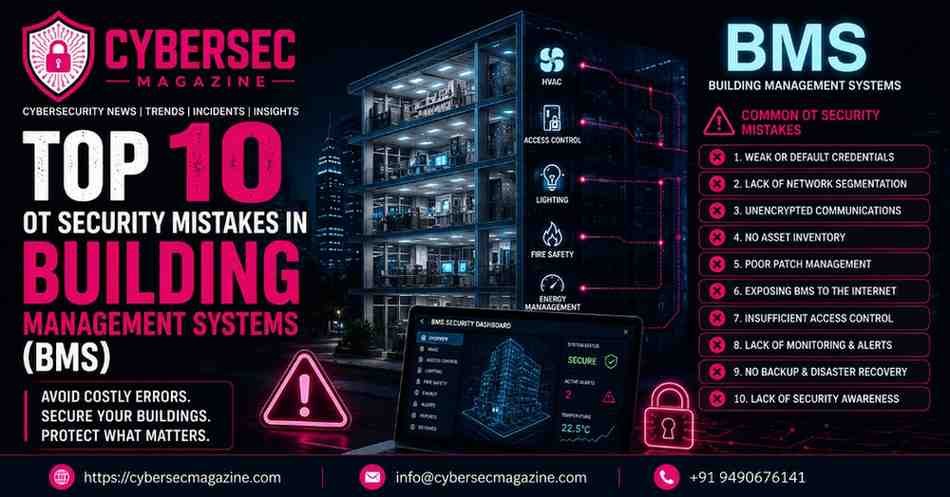
Explore the top 10 OT security mistakes in Building Management Systems (BMS). Learn how to secure smart infrastructure and prevent cyber threats.
The Evolution of Smart Infrastructure: Background and Security Landscape
Building Management Systems (BMS) and Building Automation Systems (BAS) have transitioned from localized, pneumatic, and hardwired mechanical controls into highly sophisticated, IP-connected operational technology networks. Modern commercial real estate, data centers, hospitals, and smart corporate campuses rely heavily on centralized BMS platforms to optimize energy efficiency, manage complex HVAC architectures, control automated lighting, and secure physical access points. However, this aggressive digital convergence has blurred the traditional boundaries between enterprise IT networks and operational environments. Facilities that were once safely isolated via air-gapped physical designs are now tightly integrated with cloud platforms, enterprise dashboards, and remote vendor management systems, dramatically expanding the attack surface for opportunistic hackers and advanced threat actors alike.
When malicious actors target building automation infrastructure, the repercussions extend far beyond standard data theft or minor operational inconveniences. Because a BMS interfaces directly with physical facility hardware, compromising local controllers or supervisory software can allow attackers to manipulate environmental controls, freeze critical server rooms, or disrupt physical safety systems. Historical breaches, such as the infamous third-party supply chain vectors that leveraged HVAC maintenance credentials to compromise massive retail networks, demonstrate that a weak building automation layer acts as a direct open door into corporate enterprise architectures. Traditional IT security strategies often fail when deployed in smart buildings because standard active vulnerability scans or uncoordinated software patches can easily destabilize legacy industrial controllers, leading to unexpected equipment downtime and physical system failures.
Top 10 OT Security Mistakes in Building Management Systems
1. Failing to Implement Proper IT/OT Network Segmentation
One of the most catastrophic structural errors found in modern smart building deployments is maintaining a flat network architecture where enterprise IT systems and operational BMS networks share unrestricted communication pathways. When corporate office networks, visitor Wi-Fi channels, and guest portals are allowed to talk directly to local programmable logic controllers and HVAC supervisory servers, an initial phishing compromise on the business side provides immediate lateral movement into core facility operations. Organizations frequently skip the deployment of industrial-grade firewalls and unidirectional security gateways, assuming that internal corporate firewalls provide sufficient protection against accidental or malicious intrusions. Establishing rigorous network boundaries based on the Purdue Reference Model ensures that building control loops are cleanly separated from enterprise environments. By isolating operational zones and restricting cross-layer traffic to explicit, authenticated flows, facility operators can effectively contain potential breaches and prevent threat actors from cascading across the entire facility infrastructure.
2. Utilizing Default Credentials and Insecure Passwords
The continued reliance on factory-default usernames and hardcoded administrative passwords across building management controllers, operator workstations, and field sensors represents an avoidable security crisis. System integrators frequently leave default credentials intact during initial setup to simplify rapid commissioning and routine maintenance routines, but these credentials are publicly documented and easily exploited by automated attack scripts scanning the internet. Threat actors routinely leverage default login credentials to gain administrative access to core environmental control servers without encountering any resistance. Remediation requires enforcing strict password policies, integrating enterprise identity management solutions, and deploying centralized password vaults that mandate complex, unique authentication strings for every single hardware asset and human operator account interacting with the building network.
3. Exposing BMS Web Interfaces and Remote Access Ports Directly to the Public Internet
The growing demand for convenient remote monitoring has led many property managers to expose building management web interfaces, supervisory control and data acquisition (SCADA) portals, and engineering software directly to the public internet without adequate edge protection. Exposing management ports-such as unencrypted HTTP services or remote desktop protocols-allows automated internet scanners to discover vulnerable building automation nodes within seconds. Attackers can directly access these exposed interfaces to manipulate building parameters, disable security alarms, or deploy ransomware payloads that halt operations across entire multi-tenant commercial complexes. All remote engineering access must be funneled exclusively through secure, encrypted Virtual Private Networks (VPNs) or zero-trust network access (ZTNA) gateways equipped with multi-factor authentication, ensuring that management assets are completely hidden from public visibility.
4. Overlooking Legacy Protocol Vulnerabilities and Lack of Encryption
Most legacy building automation communication protocols-including BACnet, Modbus, and KNX-were engineered decades ago with a strict focus on low latency, long-distance reliability, and interoperability, completely devoid of basic cybersecurity considerations. These foundational protocols transmit operational commands, temperature setpoints, and sensor logs entirely in plaintext, allowing local or remote attackers to easily intercept telemetry data or inject spoofed control commands. Because these protocols assume that all devices residing on the network wire are inherently trustworthy, they lack cryptographic message authentication, making them highly susceptible to replay attacks and data hijacking. Securing legacy architectures requires overlaying modern cryptographic validation tools, deploying secure tunneling mechanisms, and implementing protocol-aware intrusion detection systems that can identify anomalous command injections within older communication streams.
5. Neglecting Comprehensive Asset Discovery and Inventory Baselines
It is impossible to secure building automation assets that an organization does not officially know exist within its operational environment, yet many facility teams lack an accurate inventory of their connected hardware. Modern buildings continuously experience additions, modifications, and hardware replacements during routine tenant build-outs or seasonal maintenance cycles, often resulting in rogue IoT sensors, unauthorized network bridges, and unmanaged controllers hiding in drop ceilings or electrical closets. Without passive asset discovery tools running continuously in the background, security teams face severe blind spots regarding vulnerable firmware versions or unexpected endpoint additions. Maintaining a dynamic, real-time asset inventory allows operators to track hardware lifecycles, map communication dependencies, and rapidly correlate discovered equipment against emerging vulnerability databases and manufacturer security advisories.
6. Ignoring Regular Firmware Updates and Vulnerability Patching Cycles
Building management systems are notorious for running outdated operating systems, unpatched third-party software libraries, and legacy firmware versions that contain hundreds of publicly known security vulnerabilities. Facility managers frequently avoid updating building controllers out of fear that a reboot or a failed patch could crash sensitive mechanical systems, resulting in costly physical downtime and tenant complaints. However, leaving high-severity vulnerabilities unpatched provides threat actors with an easy pathway to establish persistent access and execute arbitrary code on critical automation servers. Organizations must adopt a risk-based vulnerability management program tailored for operational technology, utilizing virtual patching, rigorous staging environment testing, and scheduled maintenance windows to apply necessary security updates safely without disrupting physical building operations.
7. Granting Excessive Privileges and Ignoring Least Privilege Principles
Assigning broad, administrator-level privileges to everyday building operators, temporary maintenance contractors, and third-party vendor service accounts creates an unnecessary concentration of systemic risk. When every operational user possesses full read-write access to every control loop, lighting schedule, and security gateway, a single compromised user credential yields total control over the physical facility. Organizations must implement strict Role-Based Access Control (RBAC) frameworks that enforce the principle of least privilege, ensuring operators can only view or modify the specific zones and devices necessary for their designated responsibilities. Furthermore, vendor access must be managed on a strict, on-demand basis where external maintenance tunnels are automatically closed and revoked immediately upon the completion of authorized service tasks.
8. Failing to Monitor Network Traffic and Lack of Anomaly Detection
Many commercial facilities treat network security as a perimeter defense problem, installing a firewall at the corporate edge and falsely assuming that internal building traffic is completely safe from malicious interference. Because internal building automation networks rarely feature real-time traffic monitoring, security teams remain entirely blind to lateral movement, internal reconnaissance, or unauthorized device communications occurring within the facility floor. Deploying specialized industrial intrusion detection systems (IDS) enables security operations centers to establish behavioral baselines of normal operational traffic and instantly flag abnormal events, such as an HVAC controller suddenly communicating with an external IP address or querying unusual memory registers. Continuous traffic analysis provides the vital early-warning capability needed to intercept multi-stage cyber attacks before they result in physical disruption.
9. Inadequate Physical Security Safeguards for Distributed Field Panels
input/output modules, and smart sensors installed across remote mechanical rooms, electrical closets, rooftop units, and public utility corridors. If these physical control cabinets are left unlocked or unmonitored, an attacker or disgruntled insider can easily gain direct physical access to internal wiring, serial communication ports, and local diagnostic interfaces.Building management automation relies heavily on distributed field panels, Physical manipulation allows threat actors to attach rogue hardware implants, extract cryptographic keys, or directly short-circuit physical control loops to cause catastrophic equipment failures. Implementing strict physical security controls-including tamper-evident enclosure seals, continuous closed-circuit television (CCTV) coverage, and strict keycard access logs for all technical spaces-is a mandatory baseline requirement for robust industrial cyber defense.
10. Absence of Tailored Incident Response and Disaster Recovery Plans
When a sophisticated cyber incident compromises a building management system-manifesting as manipulated environmental controls, locked access doors, or ransomware-encrypted supervisory servers-relying on standard enterprise IT incident response playbooks often proves disastrous. Standard IT recovery procedures frequently dictate isolating networks or shutting down core servers blindly, which can inadvertently disable critical life-safety systems, smoke evacuation protocols, or temperature-sensitive environmental controls in mission-critical facilities. Property managers and engineering teams must collaborate to develop dedicated, OT-aware incident response playbooks that incorporate safe manual override procedures, clear escalation paths, and verified offline backup restoration processes. Maintaining immutable, air-gapped backups of all BMS configurations, HMI project files, and controller logic ensures that facilities can recover rapidly from destructive cyber disruptions without sacrificing human safety or physical infrastructure integrity.