Top 12 OT Security Lessons from Manufacturing Ransomware Incidents
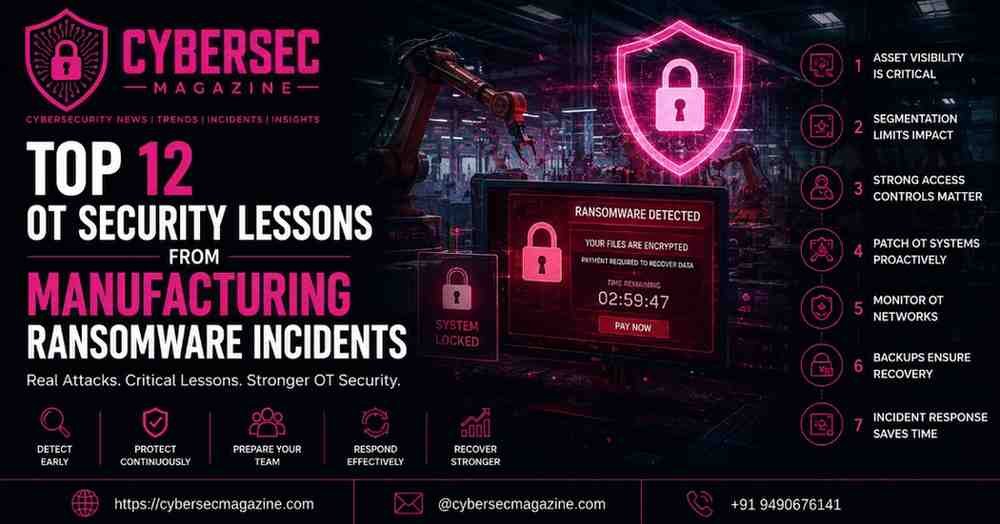
Explore top 12 OT security lessons from manufacturing ransomware. Discover how industrial plants defend against modern ICS cyber threats.
Introduction to Industrial Ransomware and Manufacturing OT Security
For decades, operational technology (OT) and industrial control systems (ICS) operated behind heavily secured, air-gapped perimeters where physical isolation served as the primary defense against external cyber threats. Manufacturing plants relied on proprietary serial protocols, fixed control loops, and specialized hardware to maintain continuous production lines without accounting for digital connectivity risks. However, the aggressive digital transformation of Industry 4.0, smart factories, and IIoT deployment has completely dissolved these traditional boundaries. Enterprise business networks now interface directly with shop-floor machinery, bridging IT and OT domains to maximize operational efficiency and real-time data visibility.
Unfortunately, this hyper-connected industrial architecture has transformed manufacturing organizations into primary targets for sophisticated ransomware syndicates. Modern ransomware no longer targets only corporate IT email servers or financial databases; advanced threat groups deliberately weaponize vulnerabilities to cross the IT-OT boundary, encrypting human-machine interfaces (HMIs) and paralyzing programmable logic controllers (PLCs). Because manufacturing facilities measure downtime in thousands of dollars per minute, attackers know that production halts exert immense pressure to pay extortion demands. Extracting critical lessons from past manufacturing ransomware incidents is now an essential roadmap for building resilient, cyber-physical defense strategies.
Top 12 OT Security Lessons from Manufacturing Ransomware Incidents
1. Bridging the IT-OT Cultural and Operational Divide
Many manufacturing ransomware attacks successfully infiltrate the operational floor because of a deep organizational disconnect between corporate IT security teams and plant-floor OT engineers. Historically, IT departments prioritize data confidentiality and rapid patching cycles, whereas OT personnel prioritize physical safety, plant availability, and zero unscheduled downtime above all else. When these two teams operate in silos, security visibility gaps emerge, allowing threat actors who breach the corporate IT environment to pivot unchecked into the physical control network. Closing this collaboration gap requires joint governance frameworks where IT security expertise and OT operational authority work cohesively to protect industrial assets.
Achieving this integration demands cross-financial and cross-functional training programs that educate IT professionals on the strict safety constraints of industrial hardware and train OT staff to recognize foundational cyber threats. Organizations must establish unified incident response teams that include both IT security analysts and plant engineers who understand how specific control loops behave under stress. By fostering mutual respect and shared responsibility, manufacturing facilities can eliminate the visibility blind spots that ransomware operators routinely exploit to bridge the corporate-to-plant divide. Regular joint tabletop exercises ensure that both departments coordinate effectively during an active crisis without compromising human safety.
2. Implementing Rigorous Network Segmentation and Zones
A recurring architectural flaw exposed by manufacturing ransomware incidents is the reliance on flat corporate-to-plant network designs that allow malware to spread horizontally across every connected subsystem. When an initial phishing email compromises a corporate IT workstation, a flat architecture grants the ransomware unrestricted access to sweep through enterprise systems, traverse the IT-OT boundary, and encrypt critical SCADA servers and PLC configurations. Implementing strict network segmentation based on the Purdue Reference Model and IEC 62443 standards creates internal firewall barriers that successfully contain malware outbreaks within isolated operational zones.
Effective segmentation requires deploying industrial-grade stateful firewalls, data diodes, and dedicated DMZs to inspect and filter all traffic moving between enterprise business tiers and physical control layers. Organizations must audit their network topologies regularly to identify and eliminate unauthorized pathways, guest network bridges, or direct internet connections leading into the shop floor. By enforcing micro-segmentation around critical manufacturing cells, security teams ensure that even if an outer perimeter defense is breached, lateral movement is abruptly halted, protecting core production lines from total encryption.
3. Maintaining Comprehensive and Immutable OT Asset Inventories
Security teams cannot protect industrial assets they do not know exist, yet many manufacturing facilities struggle to maintain accurate, up-to-date inventories of their hardware, firmware, and software components. Ransomware threat groups frequently leverage automated discovery scripts once inside a network to map out unmanaged legacy controllers, forgotten maintenance laptops, and unpatched HMI panels. Without a comprehensive asset inventory, plant operators cannot assess their true risk exposure or prioritize vulnerability patching where it matters most, leaving gaping blind spots for attackers to exploit during an infiltration.
Addressing this vulnerability requires deploying automated, OT-aware asset discovery platforms that passively query industrial networks without sending intrusive scanning packets that could disrupt sensitive control loops. These discovery tools must catalog every device attribute, including manufacturer details, firmware versions, active communication protocols, and network dependencies. Maintaining a dynamic, centralized asset repository enables security personnel to track hardware lifecycles, identify unauthorized device connections instantly, and orchestrate targeted vulnerability management programs across the entire manufacturing enterprise.
4. Prioritizing Risk-Based Vulnerability and Patch Management
Managing software vulnerabilities in a manufacturing environment is inherently complex because traditional IT patch management practices-such as immediate, automated reboots-can crash legacy industrial controllers and trigger catastrophic safety hazards. Ransomware gangs actively scan for known vulnerabilities in unpatched Windows-based engineering workstations, HMI panels, and network switches to gain initial execution footholds. Manufacturing organizations must adopt a risk-based vulnerability management strategy that evaluates patches through the lens of operational impact, balancing cyber defense requirements with the strict availability needs of industrial processes.
When direct patching of legacy OT firmware is impossible due to hardware limitations or vendor constraints, facilities must implement robust compensating controls such as network micro-segmentation, application allowlisting, and strict perimeter filtering. Security teams should prioritize patching efforts on internet-facing assets, jump hosts, and critical supervisory servers where compromise poses the highest systemic risk. Establishing structured vulnerability disclosure workflows ensures that newly discovered flaws in industrial protocols or operating systems are evaluated and mitigated before ransomware operators can weaponize them.
5. Enforcing Zero Trust and Strict Remote Access Controls
Third-party vendors, remote maintenance technicians, and external contractors require frequent access to manufacturing floors to service complex machinery, creating significant vector exposure for supply chain ransomware attacks. Many high-profile manufacturing breaches originated when attackers compromised a third-party vendor’s unsecured credentials and used that trusted remote access path to move laterally into core ICS environments. Implementing a Zero Trust architecture means that no user, device, or remote connection is trusted by default, regardless of whether it originates inside or outside the corporate perimeter.
Manufacturing organizations must mandate multi-factor authentication (MFA) for every remote administrative session, enforce least-privilege access principles, and route all vendor connections through secure, monitored jump hosts. Temporary remote access sessions should be time-bound, cryptographically verified, and subjected to real-time session recording and behavioral auditing. By eliminating standing privileges and ensuring that every remote interaction is authenticated and inspected, plants can effectively shut down unauthorized credential reuse and vendor-driven ransomware vectors.
6. Deploying Protocol-Aware Behavioral Anomaly Detection
Traditional signature-based antivirus and IT endpoint detection tools frequently fail in manufacturing environments because they cannot interpret specialized industrial communication protocols like Modbus, PROFINET, and DNP3. Ransomware operators often disguise their malicious lateral movement and command-and-control traffic by blending it seamlessly with legitimate industrial communication patterns, evading standard detection mechanisms. To catch advanced threats before encryption occurs, plants must deploy OT-specific network detection and response (NDR) solutions capable of deep packet inspection (DPI) tailored for industrial automation.
Protocol-aware monitoring tools establish a comprehensive baseline of normal operational behavior, mapping standard controller read/write cycles, register access patterns, and expected device interactions. When an anomaly occurs-such as an unauthorized configuration change on a PLC, an unexpected firmware upload, or an irregular command sequence-the security platform immediately generates high-priority alerts for human triage. Combining automated behavioral analysis with expert human oversight ensures that subtle ransomware staging activities are intercepted long before files are locked.
7. Establishing Resilient, Offline Backup and Recovery Protocols
The ultimate leverage that ransomware operators hold over manufacturing enterprises is the threat of permanent data loss and extended production downtime, forcing executives to consider paying exorbitant extortion fees. However, numerous incident post-mortems reveal that organizations with robust, regularly tested, and immutable offline backups recover significantly faster without succumbing to criminal financial demands. In an industrial context, backups must encompass more than just enterprise databases; they must include complete PLC ladder logic, HMI project files, SCADA configurations, and system recovery images.
Manufacturing facilities must enforce strict backup schedules utilizing the 3-2-1 rule, ensuring that multiple copies of critical industrial data are stored on air-gapped, immutable media that cannot be encrypted or deleted by network-connected ransomware. Crucially, having backups is insufficient without conducting regular, scheduled disaster recovery drills to verify that system images can be restored cleanly within acceptable operational recovery time objectives (RTO). Testing the restoration of PLC logic and controller configurations ensures that plant operations can resume safely following a severe cyber incident.
8. Designing Incident Response Plans Tailored for OT Environments
When a ransomware attack strikes a manufacturing plant, executing standard IT incident response playbooks-such as immediately disconnecting all network segments or power-cycling servers-can cause catastrophic physical damage, equipment failure, or severe safety hazards. OT incident response requires an entirely different operational mindset where human safety and physical process stability take precedence over data containment. A compromised control loop or an abrupt emergency shutdown can wreck physical machinery or injure workers, making traditional IT isolation techniques dangerously counterproductive in industrial settings.
Industrial incident response plans must be specifically designed for manufacturing workflows, defining clear authority lines between security analysts and plant operations managers regarding who possesses the final sign-off to halt production. Incident playbooks should outline safe fallback states, manual override procedures, and step-by-step containment actions that isolate infected nodes without destabilizing physical processes. Conducting realistic ransomware tabletop exercises that simulate cyber-physical failure scenarios prepares cross-functional teams to respond decisively under immense crisis pressure.
9. Hardening HMI Workstations and Engineering Laptops
Human-Machine Interfaces (HMIs) and portable engineering workstations represent the primary cognitive bridge between human operators and physical industrial processes, making them prime targets for ransomware infiltration. These critical endpoints frequently run standard operating systems like Windows, yet they are often neglected in routine patching cycles or loaded with unverified USB drives and unauthorized third-party software. Ransomware syndicates frequently exploit vulnerabilities in HMI software or infect engineering laptops during maintenance cycles to compromise the master control engineering environment.
Hardening HMI and engineering workstations requires implementing strict application allowlisting solutions to ensure that only cryptographically verified, approved engineering software can execute on the system. Administrators must disable all unused ports, disable unnecessary operating system services, enforce strong unique passwords, and block unauthorized USB mass storage devices. Furthermore, engineering laptops should be maintained in highly restricted, isolated management domains and subjected to rigorous security scanning before being connected directly to sensitive plant-floor PLC networks.
10. Managing Third-Party Supply Chain and Integrator Risks
Modern manufacturing ecosystems rely heavily on complex global supply chains, external system integrators, and equipment vendors who frequently require direct digital access to plant systems for remote diagnostics and maintenance. Unfortunately, ransomware threat groups increasingly target these third-party software vendors and service providers as a force multiplier, using compromised supply chain channels to slip malicious payloads past corporate perimeter defenses. A single compromised vendor management account can provide attackers with unhindered backdoor access into dozens of different manufacturing plant networks simultaneously.
Mitigating supply chain risk requires establishing rigorous cybersecurity procurement standards, contractual compliance mandates, and continuous third-party risk assessments for every vendor interacting with the industrial environment. Manufacturing organizations must enforce strict access governance, requiring all external partners to utilize secure jump hosts, multi-factor authentication, and temporary, monitored credentials while working on plant systems. Regular security audits and transparent incident notification clauses ensure that supply chain vulnerabilities are identified and remediated before they impact production operations.
11. Cultivating Cybersecurity Culture and Workforce Training
Human error remains one of the most reliable entry vectors for ransomware operators, with phishing emails, social engineering, and careless credential sharing continuing to compromise corporate perimeters. While advanced technical controls are essential, manufacturing workforces-from corporate office personnel to shop-floor machine operators-must act as an informed human firewall against cyber threats. Unfortunately, generic IT security awareness training often fails to resonate with industrial workers who deal with physical machinery and operational pressures daily.
Organizations must invest in tailored, role-specific cybersecurity awareness programs that address the unique realities of manufacturing environments, teaching plant staff how to recognize industrial-targeted phishing and social engineering. Training modules should emphasize the physical consequences of cyber breaches, encourage a blame-free reporting culture for suspicious system anomalies, and clarify standard protocol for handling unexpected digital alerts. Empowering every employee to prioritize security vigilance significantly reduces the likelihood of successful initial ransomware access.
12. Aligning OT Defenses with Global Standards and Regulations
As cyber threats targeting critical manufacturing infrastructure continue to escalate globally, government regulators and industry bodies are introducing strict mandates, reporting frameworks, and compliance guidelines. Navigating this complex regulatory landscape can be challenging, but aligning industrial security programs with recognized standards-such as IEC 62443, NIST SP 800-82, and CISA industrial control system recommendations-provides a proven, structured framework for building mature cyber resilience.
Adopting these global standards helps manufacturing leadership secure necessary capital investment, streamline cross-functional risk governance, and demonstrate proactive due diligence to insurers and regulatory authorities. Compliance frameworks provide a systematic approach to identifying security gaps, prioritizing capital allocation, and ensuring that defensive investments cover all critical areas from physical edge sensors to enterprise cloud servers. By benchmarking security postures against established international standards, manufacturing plants can future-proof their operations against evolving ransomware tactics.
Conclusion
Manufacturing ransomware incidents have fundamentally transformed how industrial organizations view operational technology security, proving that digital threats carry direct physical and financial consequences. As cyber syndicates increasingly target smart factories and supply chains, relying on traditional air-gaps or outdated IT security tools is no longer sufficient to protect critical infrastructure. Mitigating these sophisticated risks requires a holistic defense strategy built upon IT-OT collaboration, rigorous network segmentation, immutable offline backups, and protocol-aware anomaly detection. By embracing these essential lessons and prioritizing cyber resilience, manufacturing enterprises can successfully defend their production lines, safeguard worker safety, and maintain uninterrupted operational integrity in an increasingly hostile threat landscape.