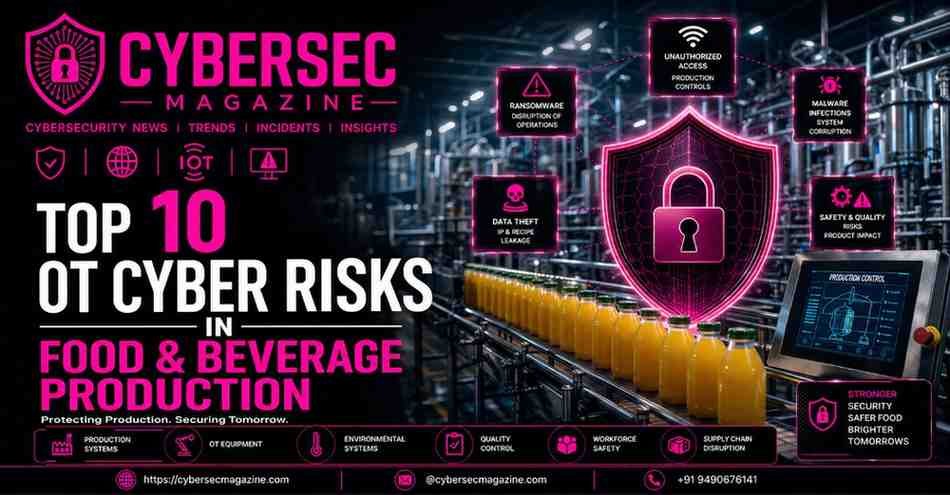
Top 10 OT Cyber Risks in Food & Beverage Production
The Evolution of the Digital Kitchen: Background
The food and beverage industry has undergone a radical transformation. What were once siloed, mechanical production lines are now hyper-connected ecosystems where data flows seamlessly from temperature sensors to enterprise resource planning (ERP) systems. While this convergence of IT and Operational Technology (OT) has unlocked massive gains in efficiency and traceability, it has also dismantled the “air-gap” that historically protected industrial control systems. Today, attackers view food and beverage facilities not just as targets for data theft, but as high-leverage points in the global supply chain. Because downtime in this sector can lead to product spoilage, regulatory breaches, and public safety concerns, manufacturers find themselves in a precarious position where digital vulnerabilities translate directly into physical risks.
Top 10 OT Cyber Risks in Food & Beverage Production
1. Proliferation of Unsecured IIoT Devices
Modern food plants are flooded with IIoT sensors for tracking temperature, sanitation cycles, and ingredient batches. Many of these devices are designed for cost-efficiency rather than security, often shipping with no authentication, no encryption, and no mechanism for firmware updates. Attackers exploit these “weak links” to gain a foothold in the network, creating network paths that security teams may not even know exist. Without visibility, these sensors become the primary entry point for lateral movement.
2. Convergence-Driven Lateral Movement
The bridge between corporate IT networks and the plant floor is the most dangerous zone in a modern food facility. Attackers often compromise IT systems via phishing or credential theft and then pivot directly into the OT environment. Because many legacy control systems lack granular access controls, once an attacker reaches the production network, they can often move freely between batching systems, packaging lines, and quality platforms.
3. Exploitation of Legacy OT Systems
Many food and beverage facilities rely on aging infrastructure-such as HMIs running on outdated operating systems or PLCs that haven’t seen a firmware update in over a decade. These systems are often impossible to patch due to the risk of production downtime or lack of vendor support. Attackers actively scan for these vulnerable, legacy assets to deploy well-known exploits that the plant is effectively defenseless against.
4. Third-Party and Vendor Access Risks
Food manufacturers rely heavily on external contractors for maintenance, support, and remote monitoring. Often, these vendors are granted permanent, unmonitored VPN access to the OT network, which becomes a “backdoor” if the vendor’s own security is compromised. A single stolen credential from a third-party service provider can provide an adversary with direct, privileged access to critical control systems without ever triggering an alarm.
5. Manipulation of Production and Quality Data
Cyber threats in food production are not always about “noisy” ransomware that shuts down a plant; sometimes they are silent. Adversaries can manipulate data within traceability platforms or quality logs, causing false readings in pH regulators or metal detectors. By subtly altering this data, attackers can potentially introduce unsafe products into the supply chain, triggering massive recalls and severe regulatory or legal consequences.
6. Disgruntled Insider Threats
The risk of an internal threat is often ignored but remains statistically significant. An employee or contractor with legitimate access to an HMI or SCADA system possesses the “keys to the kingdom.” If disgruntled or coerced, they can manually alter process recipes, disable safety alarms, or introduce malicious logic into controllers. Because their actions appear “normal” within the system, detecting this type of sabotage is incredibly difficult.
7. Ransomware Targeting Operational Uptime
Ransomware gangs have shifted their strategy from simple data encryption to the disruption of industrial availability. By targeting systems essential for packaging or batching, they force manufacturers into an “all-or-nothing” decision: pay the ransom or face days of production standstill. In a sector where supply chain deadlines are rigid and product shelf-life is short, the immense pressure to restore operations often makes manufacturers a preferred target for extortion.
8. AI-Enhanced Reconnaissance
Threat actors are no longer using manual tools to probe OT networks; they are leveraging AI and Large Language Models (LLMs) to automate reconnaissance. These tools can map out Modbus traffic patterns, identify PLC vulnerabilities, and craft highly sophisticated phishing lures tailored to plant engineers. AI effectively allows attackers to “learn” a specific plant’s architecture and operational quirks at an unprecedented speed.
9. Safety Instrumented System (SIS) Compromise
The SIS is the last line of defense in a food plant, designed to prevent hazardous conditions like overheating or pressure buildup. If an attacker gains enough privilege to interact with or disable the SIS, they move beyond disrupting production and into the realm of endangering human lives. Compromising these safety-critical systems is a common goal for sophisticated nation-state actors looking to cause long-term, permanent damage.
10. Lack of OT-Specific Incident Response
Most food and beverage manufacturers have robust IT incident response plans, but very few have playbooks designed for OT. When an attack hits the plant floor, IT teams often lack the domain knowledge to respond without accidentally causing more disruption. Without an OT-specific plan that prioritizes safety and process continuity, the reaction to a cyber incident can sometimes be just as damaging as the attack itself.
Conclusion: Building Resilience Through Visibility
Securing a food and beverage facility requires shifting from a reactive “IT-only” mindset to a proactive, OT-aware strategy. The risks outlined above are not inevitable, but they require a layered defense: starting with complete asset visibility, implementing strict micro-segmentation, and enforcing just-in-time access for all vendors. Just as food safety is a culture maintained through rigorous hygiene and audit schedules, cyber safety must be woven into the fabric of your production operations. By prioritizing visibility and resilience today, you protect not only your bottom line and brand reputation but the very integrity of the supply chain you serve.