
Best 12 Use Cases MSPs Can Sell to OT Customers (MRR Ideas)
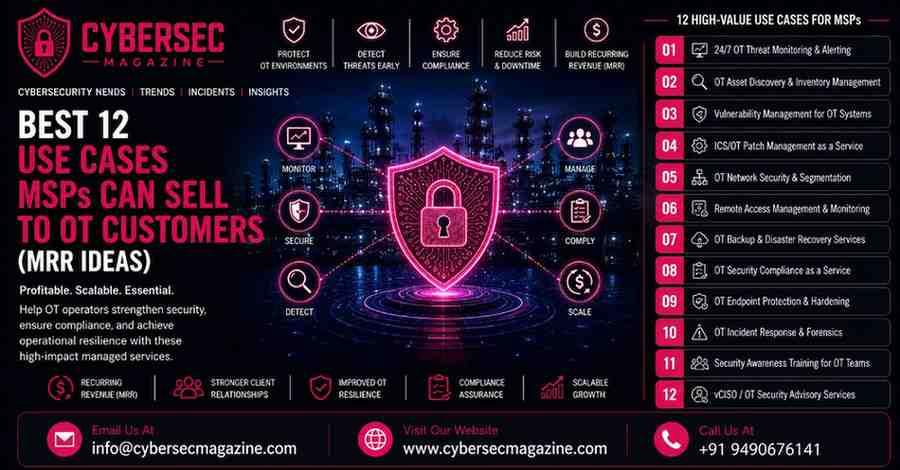
Unlock new recurring revenue with these 12 high-impact OT security use cases for MSPs in 2026. Drive value and secure industrial infrastructure today.
The Untapped Frontier: Why MSPs Must Pivot to OT
In 2026, the traditional Managed Service Provider (MSP) model is undergoing a seismic shift. For years, MSPs focused almost exclusively on the IT stack-servers, workstations, and cloud environments. However, as the lines between Information Technology (IT) and Operational Technology (OT) blur, industrial organizations are finding themselves vulnerable to threats that traditional IT security tools cannot address. Industrial Control Systems (ICS), Building Management Systems (BMS), and IoT sensors are now part of the connected enterprise, yet they often lack the specialized protection required to keep them running safely. This disconnect creates a massive, high-margin opportunity for forward-thinking MSPs to expand their service portfolios and capture sustainable Monthly Recurring Revenue (MRR).
The shift toward “Industrial-Grade” managed services is not just about installing software; it is about providing business outcomes that resonate with plant managers and C-suite executives alike. While IT security prioritizes data confidentiality, OT security is about safety, uptime, and process integrity. MSPs that can translate technical risks-such as unpatched firmware, unauthorized logic changes, or insecure vendor remote access-into potential production downtime or physical safety hazards will find themselves in a unique position to command premium pricing. By adopting a “consequence-led” security approach, MSPs can move beyond being “the IT guys” to becoming indispensable partners in industrial operational resilience.
As organizations grapple with tightening regulations, such as NIS2 and industry-specific cybersecurity standards, they are actively seeking external experts to manage their compliance burden. The following 12 use cases represent the most effective, high-demand services that MSPs can productize and sell to OT customers today. These offerings are designed to be standardized, repeatable, and deeply integrated into the operational lifecycle of industrial environments, ensuring that security becomes a foundational element of the plant floor rather than an afterthought.
The 12 Essential OT Security Use Cases
1. Continuous OT Asset Discovery & Inventory
Many industrial environments suffer from “shadow OT,” where unknown or undocumented devices are connected to the network. An MSP can offer continuous, passive asset discovery that automatically identifies every PLC, HMI, and sensor on the plant floor without disrupting traffic. This provides an accurate, real-time inventory that serves as the foundation for all other security activities. By automating this, you save customers from manual, error-prone audits while maintaining a live database essential for compliance and emergency incident response.
2. Managed Industrial Network Segmentation
Flat, unprotected networks are the greatest risk to industrial sites, as they allow malware to spread laterally from the corporate network to the shop floor. MSPs can sell identity-based microsegmentation services that partition the network into logical zones. By implementing these controls using industrial firewalls or software-defined overlays, you protect critical processes from unauthorized access. This is a recurring, high-value service that significantly reduces the potential blast radius of any successful cyber intrusion.
3. Secure Vendor Remote Access (JIT)
Always-on VPNs for third-party vendors are a massive security liability, as they provide persistent, uncontrolled access to sensitive controllers. MSPs can deploy Just-In-Time (JIT) access solutions that require multi-factor authentication (MFA) and provide time-bound, session-recorded access to specific assets. This turns a high-risk manual process into a secure, logged, and policy-driven workflow. It is a highly “sellable” service because it directly addresses a known operational pain point for maintenance teams.
4. Vulnerability Management for OT
OT environments cannot be patched like IT servers; an unauthorized reboot can halt a production line. MSPs can provide specialized OT vulnerability management, which involves assessing risk based on the actual process context of the device rather than just a CVSS score. This service includes vetting patches in a lab environment and scheduling them during planned maintenance windows, providing the customer with a documented, defensible risk-reduction roadmap that auditors crave.
5. Managed OT Threat Detection (MDR)
Traditional IT-based intrusion detection systems often fail to recognize the proprietary protocols (like Modbus or Profinet) used in industrial environments. MSPs can offer Managed Detection and Response (MDR) services that ingest telemetry from industrial sensors to detect anomalous behavior-such as unauthorized logic changes or abnormal setpoint adjustments. By triaging these alerts 24/7, you provide the peace of mind that a security incident will not escalate into a full-scale physical outage.
6. Compliance-as-a-Service (CaaS)
Regulatory pressure in the industrial sector is mounting, with mandates like IEC 62443 requiring strict, verifiable evidence of security controls. MSPs can offer a comprehensive CaaS package that automates the collection of audit evidence, such as user access logs, device inventory snapshots, and configuration drift reports. By mapping these technical telemetry points to regulatory requirements, you transform the stressful, months-long audit preparation process into a simple, automated dashboard.
7. Backup and Disaster Recovery for PLCs
While most companies back up their office files, very few have a reliable way to restore the logic files of their industrial controllers if a machine is wiped by ransomware. MSPs can offer automated, encrypted backups of PLC project files, configuration settings, and HMI applications. Having a “golden” backup ready to go can save a plant from days or weeks of costly, unplanned downtime, making this a highly compelling insurance-style service for the customer.
8. OT-Specific Cybersecurity Awareness Training
Industrial workers are the first line of defense, but they often lack training on how to spot physical security threats or handle anomalous process behavior. MSPs can deliver tailored training programs that use real-world industrial examples, such as how to safely disconnect a suspect USB drive or recognize signs of a tampered controller. This human-centric approach reduces the likelihood of accidental human-induced security incidents and builds a culture of vigilance.
9. Managed Firewall & Edge Security
Industrial edge devices and remote sites are often the weakest links in an organization’s security posture. MSPs can deploy and manage hardened, industrial-grade firewalls at these locations, ensuring that all traffic is strictly governed and monitored. By standardizing this hardware across all client sites, you simplify management and ensure consistent security policies, providing a scalable and highly profitable layer of managed infrastructure.
10. Incident Response (IR) Tabletop Exercises
Theory is not enough when a production line is down. MSPs can facilitate quarterly “physical-first” incident response simulations where they walk the plant team through an escalating breach scenario. These exercises help define clear communication channels, identify gaps in response, and ensure that the team knows exactly how to switch to manual control if necessary. It positions the MSP as a strategic partner who is deeply invested in the customer’s operational survival.
11. Managed Log Aggregation & Historian Integration
Connecting industrial historian data to a centralized SIEM allows for “process-aware” security monitoring. MSPs can ingest data from industrial historians to detect physical anomalies that indicate cyber-activity-such as a valve opening excessively or temperatures fluctuating outside of normal bounds. This service provides a unique, high-level visibility layer that integrates physical process state with cybersecurity, which is the gold standard for mature industrial security operations.
12. Firmware & Lifecycle Management
The hardware on the factory floor often outlives its security support, leading to devices that are impossible to patch but still vital to operations. MSPs can offer a lifecycle management service that inventories device end-of-life dates and helps customers plan for secure hardware refreshes. By proactively advising on secure-boot capabilities and firmware signing during procurement, you ensure the long-term security of the customer’s industrial investment.