Top 10 Vendor Tools for Continuous OT Compliance Monitoring
Discover the top 10 vendor tools for continuous OT compliance monitoring in 2026. Secure your industrial infrastructure with actionable insights and automation.
The New Era of OT Compliance: Beyond the Paper Exercise
In the industrial landscape of 2026, Operational Technology (OT) compliance has evolved from a sporadic “paper exercise” into a mission-critical operational requirement. For years, industrial organizations relied on point-in-time assessments-static reports that were often obsolete the moment they were finalized. However, the convergence of IT and OT, coupled with the rising threat of sophisticated industrial cyberattacks, has fundamentally shifted the baseline. Modern compliance is no longer about proving a security program exists on paper; it is about demonstrating that controls operate effectively day-to-day without compromising the safety or availability of industrial processes.
The core challenge in OT environments lies in the delicate balance between stringent security mandates and the physical realities of the shop floor. Unlike IT environments, where patching and system updates are routine, OT systems often involve legacy hardware, proprietary protocols, and a zero-tolerance policy for unscheduled downtime. Consequently, achieving compliance requires a “consequence-led” approach. This means prioritizing security controls based on the physical impact of a system failure-such as loss of control or loss of view-rather than relying solely on generic vulnerability severity scores that do not account for operational context.
As we move deeper into 2026, regulators and auditors are raising the bar. They expect organizations to maintain continuous visibility into their “crown jewels”-the top physical processes that would cause catastrophic harm if disrupted. This shift necessitates the adoption of automated, continuous monitoring tools that can map assets, track configuration drift, and integrate security governance directly into the operational lifecycle. The following guide examines the top-tier solutions capable of bridging the gap between industrial reality and regulatory demands.
Why Standard IT Compliance Tools Fall Short in OT
The fundamental disconnect between IT and OT security lies in their primary objectives: IT security prioritizes data confidentiality and integrity, whereas OT security centers on human safety and operational continuity. Standard IT-centric compliance tools often attempt to force-fit OT assets into a framework designed for enterprise servers and cloud workloads. This mismatch can be dangerous, as aggressive automated scanning or unauthorized patch deployment can inadvertently crash sensitive programmable logic controllers (PLCs) or disrupt critical control communications.
OT compliance monitoring requires tools that are “process-aware.” While an IT tool might flag a missing patch as a high-risk non-compliance item, an OT-specific solution recognizes whether that specific controller is on a critical path or isolated behind an industrial DMZ. The best tools for this environment provide deep packet inspection (DPI) for industrial protocols (like Modbus, DNP3, or OPC UA), allowing for monitoring without injecting traffic that could destabilize the network. Furthermore, these tools must integrate with existing GRC platforms, enabling CISOs to correlate technical security telemetry with business-level compliance requirements.
True OT compliance is also about managing the “Human-Machine-Process” triangle. Many breaches occur via third-party access or unauthorized engineering changes. Therefore, a robust compliance tool must provide granular audit trails for vendor access, changes to ladder logic, and modifications to HMI configurations. By automating the collection of evidence-such as session logs, baseline drift reports, and firewall rule intent notes-organizations can move from reactive audit preparation to a state of constant readiness.
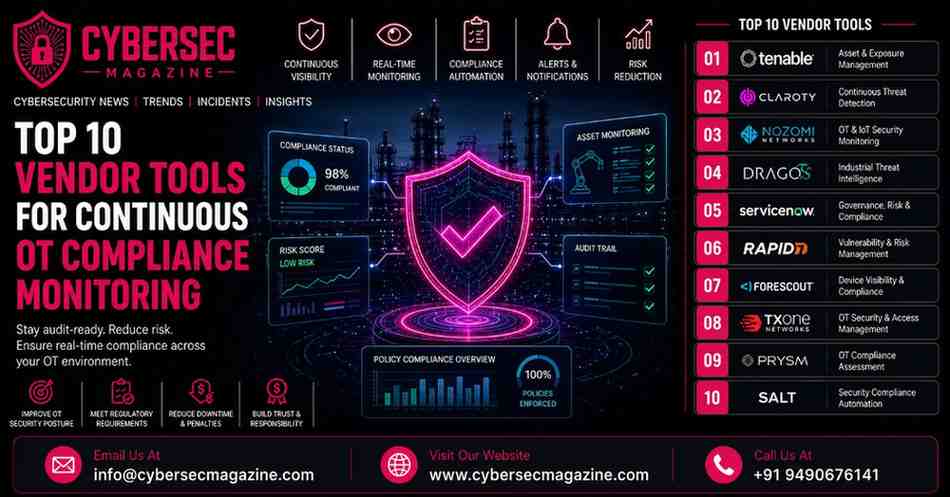
Top 10 Vendor Tools for Continuous OT Compliance
Selecting the right solution requires evaluating how well each tool handles the unique constraints of your industrial environment, such as protocol support, passive monitoring capabilities, and ease of integration with your existing stack.
1. Nozomi Networks (Vantage)
Nozomi Networks remains a powerhouse for OT/ICS visibility and compliance. Its platform, Vantage, offers unparalleled support for a wide array of industrial protocols, making it ideal for heterogeneous environments. It excels in automated asset discovery and continuous monitoring of network communications, effectively mapping “conduits” and ensuring that traffic flows adhere to defined security zones. Its ability to provide real-time alerting on unauthorized changes to industrial configurations makes it a cornerstone for teams focused on IEC 62443 compliance.
2. Dragos Platform
Dragos is built specifically for the “consequence-led” approach that modern OT environments require. By ingesting deep, site-specific intelligence, the Dragos platform goes beyond mere monitoring; it provides actionable context on why a deviation is a risk. Their tools are particularly adept at identifying malicious activity within complex industrial environments, offering specialized playbooks and threat detection capabilities that align with the MITRE ATT&CK for ICS framework, which is vital for high-level compliance audits.
3. Claroty (xDome)
Claroty’s xDome platform focuses heavily on the convergence of IT and OT security, providing a unified view that is essential for modern enterprises. It excels at identifying vulnerabilities within OT assets and managing the associated risk posture. The tool provides robust reporting features that can be tailored for both technical stakeholders and executive leadership, making it easier to justify security budgets and demonstrate compliance progress to auditors during high-stakes reviews.
4. Tenable.ot
Tenable is widely recognized for its excellence in vulnerability management, and their OT-focused module extends this capability into the industrial realm with precision. It allows users to gain visibility into industrial assets while maintaining the safety of the control environment through passive monitoring. Tenable.ot is particularly strong in identifying “drift” from established baselines-a critical requirement for auditors who want to see evidence that the configuration of your PLCs and HMIs remains in a known-good state.
5. Microsoft Defender for IoT
For organizations already embedded in the Microsoft ecosystem, Defender for IoT offers a seamless path to compliance. It provides deep visibility into industrial devices and utilizes AI-driven threat detection to identify anomalous behavior. The platform integrates tightly with Microsoft Sentinel, allowing for centralized logging and orchestration. This makes it an excellent choice for teams looking to centralize their SOC operations and automate the remediation of compliance gaps across both IT and OT silos.
6. Armis Centrix
Armis focuses on the entire “Asset Intelligence” space, covering everything from standard IT hardware to specialized industrial sensors and controllers. Its strength lies in its agentless approach, which is crucial for sensitive OT environments where you cannot risk installing software on legacy equipment. Armis provides continuous monitoring of the entire attack surface and offers robust capabilities for identifying third-party access risks, which is increasingly vital for supply chain compliance mandates.
7. Fortinet (FortiGuard for OT)
Fortinet brings a strong networking perspective to OT compliance. Their integrated approach-combining security fabric components with OT-specific analysis-allows for robust enforcement at the network boundary. For organizations that rely on high-performance firewalls for segmentation, Fortinet provides granular control over industrial traffic and allows for the automated logging of “allow-flow” catalogues, which are a major focal point for auditors reviewing zone and conduit implementations.
8. Cisco (Cyber Vision)
Cisco’s industrial security portfolio, highlighted by Cyber Vision, is designed to turn existing industrial networking hardware into security sensors. By embedding security visibility directly into the switches and routers that make up the OT network, Cisco provides a unique advantage in terms of deployment scale. This visibility is invaluable for documenting asset inventory and communication patterns, providing the foundational evidence required to prove effective network segmentation.
9. Palo Alto Networks (Cortex XSOAR/OT Security)
Palo Alto Networks provides a comprehensive security operations platform that integrates OT security into the broader XSOAR (SOAR) ecosystem. This is particularly effective for organizations that want to automate their incident response and compliance workflows. By creating custom playbooks for OT-specific scenarios-such as unauthorized HMI access-teams can ensure that their response to compliance drift or security incidents is consistent, repeatable, and fully documented for regulatory purposes.
10. Radiflow (iSID)
Radiflow’s iSID platform is built with a heavy emphasis on industrial risk management. It allows users to model their operational environment and simulate the impact of security threats, which is a powerful way to justify compliance investments based on risk rather than fear. Its focus on visualizing the “attack path” within the OT network helps security teams prioritize remediation efforts, ensuring that compliance resources are spent on the most critical assets first.
Strategic Recommendations for Compliance Success
To truly leverage these tools, you must treat your compliance program as a governance model rather than just a technical deployment. Start by mapping your OT environment to a recognized backbone like IEC 62443. Use your chosen tool to enforce the “Purdue Model” of segmentation, ensuring that every conduit between zones has an explicitly approved and documented flow.
Finally, remember that human training and incident response drills are just as important as the software you install. Even the best vendor tool cannot prevent human error or mitigate a breach if your staff is not trained to handle the specific consequences of a loss-of-view or loss-of-control scenario. By combining high-quality vendor tools with a disciplined, consequence-led operational culture, you will not only satisfy auditors but also build a more resilient industrial operation.