Top 10 Vendor Case Studies Showing OT Attack Prevention
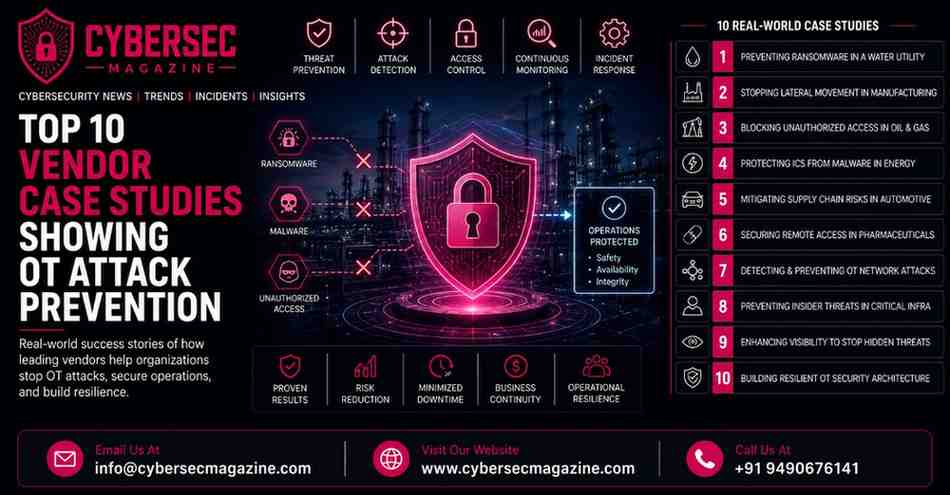
Discover how top industrial enterprises utilize advanced OT/ICS cybersecurity vendor solutions to prevent devastating cyberattacks and secure critical infrastructure.
The New Era of Industrial Cyber Defense
For decades, operational technology (OT) and industrial control systems (ICS) relied on physical isolation-the classic “air gap”-as their primary defense against external threats. However, the rapid acceleration of digital transformation, industrial IoT (IIoT) deployment, and IT/OT network convergence has permanently erased these traditional boundaries. Today, critical infrastructure facilities, manufacturing plants, and energy grids are deeply interconnected, exposing legacy industrial assets to sophisticated cyber threats that were once confined to corporate IT networks. Threat actors are aggressively exploiting these newly formed pathways, using advanced ransomware, malicious firmware updates, and credential abuse to disrupt physical operations and threaten public safety.
In this high-stakes landscape, industrial enterprises can no longer rely on passive defense mechanisms or generic IT security controls that fail to understand proprietary industrial protocols like Modbus, DNP3, or Profinet. Preventing catastrophic downtime and safeguarding human lives requires specialized, industrial-grade cybersecurity solutions designed specifically for cyber-physical systems. Leading cybersecurity vendors have stepped up to this challenge, deploying innovative architectures that emphasize deep packet inspection, zero-trust remote access, and automated network micro-segmentation. Analyzing real-world deployments reveals exactly how forward-thinking industrial organizations are successfully neutralizing threats, containing lateral movement, and achieving continuous operational resilience.
1. Network Segmentation in Automotive Manufacturing (TXOne Networks)
A multi-facility global automotive manufacturer faced severe operational risks due to flat network architectures that allowed IT-based ransomware to easily spill over into the production floor. To mitigate this vulnerability, the company deployed TXOne Networks’ industrial firewalls and security inspection consoles to enforce strict micro-segmentation across its assembly lines. By segmenting the plant floor into localized security zones based on the ISA/IEC 62443 standard, the manufacturer successfully isolated legacy programmable logic controllers (PLCs) from the corporate network. This targeted deployment effectively blocked a lateral-movement ransomware variant from traversing production cells, ensuring that an IT breach would not trigger a costly multi-million-dollar halt in manufacturing operations.
2. Real-Time Threat Detection in Oil & Gas Operations (Claroty)
An international oil and gas enterprise operating sprawling midstream assets struggled with zero visibility into its distributed pipeline telemetry and remote terminal units (RTUs). The company integrated Claroty’s Continuous Threat Detection (CTD) platform across its entire pipeline infrastructure to baseline normal industrial communications and capture anomalous behavior. During a routine operational window, the platform flagged an unauthorized configuration change attempt on a critical valve controller originating from a hijacked third-party engineering workstation. Because the platform delivered real-time alerts with full industrial context, the security team instantly blocked the connection, preventing a potential environmental hazard and validating the necessity of deep packet inspection.
3. Secure Remote Access at a Major Water Treatment Facility (Dragos)
Following high-profile cyberattacks on municipal water infrastructure, a large metropolitan water treatment utility sought to replace its unmonitored commercial desktop-sharing software with an industrial-grade alternative. The utility deployed the Dragos Platform combined with secure, multi-factor authentication (MFA) remote access proxies specifically tailored for operational technology environments. This integration ensured that all external vendor sessions targeting the plant’s supervisory control and data acquisition (SCADA) systems were time-limited, continuously logged, and strictly restricted to necessary assets. The system successfully intercepted and terminated an unauthorized remote access attempt utilizing stolen credentials, preventing a malicious actor from tampering with chemical dosing levels.
4. Unified Threat Management Across Food and Beverage Sites (Rockwell Automation)
A global consumer packaged goods and food manufacturer faced the daunting challenge of standardizing cybersecurity across 46 disparate production sites acquired through various corporate mergers. The company collaborated with Rockwell Automation to deploy a unified threat management (UTM) architecture featuring managed security services and centralized OT asset inventory tracking. By implementing standardized industrial firewalls and continuous anomaly detection across all locations, the manufacturer established a corporate-wide baseline for operational technology visibility. This comprehensive defense framework actively detected and neutralized a cross-site malware propagation attempt, reducing the average network response time during incidents to under four minutes and safeguarding critical supply chains.
5. Protecting Electrical Grids via Managed Detection and Response (Radiflow)
A regional electrical utility operating dozens of transmission substations required an automated solution to comply with stringent NERC CIP regulations while defending against state-sponsored grid sabotage. The utility implemented Radiflow’s risk assessment software and industrial threat detection gateways to monitor inter-substation traffic and enforce strict policy baselines. The system was put to the test when an advanced persistent threat (APT) group attempted to execute rogue commands aimed at protective relays via an unencrypted communication protocol. Radiflow’s edge sensors immediately recognized the out-of-pattern command structure, triggering an automated alert that allowed operators to isolate the compromised segment before any regional power fluctuations occurred.
6. SASE and Zero-Trust Convergence in Chemical Processing (Fortinet)
A chemical processing conglomerate with complex, highly hazardous production environments needed to secure its extensive workforce of remote engineers and third-party maintenance contractors. The enterprise deployed Fortinet’s Secure Access Service Edge (SASE) for OT, bringing zero-trust network access (ZTNA) principles directly to the industrial perimeter. This deployment verified the identity, device posture, and precise access authorization of every user before granting temporary access to engineering workstations. When a contractor’s laptop containing a dormant credential-stealing trojan attempted to establish an active session to a critical safety instrumented system (SIS), the zero-trust framework denied the connection, protecting the facility from potential physical damage.
7. Endpoint Protection for Legacy Maritime Logistics Systems (Nozomi Networks)
A global maritime logistics and shipping giant required a comprehensive security upgrade for its port terminal operating systems, many of which relied on legacy operating systems that could not be easily patched. The organization deployed Nozomi Networks’ Guardian appliances alongside specialized lightweight endpoint agents to gain real-time visibility and threat monitoring capabilities across its cranes and automated guided vehicles. The deployment proved vital when a sophisticated wiper malware variant, similar to historic supply chain attacks, infiltrated the facility’s logistics network. Nozomi’s behavioral monitoring immediately identified the rapid file-modification behavior of the malware and alerted the containment team, allowing them to isolate infected systems without interrupting port container movements.
8. Firmware Integrity Verification in Aerospace Manufacturing (Palo Alto Networks)
An aerospace components manufacturer was highly concerned about sophisticated supply chain attacks targeting the firmware integrity of its high-precision CNC machining centers. To address this vector, the manufacturer utilized Palo Alto Networks’ industrial next-generation firewalls paired with specialized OT security subscriptions to inspect all incoming assets and updates. The solution continuously analyzed vendor-supplied files and monitored active network sessions for unauthorized firmware downloads or changes to underlying control logic. The firewall successfully intercepted an unauthorized, altered firmware package disguised as a legitimate vendor update, stopping a malicious actor from permanently damaging precision manufacturing machinery and stealing proprietary designs.
9. Air-Gapped Network Defense at a Nuclear Power Facility (Waterfall Security Solutions)
A nuclear power generation facility needed to export real-time operational data from its reactor monitoring systems to corporate analysts without introducing any inbound cyber risks. The facility implemented Waterfall Security Solutions’ Unidirectional Security Gateways to replace traditional firewalls at the critical perimeter boundary. By utilizing hardware-enforced, one-way data transfer technology, the gateway allowed data to flow seamlessly out of the plant while making it physically impossible for any cyber threat to travel back into the control environment. This deployment permanently eliminated the possibility of remote execution attacks or external ransomware infections penetrating the plant’s most sensitive control loops, guaranteeing absolute operational safety.
10. API and IoT Security in Smart Grid Infrastructure (Microsoft Defender for IoT)
A major municipal power provider deployed thousands of smart IoT meters and localized microgrid sensors, creating a massive, highly distributed digital attack surface. To secure these edge devices, the utility integrated Microsoft Defender for IoT to manage asset discovery, identify vulnerabilities, and monitor API traffic across its cloud-connected infrastructure. The security platform continuously scrutinized API calls between the edge devices and the central data center to detect anomalous patterns or configuration flaws. The system flagged and blocked an automated API probing attack that was searching for authentication bypass vulnerabilities, preventing the threat actor from executing a coordinated, wide-scale disconnection of customer smart meters.
Strategic Blueprint for Modern Industrial Security
As demonstrated by these diverse vendor case studies, successful OT/ICS cyber defense requires a defense-in-depth model tailored to the unique realities of industrial environments. Organizations must transition away from legacy assumptions of absolute isolation and instead embrace proactive security frameworks that treat visibility, micro-segmentation, and zero-trust access as mandatory baselines. Implementing these specialized solutions allows industrial operators to bridge the historical gap between IT efficiency and OT safety, ensuring long-term resilience against sophisticated threat groups. Ultimately, investing in purpose-built industrial cybersecurity is no longer just an administrative IT checklist item-it is a foundational pillar of modern operational survival and critical infrastructure protection.