The Definitive Guide: 12 Strategic Factors for On-Premise vs. Managed OT Security
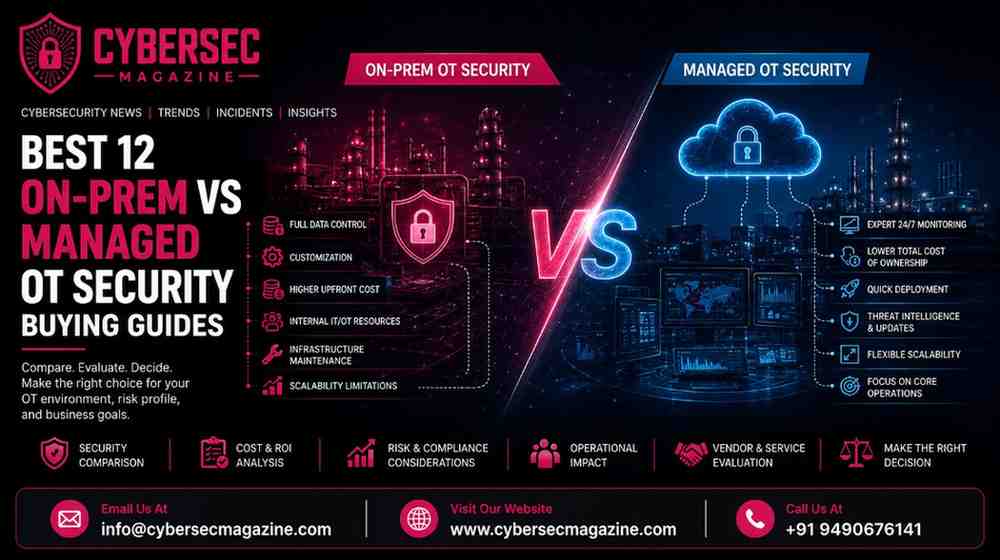
Navigating OT security in 2026? Use these 12 strategic criteria to decide between on-premise control and managed OT security services for your facility.
The convergence of Information Technology (IT) and Operational Technology (OT) has fundamentally altered the industrial landscape. As critical infrastructure and manufacturing sectors face increasingly sophisticated AI-driven threats, the age-old question has returned to the boardroom: Should we maintain our security stack on-premise, or leverage the specialized expertise of a Managed Security Service Provider (MSSP)? There is no one-size-fits-all answer in 2026; the choice depends on your organization’s risk appetite, regulatory landscape, and operational agility. This guide breaks down 12 critical decision-making factors to help you architect a resilient defense that keeps your production lines running and your data secure.
12 Factors for Evaluating Your Security Deployment Model
1. Granular Control and Customization
On-premise solutions offer unparalleled control, allowing your internal teams to fine-tune security policies to match the unique, often proprietary, requirements of your industrial control systems (ICS). Because the infrastructure is entirely local, you can implement bespoke configurations that wouldn’t survive in a standardized managed environment. This is vital for facilities using legacy protocols where traditional “off-the-shelf” security rules might inadvertently cause operational disruption or system latency.
2. Regulatory Compliance and Data Sovereignty
Industries governed by strict mandates-such as energy or defense-often require that sensitive operational data never leave the facility walls. On-premise deployments satisfy these “air-gapped” or local data residency requirements with ease, providing an auditable, physical boundary for security logs. Conversely, while many managed providers now offer localized data handling, verifying their compliance with regional sovereignty laws can be a heavy administrative burden for your legal and IT teams.
3. Immediate Incident Response Capability
When a critical asset on the plant floor is compromised, every second counts, and having an on-site team provides a decisive advantage in local decision-making. Your internal staff, who deeply understand the specific nuances of your production environment, can isolate a threat without waiting for an external provider’s support ticket workflow. This immediacy is often the difference between a minor incident and a full-scale operational shutdown that impacts your entire supply chain.
4. Specialized OT Cybersecurity Expertise
The primary argument for managed services is access to a “bench” of experts who handle industrial threats daily across various sectors. Most internal teams struggle to recruit and retain the rare talent capable of dissecting both complex ICS protocols and advanced IT-borne ransomware. By opting for a managed model, you gain instant access to threat hunters and engineers who are already equipped to handle the latest 2026-era vulnerabilities, saving you years of internal training.
5. Predictability of Operational Expenses
Managed services generally shift your security spend from a capital expenditure (CapEx) heavy model-requiring large upfront investments in servers, licenses, and hardware-to a more predictable, subscription-based operating expense (OpEx). This allows organizations to budget for security as a recurring cost, which often aligns better with annual corporate financial planning. On-premise setups, by contrast, carry hidden costs in hardware lifecycle management, power, cooling, and the constant need for infrastructure refreshes.
6. Scalability Across Global Operations
As your industrial footprint grows, an on-premise model becomes increasingly difficult and expensive to scale uniformly across multiple geographic locations. Managed providers offer a centralized management plane that can roll out security policies to new branches or sites in a fraction of the time. This scalability is essential for modern enterprises that are rapidly expanding their IoT networks and need a consistent security baseline that doesn’t dilute as the organization grows.
7. Integration with Existing IT Infrastructure
Managed security providers typically possess deep integration capabilities with broader enterprise security ecosystems, such as SOAR, SIEM, and identity management platforms. If your organization is already pushing for a unified IT/OT security operations center (SOC), a managed partner can act as the “glue” that bridges these historically siloed worlds. They bring the necessary connectors and APIs that might take your internal IT team months to develop and troubleshoot on their own.
8. Threat Intelligence Fusion
Managed providers don’t just protect you; they protect hundreds of other clients, meaning they catch threats and novel attack patterns before they ever touch your network. By subscribing to a managed model, you essentially “crowdsource” your threat intelligence, benefiting from the global visibility that your team could never replicate in isolation. This is particularly valuable against state-sponsored actors who use standardized tactics that are already being blocked elsewhere in the provider’s client base.
9. Maintenance and Patching Burdens
The reality of on-premise security is that it requires a constant, manual effort to patch vulnerabilities, update firmware, and ensure that security sensors are functioning correctly. Managed services offload this “security hygiene” to the provider, ensuring your tools are always running the latest signatures and patches without your team needing to constantly monitor for update releases. This frees your internal staff to focus on high-value business initiatives rather than mundane infrastructure upkeep.
10. Cultural Alignment and Organizational Knowledge
Internal teams possess a “tribal knowledge” of the facility-knowing exactly which servers are mission-critical and which production lines cannot tolerate even a millisecond of network jitter. A managed provider, no matter how skilled, will always be an outsider and may lack this historical context during an active crisis. If your facility has highly unique, custom-coded, or fragile processes, the “insider perspective” of an in-house team is often more valuable than external expertise.
11. Cost of Talent Retention
In the current cybersecurity job market, the cost of hiring, training, and retaining a full-time, 24/7 internal SOC team can be astronomical. When you factor in the turnover rates for highly skilled security professionals, the total cost of ownership (TCO) for an internal team often far exceeds the cost of a managed contract. Managed services effectively “buy out” the human resource challenge, providing you with a fully staffed, round-the-clock defense team for a flat fee.
12. Visibility vs. Vendor Lock-in
The major risk of managed services is the potential for vendor lock-in, where you lose visibility into the “how” and “why” of security decisions made by the provider. An on-premise setup ensures that you retain full visibility into every packet captured and every policy applied, giving you ultimate transparency. While managed providers usually offer dashboards, the lack of deep, granular access to their back-end processes can be a dealbreaker for organizations that prioritize total system autonomy.
Conclusion: Making the Right Call
Choosing between on-premise and managed services is not a binary decision; many mature organizations are now adopting a hybrid approach. This model keeps sensitive, highly customized OT security policies on-premise while offloading routine monitoring, threat hunting, and infrastructure maintenance to an expert partner. Before finalizing your strategy, conduct a comprehensive risk assessment of your current assets and ask: Does this component require deep, local control, or does it benefit from global, expert-led scale? By balancing these two forces, you can build a resilient, 2026-ready security posture that serves both your operational needs and your business goals.