Best 12 Vendor Certifications & Security Claims to Verify
Vetting OT vendors in 2026? Learn the 12 essential security certifications, SBOM requirements, and CVE handling claims you must verify to ensure resilience.
In 2026, the industrial landscape is defined by hyper-connectivity. As we integrate IIoT, cloud analytics, and advanced robotics into our Operational Technology (OT) environments, the “air-gap” has become a memory. However, this progress brings a significant risk: the software supply chain. Today, an industrial controller or a management platform is only as secure as the hundreds of third-party libraries and firmware components embedded within it.
For security leaders, the era of taking vendor security claims at face value is over. With high-profile supply chain attacks and new regulatory pressures like the CIRCIA reporting mandates and the global adoption of IEC 62443, you need a standardized way to vet your partners. This guide breaks down the 12 critical certifications, artifacts, and operational claims you must verify before a single piece of vendor hardware or software enters your production network.
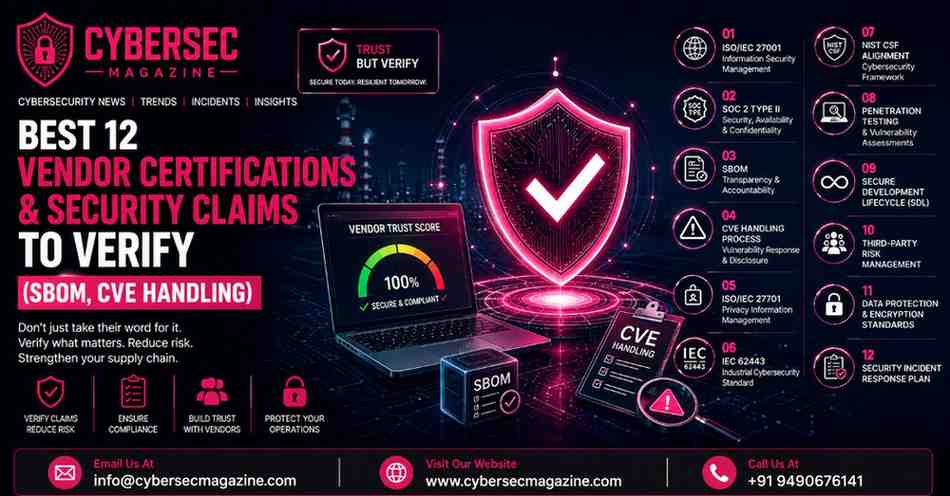
Best 12 Vendor Certifications & Security Claims to Verify
1. IEC 62443-4-1 (Secure Development Lifecycle)
IEC 62443 is the global standard for industrial cybersecurity, and the -4-1 section is perhaps the most important for procurement. It certifies that a vendor has a documented, repeatable “Secure Development Lifecycle” (SDL). This means security isn’t an afterthought; it’s baked into their process from design through retirement. When a vendor holds this certification, you have third-party assurance that they aren’t just writing code, but actively identifying, testing, and mitigating security flaws throughout the product’s development, which significantly reduces the likelihood of “insecure-by-default” hardware reaching your facility.
2. Machine-Readable SBOM (CycloneDX or SPDX)
A Software Bill of Materials (SBOM) is no longer a “nice-to-have” document; it is a fundamental security requirement for any industrial device in 2026. Demand that vendors provide a machine-readable SBOM in a standard format like CycloneDX or SPDX for every release. This artifact acts as an ingredients list for the software, allowing your security team to automatically scan for vulnerabilities in third-party libraries without waiting for the vendor to notify you. If a vendor cannot provide a machine-readable list, they lack the transparency necessary for modern, automated vulnerability management in a complex OT ecosystem.
3. VEX (Vulnerability Exploitability eXchange) Documentation
An SBOM tells you what is inside your software, but a Vulnerability Exploitability eXchange (VEX) tells you if those components are actually exploitable in the context of the device. Many components contain known vulnerabilities that are unreachable or inactive in the final product. A vendor that provides VEX documents alongside their SBOM demonstrates maturity by helping you filter “noise” from “risk.” This saves your team countless hours of manual triage, allowing you to prioritize patches for vulnerabilities that are actually reachable and high-impact in your specific industrial process.
4. Hardware-Rooted Trust (TPM 2.0 or Secure Element)
Does the vendor’s hardware include a Trusted Platform Module (TPM) 2.0 or a dedicated Secure Element (SE)? These hardware-based modules are critical for secure boot and cryptographic key storage. They ensure that the device’s firmware has not been tampered with and that the identity of the device is cryptographically verifiable. Without this, your devices are susceptible to “man-in-the-middle” firmware injection, where an attacker could replace the device’s logic with a malicious version that your system would trust as legitimate.
5. Coordinated Vulnerability Disclosure (CVD) Policy
Every vendor will have vulnerabilities; the mark of a mature vendor is how they handle them once they are discovered. Verify that the vendor has a public-facing Coordinated Vulnerability Disclosure (CVD) policy, often managed through a PSIRT (Product Security Incident Response Team). Check if they participate in recognized programs like CVE Numbering Authority (CNA). A formal policy ensures they have a structured process to acknowledge, validate, and communicate risks to their customers, rather than keeping discoveries hidden to protect their brand reputation at the expense of your operational safety.
6. SOC 2 Type II Compliance (for Cloud/SaaS Components)
If the vendor offers a cloud-based management platform or SaaS component, SOC 2 Type II is the industry-standard benchmark. This report verifies that the vendor’s internal security controls-such as access management, encryption, and monitoring-are not just “on paper,” but have been tested and proven effective over a period of at least six to twelve months. It is essential for ensuring that the vendor’s cloud infrastructure, which may be polling data from your plant floor, is protected against unauthorized access and data breaches.
7. Digitally Signed Firmware Updates
Ensure the vendor mandates cryptographic signing for all firmware updates. Any update package you receive must be signed by the vendor’s private key, and the device must verify that signature before it executes the update. This process prevents attackers from injecting malicious code into the update pipeline, effectively protecting your facility against the “supply chain update attack” scenario where a compromised update server pushes a backdoor directly into your mission-critical controllers.
8. NERC CIP / NIS2 Alignment Mapping
If you operate in the energy or utility sector, your vendor’s claims must align with your regulatory mandates. Ask for a specific mapping document that details how their product features help you meet the requirements of standards like NERC CIP or the European NIS2 Directive. Vendors that understand these frameworks will provide features like automated audit logging, granular role-based access control (RBAC), and push-button reporting, which will dramatically reduce your organization’s compliance burden during upcoming audits.
9. Secure Default Configuration (“Hardened by Design”)
Vendor security claims often fall apart at the “out-of-the-box” configuration. Verify that the vendor ships products in a “hardened” state: all default credentials must be forced to change on first login, all unnecessary services (e.g., Telnet, FTP, HTTP) must be disabled, and all communication ports must be closed by default. A vendor that forces you to spend hours “disabling” insecure features after installation is a vendor that prioritizes ease-of-use over security, which is an unacceptable trade-off in modern industrial environments.
10. Third-Party Penetration Test Summaries
While a vendor might not share their full, confidential security report, they should be willing to provide an executive summary of their most recent independent penetration test. This document provides external validation of their security claims and often highlights areas of ongoing improvement. If a vendor refuses to share any form of third-party validation, it is a significant red flag; at this stage of the cybersecurity market, transparency is the primary indicator of a trustworthy partnership.
11. CVE Handling & Patch Response SLA
Ask for the vendor’s stated Service Level Agreement (SLA) for vulnerability response. How many days does it typically take them to release a patch for a “Critical” (CVSS 9.0+) vulnerability? A high-performing vendor will have a documented response plan that provides not just the patch, but also compensating control guidance for systems that cannot be taken offline for an immediate update. This level of support ensures that even when a vulnerability is announced, you have a clear path to minimize risk without halting production.
12. Legacy System Support & “Security-Only” Patching
In OT, hardware often stays in the field for 20+ years, far outliving the vendor’s feature-development cycle. Verify if the vendor offers a “Security-Only” patch stream for legacy devices that are no longer receiving new features. This is critical for industrial environments where you cannot simply “upgrade” to the newest version because it would require a complete re-validation of your entire safety-instrumented system (SIS), ensuring you can remain secure without constant hardware replacement.
Conclusion
Procurement is the new front line of cybersecurity. By demanding these 12 certifications and security artifacts, you shift the burden of security from your team to the vendor, where it belongs. In 2026, the industrial organizations that thrive will be those that view their vendors not as black boxes, but as transparent partners in a secure, shared supply chain. When you vet a vendor today, you aren’t just buying hardware-you are choosing your partner in operational resilience.