Top 10 Questions to Vet an OT Remote Access Vendor
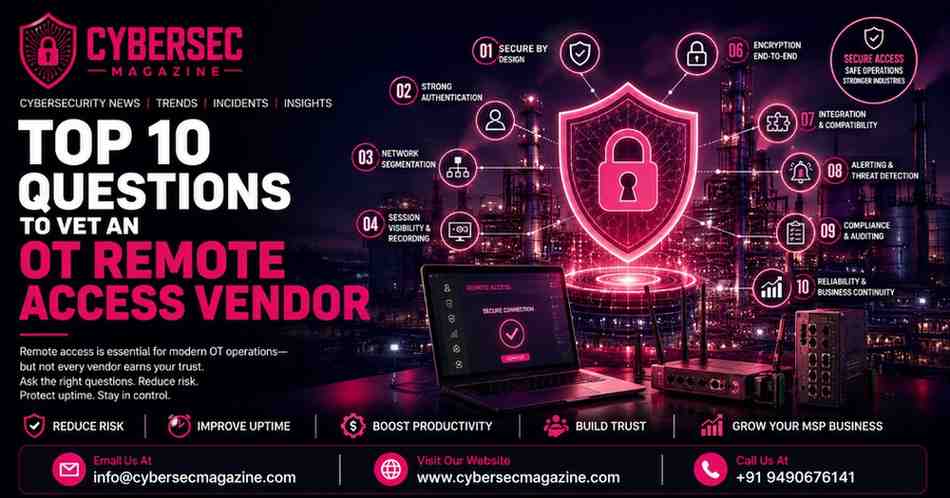
Secure your industrial network. Use these 10 critical questions to vet OT remote access vendors and ensure your operations remain resilient in 2026.
The Evolution of Industrial Remote Access
In the hyper-connected industrial environment of 2026, remote access has transitioned from a “nice-to-have” utility for convenient vendor maintenance to a fundamental operational pillar. However, this convenience is a double-edged sword. As industrial facilities increasingly rely on third-party access to maintain complex PLCs, HMIs, and IIoT gateways, the attack surface has expanded far beyond the plant perimeter. Legacy VPNs and static RDP connections are no longer sufficient; they are often the primary entry points for ransomware and state-sponsored actors looking to pivot into critical infrastructure.
For asset owners, selecting a remote access solution is no longer just an IT procurement task. It is an engineering and safety decision. A misconfigured or insecure remote access gateway can lead to catastrophic operational downtime or, worse, safety incidents that endanger human lives. To navigate this landscape, you must move beyond vendor marketing materials and conduct a rigorous technical interrogation. The following ten questions are designed to challenge potential partners on their ability to meet the stringent security, safety, and compliance requirements of modern Operational Technology (OT) environments.
1. Does your solution enforce “Least Privilege” and just-in-time access?
Generic, “always-on” remote access is a relic of the past. Your vendor must demonstrate how their platform enforces the Principle of Least Privilege (PoLP) by restricting access to only the specific assets or services the third party requires, rather than the entire network. Furthermore, ask if they support Just-in-Time (JIT) access, where connectivity is only active for a pre-approved, time-bound window. This approach ensures that if a vendor’s credentials are compromised, the attacker is not met with an open door to your entire OT stack, effectively shrinking your attack surface and preventing unauthorized lateral movement during idle periods.
2. Is your solution architected to be “Zero Trust” or does it still rely on traditional VPN tunnels?
Traditional VPNs often connect users directly to the network, granting them an IP address on the internal subnet. This is dangerous in OT because it makes the remote user appear as a trusted device, often bypassing internal security zoning. Demand an architecture that hides your OT assets from the public internet (a “dark” network approach) and mediates all traffic through an identity-aware proxy. This ensures that the user never actually “touches” the network layer, and the connection is established only after both the user’s identity and the health of their device are verified against your security policies.
3. How does your solution support granular, protocol-aware visibility and session recording?
In the event of an operational anomaly, you need to know exactly what a remote user did on your controllers. Does the vendor’s platform log the specific industrial protocols (e.g., Modbus, EtherNet/IP, S7) and the actual commands (e.g., “Stop PLC,” “Upload Program”) issued during the session? Ask if they provide full-video session recording or searchable logs that correlate user identity with industrial-specific actions. This level of granular visibility is critical for incident response, ensuring you can differentiate between a legitimate maintenance action and a malicious attempt to alter physical processes.
4. What is your strategy for third-party identity verification and MFA integration?
Remote access security is only as strong as the authentication controlling it. Does the vendor support integration with your existing enterprise Identity Provider (IdP) via SAML or OIDC? More importantly, can they enforce Multi-Factor Authentication (MFA) that is hardware-backed or FIDO2-compliant? Avoid vendors that rely solely on SMS-based MFA, which is susceptible to interception. The ideal vendor will allow you to enforce your own organization’s authentication policies, ensuring that you retain control over who is entering your environment, regardless of which third-party firm they work for.
5. Does your solution align with IEC 62443 security standards?
IEC 62443 is the global benchmark for securing industrial automation and control systems. Ask your vendor to explain exactly how their product maps to the “Foundational Requirements” of the standard, particularly regarding data integrity, restricted data flow, and timely response to incidents. A vendor that cannot speak the language of IEC 62443 likely lacks the OT-native mindset required to understand the nuances of plant-floor safety and reliability. They should be able to provide documentation or a security whitepaper demonstrating their compliance or compatibility with these international industrial security guidelines.
6. How do you handle firmware updates and vulnerability remediation for the gateway appliance itself?
The remote access gateway is a high-value target; if it is compromised, the entire plant is at risk. Demand a clear explanation of how the vendor pushes security patches to their own infrastructure. Is the process automated, or does it require manual intervention? Ask how they notify customers of vulnerabilities (CVEs) and what their service level agreement (SLA) is for providing a fix. A vendor that treats their own product’s security as a “reactive” task rather than a proactive part of their development lifecycle is a liability you cannot afford to introduce into your sensitive industrial network.
7. Does the platform provide a “vendor-agnostic” way to manage diverse third-party connections?
Your industrial environment likely features hardware from dozens of vendors, each with their own preferences for remote support tools. Does the remote access solution require you to install proprietary software on every end-user laptop, or does it provide a seamless, browser-based experience that works regardless of the user’s device? Look for a solution that acts as a “universal gateway,” allowing you to standardize security policies across all vendors while respecting their need for an easy, efficient way to connect and perform their required maintenance tasks without friction.
8. What mechanisms are in place to ensure operational continuity (High Availability)?
In an OT environment, connectivity is often synonymous with uptime. If the vendor’s remote access cloud or gateway appliance fails, will you lose the ability to manage your production line during an emergency? Ask about their High Availability (HA) architecture, local failover capabilities, and disaster recovery plans. A robust solution should offer a “hot-standby” configuration or at least ensure that the remote access tool does not become a single point of failure that prevents your on-site engineering team from performing essential repairs when the network is offline.
9. Can the solution be integrated into our existing SIEM or SOC workflows?
Security data is useless if it lives in a silo. Does the vendor’s remote access platform provide structured, real-time alerts (via Syslog, API, or Webhooks) that can be ingested into your Security Information and Event Management (SIEM) system? You need to be able to correlate remote access events with other network telemetry to spot complex, multi-stage attacks. A vendor that treats their logs as proprietary and inaccessible is a red flag, as it prevents your SOC team from gaining the holistic visibility they need to defend your infrastructure.
10. Can you demonstrate a “Secure Development Lifecycle” (SDL) for your own product?
Finally, you must vet the vendor’s own internal security maturity. How do they build their software? Do they conduct regular third-party penetration testing, and are they willing to share an executive summary of the results? A vendor that cannot provide evidence of a rigorous SDL process is essentially asking you to trust their code blindly. In the current 2026 threat landscape, trust is not a security strategy-you must demand transparency and proof that the vendor is as serious about their own product’s security as you are about your production facility’s safety.