Top 10 Vendor SLAs You Should Demand for OT Devices: A 2026 Procurement Guide
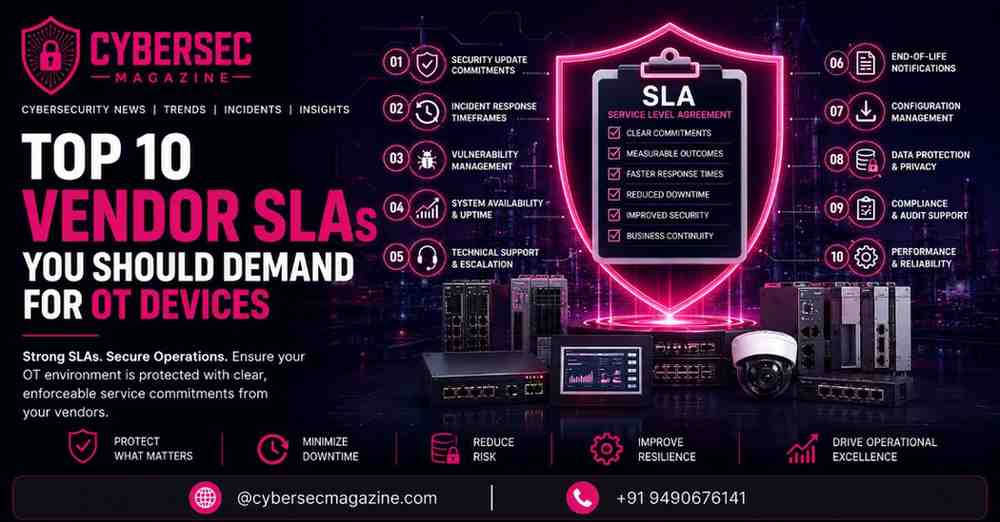
Protect your industrial assets. Learn the 10 essential SLA requirements for OT hardware vendors to ensure security, compliance, and operational resilience.
In the hyper-connected industrial landscape of 2026, the traditional “set it and forget it” approach to Operational Technology (OT) procurement has become a major liability. As digital transformation converges IT and OT, industrial hardware is increasingly exposed to sophisticated cyber threats. Yet, many organizations continue to procure PLCs, HMIs, and IIoT gateways based solely on performance and cost, completely neglecting the contractual obligations required to keep these assets secure over their 15–20 year lifespans.
A Service Level Agreement (SLA) for OT is not just a document; it is your primary defense against “security debt.” When a critical zero-day vulnerability emerges in your plant’s controller, the vendor’s legal obligation to provide a patch-and the speed at which they must deliver it-is dictated by the terms you negotiated at the point of sale. This guide outlines the ten critical SLA requirements that every modern industrial organization must mandate to bridge the gap between operational uptime and cyber resilience.
Top 10 Vendor SLAs You Should Demand for OT Devices
1. Guaranteed Vulnerability Disclosure & Patching Timeline
Generic “best effort” support is insufficient for critical infrastructure. You must demand an SLA that categorizes vulnerabilities by severity-Critical, High, Medium-and sets binding deadlines for remediation. For critical flaws that threaten physical safety or operational continuity, mandate a patch delivery or mitigation guidance within 24–48 hours. This ensures your vendor is contractually aligned with the urgency required to protect your specific production environment.
2. Secure Development Lifecycle (SDL) Certification
Your SLA should require vendors to verify that their hardware is built according to secure-by-design principles, specifically aligning with standards like IEC 62443-4-1. Demand documentation confirming that the vendor conducts regular threat modeling, static/dynamic code analysis, and third-party penetration testing. A vendor who cannot prove a disciplined approach to building secure hardware is an unacceptable risk for your primary control network.
3. Transparency via Software Bill of Materials (SBOM)
Supply chain attacks are a primary vector for modern industrial breaches. Require your vendors to provide an up-to-date SBOM for every piece of hardware, listing all third-party and open-source components used. This transparency is vital for your security team to perform impact analysis when a new vulnerability is announced in a common library or component (such as an embedded TCP/IP stack) used across multiple vendors.
4. Documented End-of-Life (EoL) & Support Policy
Legacy devices are the most frequent targets for attackers because they often lack the processing power to run modern security agents. Your SLA must define the minimum support window for any hardware you purchase and mandate a clear “end-of-support” notification period (e.g., 24 months). Furthermore, insist on a “security-only” maintenance phase where the vendor continues to provide critical security patches even after new feature development ceases.
5. Secure-by-Default Configuration Mandates
Hardware should not arrive with hardcoded credentials or unnecessary services enabled. Your contract should explicitly state that all devices must be delivered in a “hardened” state: all default passwords removed (or requiring immediate change upon first login), and all unused ports, services, and protocols (e.g., Telnet, FTP) disabled by default. This simple clause eliminates one of the most common and easily exploitable “low-hanging fruit” vulnerabilities.
6. Incident Notification & Reporting Requirements
In the event of a security breach within the vendor’s own environment that impacts the hardware supplied to you, you need immediate visibility. Mandate that the vendor notifies your organization of any relevant security incidents within 24 hours of discovery. This obligation should be legally binding, ensuring you aren’t left in the dark while a vulnerability in your supply chain is exploited by malicious actors across their other clients.
7. Managed Remote Access & Auditability
Industrial vendors frequently require remote access for maintenance, often bypassing standard security firewalls. Your SLA should forbid persistent “backdoor” connections and mandate the use of vendor-neutral jump hosts or controlled, time-bound access tokens. Require that all vendor activity is fully logged, recorded, and integrated into your centralized SIEM, ensuring complete auditability of who changed what, and when, on your plant floor.
8. Cryptographic Integrity Guarantees
Require vendors to support hardware-rooted trust for all firmware updates. This means that any firmware provided by the vendor must be cryptographically signed, and the hardware must be capable of verifying this signature before installation. This prevents an attacker from pushing a malicious “firmware update” to your PLCs or HMIs, a sophisticated technique used to gain permanent, low-level control over industrial processes.
9. Defined Recovery Time & Point Objectives (RTO/RPO)
When a security event occurs, how quickly can your vendor help you restore your hardware to a known-good state? Your SLA should specify RTOs for security-related recoveries-for example, how quickly they must provide specialized recovery tools or expertise if a device is bricked during a botched security update. Having these metrics defined ensures that your vendor treats your “recovery” as a priority, not an afterthought.
10. Annual Security Posture Audit Rights
For high-criticality systems, you need the right to verify the vendor’s claims. Include a clause that grants your organization (or a designated third-party auditor) the right to conduct an annual review of the vendor’s security documentation, incident response logs, and remediation performance metrics. This turns the SLA from a passive document into a living, enforceable standard of care that matures along with your security requirements.
Conclusion: From Procurement to Partnership
The procurement of OT hardware is the first step in a long-term cybersecurity partnership. By integrating these ten requirements into your SLAs, you transform the procurement process from a cost-focused task into a strategic security activity. As we navigate the complex threat landscape of 2026, manufacturers and utility operators must leverage their buying power to demand the security maturity that critical infrastructure requires. Do not just buy the machine-buy the guarantee that it will remain secure, supported, and defensible for its entire operational lifecycle.