Best 15 Hardware Vendors That Need Improved Security Practices
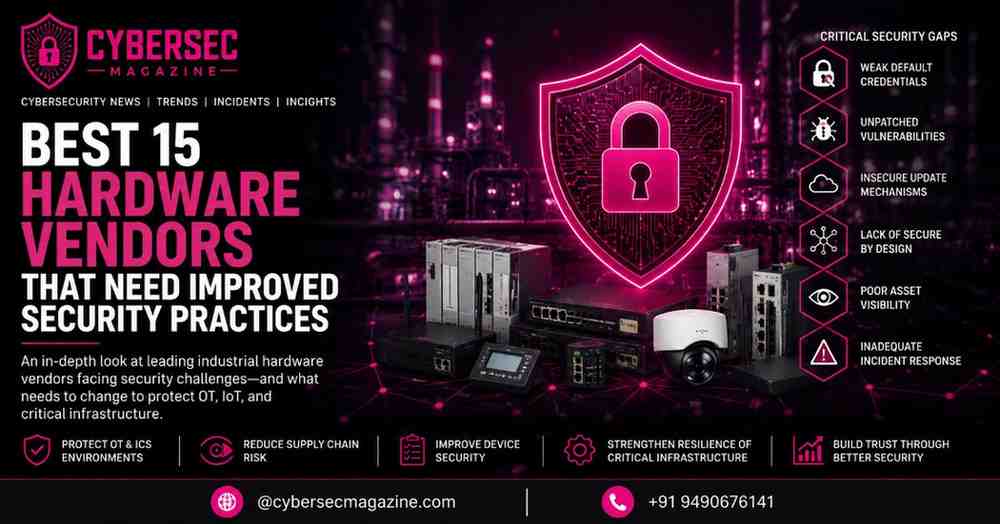
Are your industrial assets secure? Explore 15 hardware categories and vendor practices that require urgent security maturity to protect critical infrastructure.
In 2026, the industrial ecosystem faces a paradox: while software-based cybersecurity tools have reached unprecedented maturity, the physical hardware underlying our critical infrastructure-the PLCs, sensors, gateways, and controllers-remains a persistent weak link. Many industrial hardware vendors are still grappling with a “legacy mindset,” where devices were designed for decades of uninterrupted operation but never for a world where they are directly exposed to the internet.
As IT/OT convergence accelerates, these devices have become the “soft underbelly” of global manufacturing, energy, and logistics networks. When a hardware vendor fails to prioritize secure boot, lacks cryptographically signed firmware, or relies on hardcoded credentials, they are effectively leaving the front door unlocked for state-sponsored actors and sophisticated ransomware syndicates. This article analyzes 15 categories of industrial hardware vendors that must urgently evolve their security practices to meet the threats of 2026.
The Hardware Security Gap: Why Vendors Must Change
The industry is currently shifting from a reactive “patch-when-broken” model to a “secure-by-design” requirement, heavily influenced by regulations like the EU’s NIS2 directive and the US NERC CIP standards. However, many vendors are tethered to aging architectures that cannot support modern security requirements like Multi-Factor Authentication (MFA), granular role-based access, or automated telemetry.
Hardware security is no longer an optional feature; it is a fundamental requirement for operational resilience. Vendors who continue to ship products with default passwords, lack of software bill of materials (SBOM) transparency, or opaque update processes are increasingly becoming a liability for their end-users.
1. Legacy PLC & Controller Manufacturers
Many vendors of legacy Programmable Logic Controllers (PLCs) still rely on decades-old CPU architectures that lack hardware-based security modules like Trusted Platform Modules (TPMs). These devices often process instructions without verifying the integrity of the incoming code, making them highly susceptible to unauthorized logic changes. To improve, these vendors must prioritize the integration of secure elements into their next-generation controller boards to ensure that only cryptographically signed firmware can execute.
2. Low-Cost Industrial IIoT Sensor Vendors
The rapid expansion of IIoT has led to a market flooded with inexpensive sensors designed for quick deployment rather than long-term security. These devices frequently lack the compute power to handle encryption or secure communications, creating massive “blind spots” in the network. Vendors in this space must adopt lightweight cryptographic standards and provide clear, automated pathways for firmware updates to address vulnerabilities discovered post-deployment.
3. Industrial Gateway & Router Providers
Industrial gateways act as the bridge between the plant floor and the enterprise/cloud network, making them prime targets for lateral movement. Many vendors in this category fail to implement robust segmentation features or provide meaningful logging capabilities to detect reconnaissance traffic. Improved security requires these vendors to move toward “hardened by default” configurations that block all unused ports and services immediately out of the box.
4. Human-Machine Interface (HMI) Hardware Suppliers
HMIs often run on stripped-down, proprietary versions of common operating systems that are rarely patched because the hardware vendor manages the lifecycle. This “frozen” state means that any vulnerability discovered in the underlying OS remains active for years. Vendors must transition to containerized or modular software architectures that allow for security patching without requiring a complete hardware replacement or process shutdown.
5. Remote Access Appliance Vendors
Despite the push for Zero Trust, many remote access hardware solutions still rely on outdated VPN protocols that are easily exploited. Some vendors provide proprietary tunneling hardware that lacks support for modern MFA or single sign-on (SSO) integrations, forcing users to rely on single-factor authentication. Vendors need to embrace open, interoperable security standards that allow for seamless integration with enterprise-grade identity management systems.
6. Variable Frequency Drive (VFD) Manufacturers
VFDs are the “muscles” of the factory, but they are often overlooked in security audits. Many vendors do not provide any form of encryption for their internal configuration parameters, allowing an attacker to physically or digitally alter operational settings to induce mechanical failure. Implementing digital signatures for configuration files would prevent unauthorized manipulation and ensure that any change to the drive’s behavior is traceable.
7. Industrial Wireless Access Point (WAP) Makers
Industrial wireless environments are often insecure by default to ensure maximum compatibility with legacy devices. Many WAP vendors fail to provide the granular “client isolation” or “MAC-based filtering” necessary to prevent a rogue device from gaining a foothold in the OT network. Vendors should focus on implementing WPA3 enterprise-grade security and providing automated rogue AP detection as standard features in all industrial-grade hardware.
8. Vision System & Camera Hardware Providers
Industrial cameras and inspection systems are increasingly connected to high-bandwidth networks, providing a massive surface for data exfiltration. Often, these vendors prioritize image processing performance over security, resulting in devices that ship with open telnet ports or administrative interfaces. These vendors need to enforce HTTPS/TLS 1.3 by default and provide users with the ability to disable all non-essential communication protocols.
9. Smart Meter & Utility Hardware Vendors
The infrastructure powering our energy grid consists of millions of smart meters, many of which were deployed with minimal thought toward long-term cybersecurity. As these devices are now central to the Smart Grid, they require robust anti-tamper mechanisms and secure boot capabilities to ensure the integrity of the data they transmit. Vendors must move toward hardware-level device identity (e.g., unique per-device certificates) to prevent device impersonation.
10. Serial-to-Ethernet Converter Vendors
These “bridge” devices are everywhere in industrial environments, connecting ancient serial devices to modern IP networks, often without any security layer in between. Many vendors offer no encryption for the data crossing the bridge, leaving serial communications vulnerable to simple packet sniffing. Manufacturers should embed hardware-based encryption engines that can secure these serial streams without adding significant latency to the industrial process.
11. Industrial Firewall & Security Appliance Vendors
Ironically, some vendors of security appliances themselves have been slow to update their own firmware or address known vulnerabilities in their proprietary software stacks. When the security tool becomes a vector for attack, it undermines the entire security strategy. These vendors must adopt “Secure Development Lifecycle” (SDL) processes and undergo independent, third-party security audits to ensure their products are actually robust.
12. Robotics & Autonomous System Hardware Vendors
As industrial robots become more autonomous, the security of their control hardware becomes a physical safety issue. Many vendors do not provide any way to verify the authenticity of the “motion scripts” being sent to the robot, leading to potential safety hazards. Implementing a “safety-aware” security layer that verifies the physical integrity of commands would be a massive step forward in the robotics industry.
13. Data Logger & Historian Appliance Providers
These devices act as the “black box” of the industrial process, storing years of sensitive operational data. Yet, many data loggers lack basic data-at-rest encryption or physical anti-tamper ports. To improve, vendors must implement full-disk encryption and provide secure, audit-logged APIs that allow security teams to monitor who is accessing historical data logs in real-time.
14. Industrial Protocol Converter/Gateway Manufacturers
Converters that handle complex translations between protocols (like OPC-UA to Modbus) are often “black boxes” that hide security flaws. If the conversion logic is flawed, it can be exploited to crash the target controller. These vendors need to provide transparency into their software stack and undergo rigorous fuzzing tests to ensure that malformed packets cannot crash their conversion engines.
15. GPS & Time Synchronization Hardware Vendors
Precision time protocol (PTP) is essential for modern grid synchronization, but it is rarely authenticated. GPS/GNSS-based time sources are susceptible to spoofing, which can disrupt critical infrastructure timing. Hardware vendors in this space must adopt authenticated time synchronization standards and implement multi-source verification to protect against signal interference or malicious spoofing attacks.
Conclusion: The Path to Industrial Resilience
The responsibility for securing industrial hardware does not lie solely with the end-user. Hardware vendors must accept that in 2026, their products are components of a national security infrastructure. By adopting secure development lifecycles, integrating hardware-based roots of trust, and providing transparency through SBOMs, these 15 hardware categories can move from being an attack vector to a cornerstone of industrial resilience. As a user, the best defense is to demand these security features during the procurement process-forcing the market to value security as much as they value operational uptime.