Understanding OT Managed Detection & Response (MDR) Pricing Models for 2026
Navigate the complexities of OT/ICS MDR pricing. Discover the top 10 models for 2026 to optimize your industrial cybersecurity budget effectively.
In the rapidly evolving landscape of 2026, the Industrial Control System (ICS) and Operational Technology (OT) sectors are facing an unprecedented escalation in cyber-physical threats. As organizations transition from isolated legacy systems to hyper-connected industrial environments, the “security-by-obscurity” model has officially failed. Today, CISO and plant managers are increasingly turning to Managed Detection and Response (MDR) providers to secure their critical assets. Unlike traditional IT security, OT-centric MDR requires deep knowledge of industrial protocols, specialized environmental constraints, and a zero-tolerance policy for operational downtime.
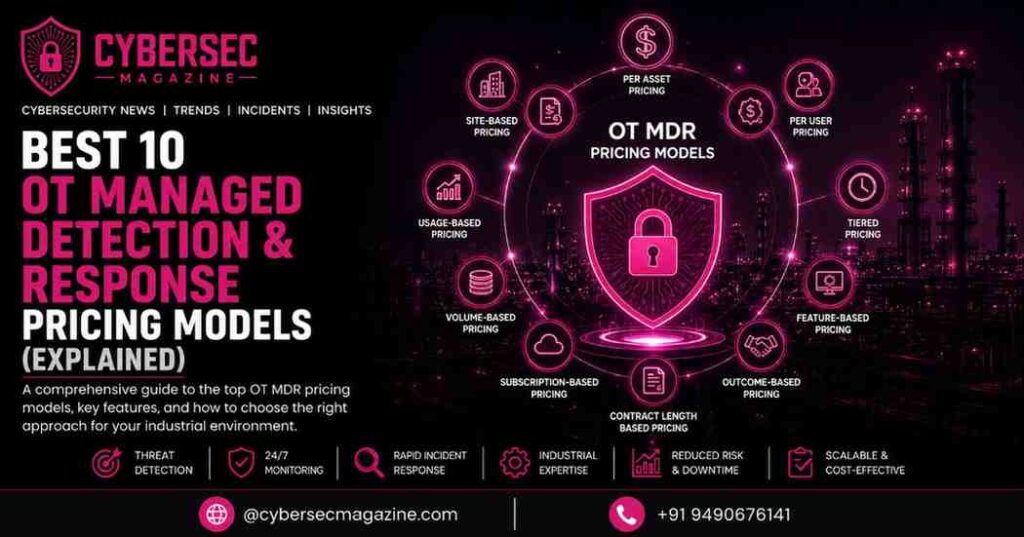
However, one of the biggest hurdles to adoption remains the lack of transparency in pricing. Because no two industrial facilities are alike, vendors often rely on complex, custom-quoted structures that can be difficult to benchmark. Understanding these costs-and the value they provide-is critical for any industrial leader aiming to secure their footprint without breaking their budget. In this guide, we break down the 10 most common and emerging pricing models for OT MDR services, explaining their structures, the risks they entail, and how to select the right one for your facility.
1. The Per-Asset (Device-Based) Model
The per-asset model is perhaps the most intuitive structure for OT environments, where the primary security focus is on the inventory of PLCs, HMIs, and RTUs. In this model, you pay a recurring monthly or annual fee for every unique industrial device monitored by the MDR provider’s sensors. It is highly predictable, allowing budget managers to forecast costs based on their current hardware census. However, the caveat here is “device bloat”; if your environment is dynamic, adding new IIoT sensors can lead to unexpected cost escalations if not strictly managed.
2. Per-Gigabyte (Data Ingestion) Model
Commonly used in large-scale utility or manufacturing environments with massive traffic throughput, this model charges based on the volume of data ingested into the provider’s SOC (Security Operations Center). While it can be cost-effective for smaller networks, it carries the highest “billing risk” during security incidents. If you suffer a ransomware attack or a network loop that floods your logs, your data volume-and consequently your invoice-can skyrocket during the exact period you are already dealing with an emergency.
3. The Flat Monthly Retainer Model
Many premium OT cybersecurity firms prefer a flat retainer, which provides a fixed monthly fee covering a baseline number of assets or a specific facility footprint. This model is highly prized for its simplicity and the ability to maintain predictable operational expenses (OPEX). It usually includes 24/7 monitoring, standard alert triage, and quarterly threat-hunting reports. While it eliminates billing surprises, it often comes with “caps” on incident response hours, meaning you might pay an additional “surge fee” if a major investigation requires the provider to dedicate excessive resources to your site.
4. Tiered Service Level Pricing
This model categorizes service offerings into “Basic,” “Standard,” and “Enterprise” tiers, each offering different levels of depth in threat hunting and incident response. For example, a basic tier might only include monitoring and notification, while an enterprise tier adds proactive threat hunting, configuration audit logs, and digital forensics. This is an excellent model for organizations that want to start small and scale their investment as their cybersecurity maturity increases, though it requires a clear understanding of your internal team’s ability to act on the alerts provided.
5. The Co-Managed (Hybrid) Pricing Model
In a co-managed model, you leverage the provider’s technology stack and threat intelligence, but your internal team retains control over the response actions. Pricing is typically lower than fully managed services because the provider does not assume the operational liability of manual remediation. This structure is ideal for organizations with an existing, though perhaps understaffed, SOC team that needs the specialized OT-protocol expertise that an external provider brings to the table. It balances external intelligence with internal operational knowledge.
6. Outcome-Based (Value-Added) Pricing
A more modern approach, outcome-based pricing ties the vendor’s compensation to specific performance metrics, such as Mean Time to Detect (MTTD) or the number of successful remediations. This model aligns the provider’s incentives directly with your security goals. While still rare in the conservative industrial space, it is gaining traction among top-tier MDR firms that are confident in their AI-driven triage capabilities. It often includes a “bonus” structure or a “performance discount,” making it one of the most transparent models for justifying the ROI of your cybersecurity spend.
7. The “Platform-Plus-Service” Bundle
Many vendors (e.g., those providing both the hardware/software and the managed service) offer a bundled model where the MDR service cost is hidden within the annual licensing fee for the cybersecurity platform. This can appear cheaper on paper, but it effectively locks you into that vendor’s proprietary ecosystem, making it difficult to switch providers later. It is convenient for procurement teams because it consolidates all costs into a single line item, but it can limit your flexibility in adopting best-of-breed tools for different parts of your network.
8. Incident-Based “Surge” Pricing
Some providers charge a low, nominal maintenance fee for continuous monitoring, with an additional “as-needed” cost for active incident response and remediation. This is a high-risk, high-reward model. If you go an entire year without an incident, you save significant capital; however, a single major security event can be financially devastating. This model is generally not recommended for mission-critical industrial environments where regulatory requirements necessitate 24/7 readiness and forensic reporting, regardless of whether an incident is currently occurring.
9. Consumption-Based Scaling (Modular Pricing)
This model treats OT cybersecurity as a utility. You pay for the modules you need: “Log Monitoring,” “Threat Hunting,” “Vulnerability Management,” and “Active Response.” As your facility grows or you add new network segments, you simply “turn on” more modules and the price scales linearly. It is extremely flexible and prevents over-provisioning, allowing you to pay only for the security coverage that is active at any given time. This modular approach is excellent for phased digital transformation projects where the network footprint changes frequently.
10. Multi-Year Contract Discounts
While not a “model” in itself, the multi-year subscription is the most common way to reduce the overall cost of any of the above structures. Providers often offer 10–20% discounts for two-to-three-year commitments because it guarantees them predictable revenue and allows for deeper integration into your environment. For critical infrastructure providers who know they will require long-term monitoring for compliance with standards like IEC 62443 or NIS2, this is almost always the most cost-effective path, provided the vendor has a proven track record.
Selecting the Right Model for Your Industrial Environment
When comparing these models, ignore the “sticker price” and focus on your Total Cost of Ownership (TCO). Ask vendors about hidden fees such as onboarding costs, API integration charges, or the cost of “custom detection engineering”-the process of writing rules specific to your proprietary industrial protocols. Most importantly, ensure your contract clearly defines “responsiveness.” In the world of OT, an alert that arrives three hours late is often worse than no alert at all. Choose a partner whose pricing model incentivizes speed, accuracy, and deep industrial context rather than just “alert volume.”