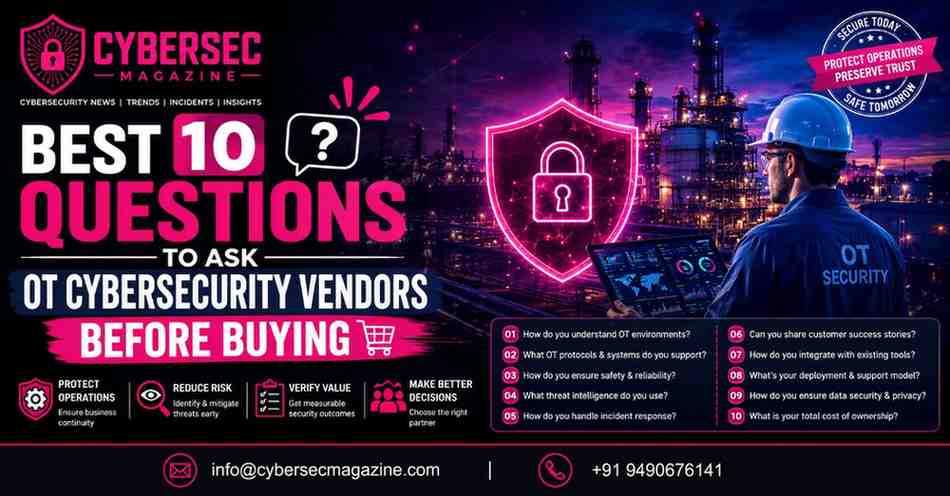
Best 10 Questions to Ask OT Cybersecurity Vendors Before Buying
The New Reality of Industrial Procurement
In 2026, the lines between IT and Operational Technology (OT) have blurred, yet the stakes remain vastly different. While an IT breach might lead to data exfiltration or financial loss, an OT compromise directly threatens human safety, environmental integrity, and the physical availability of critical infrastructure. Choosing a vendor is no longer just about software performance-it is about selecting a partner that understands that “uptime” is a life-safety issue. Many vendors market “all-in-one” cybersecurity solutions, but few truly grasp the sensitivity of legacy PLCs, the nuances of industrial protocols like Modbus or PROFINET, and the catastrophic risk of active network scanning in a live production environment. Before committing your budget, you must peel back the marketing layers to determine if a vendor is genuinely “OT-native” or merely repurposing enterprise IT tools. This guide outlines the 10 essential questions that will help you separate credible industrial security partners from generic IT vendors.
10 Critical Questions for OT Vendors
1. “Was your platform designed for OT, or is it an IT-adapted solution?”
Many vendors simply “bolt on” OT capabilities to existing enterprise IT tools, which can be dangerous in industrial environments. A true OT-native solution accounts for the unique constraints of industrial hardware, such as sensitivity to network traffic and the use of proprietary legacy protocols. Ask them to explain their architecture and how they handle the specific communication patterns found in your sector, like energy or manufacturing. If they struggle to distinguish between a standard IT endpoint and a field controller, they likely lack the foundational knowledge required to secure your most sensitive assets.
2. “How do you handle asset discovery without disrupting delicate legacy controllers?”
Traditional IT tools often use active vulnerability scanning, which can easily crash older, fragile PLCs or HMIs that were never built for modern network loads. An elite OT security vendor will emphasize passive monitoring techniques, such as analyzing traffic via SPAN ports or TAPs, to identify assets without ever injecting packets. Ask them to detail their methodology for asset inventory-specifically, whether they require active polling and what safety mechanisms they have in place to ensure zero impact on your real-time operations.
3. “Can you provide references from industrial clients with similar OT environments?”
Generic corporate references are insufficient for the industrial sector; you need proof of success in environments with high physical risks and legacy complexities. Ask for specific use cases involving your industry-such as oil and gas, power distribution, or automotive manufacturing-and verify if their deployment was successful in a live production environment. If a vendor cannot provide at least three references from organizations that share your specific infrastructure challenges, treat it as a significant red flag for their capability to handle your unique requirements.
4. “How does your solution integrate with my existing IT/OT tech stack?”
A great security tool shouldn’t require a total overhaul of your current investments, such as existing firewalls, endpoint protection, or SIEM platforms. Ask the vendor about their API maturity, native integrations, and their ability to feed data into your existing dashboard for a “single pane of glass” view. If they push for a “rip and replace” strategy, they are likely ignoring your operational reality; instead, look for partners that offer an open ecosystem designed to augment and unify your existing security controls.
5. “What is your approach to OT-specific threat intelligence and adversary tracking?”
Generic cyber-threat feeds often focus on phishing or common web malware, which are rarely the primary threats to industrial networks. You need a partner that tracks the specific Tactics, Techniques, and Procedures (TTPs) of groups targeting Industrial Control Systems (ICS). Ask them to show you examples of their intelligence regarding custom industrial malware or campaigns targeting your specific vendor hardware. Their ability to provide actionable, industrial-grade intelligence is what will keep you one step ahead of nation-state actors and specialized ransomware syndicates.
6. “How do your incident response playbooks account for physical process safety?”
In IT, an infected device is often isolated or shut down immediately, but in OT, such an action could cause a safety incident or an uncontrolled process failure. Challenge the vendor to explain their “Safety-First” response playbooks and how they coordinate with on-site engineering teams. They must prove that their security actions can be staged, reviewed by operators, and executed in a way that prioritizes operational availability over standard IT remediation logic.
7. “Does your software support compliance with global standards like ISA/IEC 62443?”
Compliance is a baseline expectation, but your vendor should actively make your audit process faster and more reliable. Ask them how their reporting tools map directly to the ISA/IEC 62443 standard or the NIST Cybersecurity Framework (CSF) for OT. A strong vendor will offer “push-button” compliance reporting, automated audit logs, and risk-scoring modules that demonstrate to your board or regulators that you are not just meeting compliance on paper, but in practice.
8. “How does your platform handle distributed sites and remote access?”
Industrial organizations often operate across multiple remote substations or geographically dispersed plants, making centralized visibility extremely difficult. Ask the vendor how their architecture handles multi-site deployment without requiring massive hardware overhead at every location. Furthermore, inquire about their specific features for securing third-party remote access-a common vector for breaches-such as session recording, time-bound access, and granular privilege controls that allow you to lock down external connections.
9. “What is your roadmap for securing evolving IIoT and cloud-connected assets?”
The rise of Industrial IoT (IIoT) and cloud-based analytics means your attack surface is constantly growing, and your vendor must evolve with it. Ask them to share their product roadmap for the next 18–24 months regarding new protocol support, cloud-native visibility, and AI-driven detection. A partner that is stagnant in their development cycle will leave you exposed as your facility becomes more digitized and connected to the broader enterprise ecosystem.
10. “What is the total cost of ownership (TCO) beyond the initial software license?”
Hidden costs-such as sensor hardware, recurring maintenance fees, training for your staff, and professional services for onboarding-can quickly derail your budget. Ask for a comprehensive cost breakdown and a clear explanation of how the system scales as you add more devices or sites. Transparency at this stage is a indicator of a healthy, long-term partnership; avoid vendors that provide vague pricing models that could lead to unexpected charges during critical deployment phases.
Final Thoughts for the Decision Maker
Selecting an OT cybersecurity vendor is a strategic decision that bridges the gap between digital security and physical reality. As you interview these candidates, look for more than just technical features; look for a partner that respects your operational constraints and understands the gravity of protecting critical infrastructure. The right vendor will not only provide better visibility and response capabilities but will also empower your internal teams to make smarter, risk-informed decisions every single day. By asking these 10 questions, you move beyond the marketing pitch and into a rigorous evaluation process that ensures your industrial environment is resilient, safe, and ready for the future.