Best 10 OT Cloud SIEM Connectors and Hybrid Tools
OT and ICS teams are no longer securing isolated plant networks. They are defending environments where legacy controllers, HMIs, historians, remote access paths, cloud analytics, and third-party vendors all meet in the same operational chain. NIST’s OT guidance makes it clear that these systems need security controls tailored to performance, reliability, and safety, while Microsoft’s Defender for IoT documentation notes that many OT assets still need agentless, network-layer monitoring and SOC integration because they were never designed with modern endpoint agents in mind. That is the real reason OT cloud SIEM connectors matter: they turn raw industrial telemetry into SOC-ready context without forcing every device to become “cloud-native.”
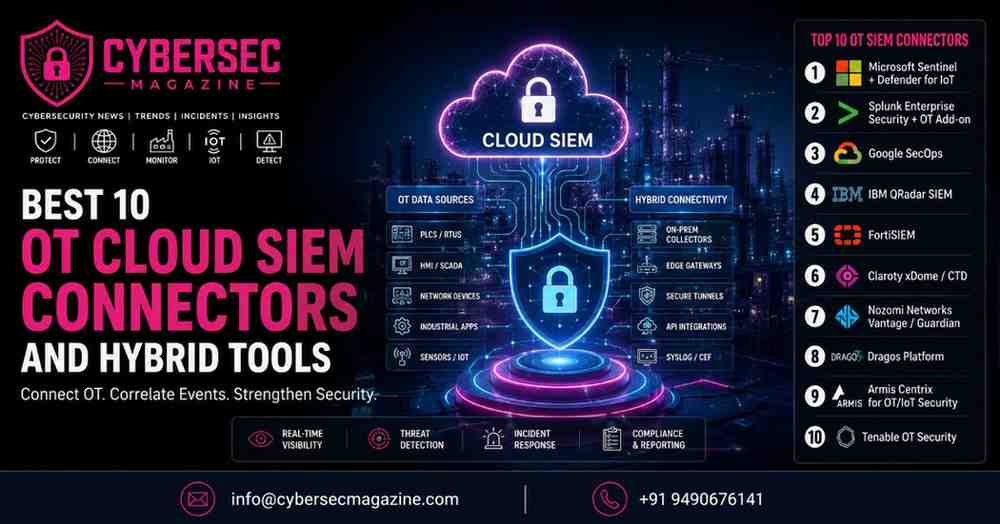
In practice, the best OT SIEM stack is usually hybrid. OT platforms collect and normalize industrial context at the edge, then cloud SIEMs or SIEM/SOAR platforms correlate those events with enterprise identity, endpoint, and cloud logs. Microsoft Sentinel supports Syslog and CEF ingestion through AMA connectors, while vendor platforms such as Claroty, Nozomi Networks, Dragos, Armis, and Tenable all emphasize integrations that push device, vulnerability, and alert data into broader security operations workflows. That mix of local visibility and central analytics is what modern OT monitoring looks like now.
What makes an OT cloud SIEM connector actually useful
A good OT SIEM connector does more than forward logs. It should preserve OT context such as asset identity, protocol behavior, vulnerabilities, network relationships, and criticality, then map that into a format the SOC can use. Splunk’s OT Security add-on, for example, is designed to expand Splunk Enterprise Security into OT environments and work alongside OT vendors such as Claroty, Nozomi Networks, Armis, and Dragos. Nozomi Networks similarly exposes integrations for Splunk, Microsoft Sentinel, QRadar, Google SecOps SIEM, NetWitness, FortiSIEM, and others, showing how modern OT programs are built around data translation rather than a single tool.
1) Microsoft Sentinel + Defender for IoT
Microsoft Sentinel is a cloud SIEM and SOAR platform, and Microsoft Defender for IoT is the OT/IoT layer that feeds it. Microsoft says the Sentinel connector can stream Defender for IoT alerts and incidents into the SIEM, and its Syslog/CEF via AMA connectors can ingest logs from security appliances, Linux machines, and network devices. Defender for IoT also provides agentless monitoring and integrates with industrial equipment and SOC tools, which makes the pair a strong fit for teams that want one cloud analysis layer across enterprise IT and industrial networks.
This stack is especially attractive when a SOC already lives in Microsoft and needs OT data to land in the same investigation workflow. Microsoft also says the Defender for IoT and Sentinel integration supports OT incident analysis and investigation improvements, including IoT device entity pages in Sentinel. For organizations that want a cloud-native SOC with OT as a first-class data source, this is one of the cleanest current options.
2) Splunk Enterprise Security + OT Security Add-on
Splunk remains one of the strongest hybrid choices because its OT Security add-on is built to extend Enterprise Security into industrial environments. Splunk says the add-on improves visibility across both IT and OT, supports on-prem and cloud deployments, and is aligned to ICS use cases. Splunk’s OT content also highlights integrations with Claroty, Nozomi Networks, Armis, and Dragos so that asset inventory, alerts, network traffic, and vulnerability data can be correlated inside Splunk.
That ecosystem matters because OT security teams rarely need just one source of truth. They need OT-aware telemetry plus enterprise correlation, and Splunk’s OT Security tooling is designed for that bridge. Splunk also positions OT Intelligence as a unified view of operational technology, security intelligence, and IT infrastructure, which is exactly the kind of hybrid model most industrial SOCs are trying to reach.
3) Google SecOps
Google SecOps is a cloud-native security operations platform, and its current partner-hosted integration model is built around third-party telemetry sources. Google’s documentation says partner-hosted integrations can push alerts and events into SecOps for correlation, analysis, and response. That makes it a practical destination for OT data that has already been normalized by an OT visibility platform or gateway.
For OT programs, the important idea is not that Google SecOps is “OT-specific” in the narrow sense. It is that it can sit at the cloud end of a hybrid pipeline and receive structured OT data from upstream systems. In environments that already use partner-hosted collectors, API-based integrations, or structured feeds, SecOps can become the central place where OT alerts, enterprise events, and cloud security signals are stitched together.
4) IBM QRadar SIEM
IBM QRadar SIEM is still a serious enterprise SOC platform because of its integration depth. IBM says QRadar supports more than 700 integrations and partner extensions, and QRadar can collect events through DSMs and supported third-party vendor extensions. For OT teams, that broad ecosystem is useful because industrial alerts often need to land next to identity, endpoint, firewall, and cloud signals.
QRadar also shows up repeatedly in OT vendor ecosystems. Nozomi Networks offers QRadar integrations, and Dragos says its platform integrates with IBM Security QRadar by sending information from critical OT networks to SOCs for incident response and investigation. That tells you QRadar is still a meaningful hybrid endpoint for industrial telemetry even as cloud SOC models continue to evolve.
5) FortiSIEM
FortiSIEM stands out because Fortinet explicitly frames it as an IT/OT SIEM. Its datasheet says the platform collects and normalizes events and alerts from hundreds of IT/OT multivendor sources across cloud and on-prem environments, while the product page highlights a full IT/OT CMDB, automatic asset discovery and classification, Purdue model mapping, and asset health alerting. That combination makes it especially relevant in industrial environments where asset inventory and event correlation are equally important.
FortiSIEM also appears in OT support lists for technologies such as Armis Centrix, Claroty CTD, Dragos Platform, and Hirschmann SCADA devices. In other words, it is not just a generic SIEM; it is being positioned as a hybrid security backbone for industrial visibility and monitoring.
6) Claroty xDome / CTD
Claroty’s current integration story is built around connecting CPS protection tools with the systems already in place. Claroty says its integrations are designed to strengthen existing IT, OT, and security technologies, and its Splunk integration can pass device profiling, vulnerability data, risk insights, advanced traffic monitoring, and threat or alert data into Splunk’s analytics and reporting workflow. That makes Claroty a strong connector layer when the OT team wants rich industrial context to flow into the SOC.
Claroty is especially valuable when the SOC needs more than raw alerts. The platform’s OT data model gives the analyst more context about which device is talking, what it is exposing, and how risky that communication looks. That is why Claroty often appears as the upstream source in hybrid OT-SIEM architectures rather than as the SIEM itself.
7) Nozomi Networks Vantage / Guardian
Nozomi Networks has one of the broadest current OT integration ecosystems. Its security operations page lists designed or certified integrations for Splunk, Microsoft Sentinel, IBM QRadar, Google SecOps SIEM, NetWitness, FortiSIEM, OpenText ArcSight, Trellix SIEM, AWS Security Hub, and more. Nozomi’s technical docs also show data integration options for forwarding alerts, asset information, and vulnerabilities to Google Chronicle/Google SecOps SIEM and IBM QRadar, with CEF support and TLS encryption options.
That breadth makes Nozomi a very strong connector-first choice for hybrid SOCs. If your OT visibility stack needs to feed multiple security tools, or if your organization is still deciding between SIEMs, Nozomi’s ecosystem reduces lock-in and helps keep OT telemetry usable across different SOC platforms.
8) Dragos Platform
Dragos is still one of the most recognizable names in OT threat detection, and its integration catalog includes a dedicated SIEM category. Dragos also states that its platform integrates with IBM QRadar by sending information from critical OT networks into enterprise SOCs for response and investigation. That makes it a compelling upstream OT intelligence source for teams that want industrial context before the data hits the SIEM.
For industrial environments, Dragos is often selected not because it replaces the SIEM, but because it improves what the SIEM sees. The platform’s value is strongest when the SOC wants OT-specific prioritization, threat intelligence, and visibility that can be shared with enterprise analytics tools.
9) Armis Centrix for OT/IoT Security
Armis positions Centrix for OT/IoT Security as both SaaS and on-prem, with the on-prem version tailored for air-gapped or sequestered environments. Armis also says its platform integrates natively with SIEM and SOAR platforms, and its SIEM-focused materials explain that it feeds comprehensive device data for IT, OT, and IoT assets into SIEMs to improve decision-making and response. That makes Armis particularly relevant where unmanaged devices are the problem.
Armis is a strong fit for hybrid architectures because it can live close to the industrial environment while still enriching the enterprise SOC. In practical terms, that means the SIEM gets better asset context before it has to decide whether an alert is normal plant behavior or a real incident.
10) Tenable OT Security
Tenable OT Security belongs on this list because it is tightly integrated with the SIEMs that industrial SOCs already use. Tenable’s integration pages and documentation show support for Microsoft Sentinel, Splunk, IBM QRadar, and other SIEM platforms, while its partner ecosystem includes the OT Security add-on for Splunk. Tenable’s own glossary also says its SIEM integrations forward vulnerability findings, asset data, and scan results to enrich SIEM-based detection.
Tenable works well as the vulnerability-and-asset layer in a hybrid OT stack. It is especially useful when the SOC wants to correlate exposure data with live security events, which is often where OT triage becomes faster and more accurate.
How to choose the right one
If you already run Microsoft security tooling, Microsoft Sentinel plus Defender for IoT is the most direct cloud-first route. If you want the broadest OT ecosystem with strong enterprise SIEM depth, Splunk remains a safe shortlist item. If your priority is upstream OT visibility and cross-SIEM forwarding, Claroty, Nozomi, Dragos, Armis, and Tenable are all strong connector layers. If you need a SIEM core with industrial asset depth, FortiSIEM and QRadar are still relevant choices. That recommendation is an inference based on the vendor capabilities above, not a one-size-fits-all rule.
The strongest OT cloud SIEM designs do not force a binary choice between cloud and industrial reality. They use local OT sensors, collectors, or visibility platforms to preserve protocol and asset context, then forward curated telemetry into a SIEM or SIEM/SOAR platform that the SOC can actually operate. That hybrid approach aligns with Microsoft’s connector model, Splunk’s OT add-on strategy, and the broad integration ecosystems exposed by Nozomi, Claroty, Dragos, Armis, and Tenable.
Final take
OT cloud SIEM connectors are not just about log shipping. They are about preserving industrial context so the SOC can investigate faster, correlate better, and respond without losing sight of plant safety and uptime. The best current options are the ones that combine OT-aware collection with SIEM-ready output, whether that target is Sentinel, Splunk, Google SecOps, QRadar, FortiSIEM, or another hybrid SOC platform.