Top 10 Industrial Protocol Translators & Their Security Risks
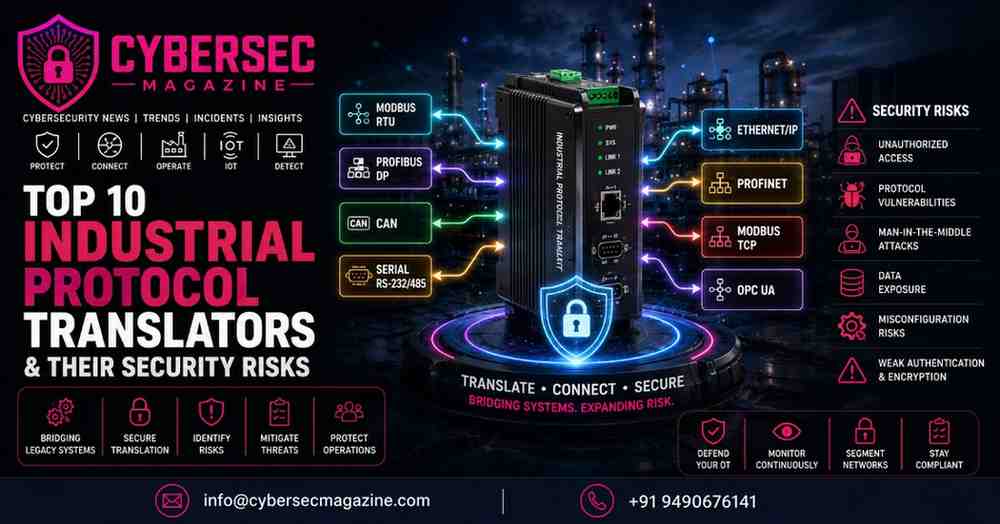
Industrial protocol translators are one of the quiet enablers of modern OT. They keep brownfield plants running, let legacy devices speak to newer control systems, and help teams connect serial, fieldbus, and Industrial Ethernet environments without replacing everything at once. NIST describes OT as a broad class of systems that interact with the physical environment and requires security countermeasures tailored to performance, reliability, and safety. The ISA/IEC 62443 series takes the same view, treating security as a lifecycle discipline for industrial automation and control systems.
The problem is that every protocol translation layer also creates a new trust boundary. The OPC Foundation’s 2026 risk-management paper says non-Ethernet industrial protocols are often expected to live in isolated, secured networks, and if their data is exposed to larger networks, that should happen through gateway/network translation functionality where security controls can be applied. It also notes that many non-Ethernet protocols rely on interoperability without state-of-the-art authentication or encryption. In other words, translators are useful, but they are also security-critical chokepoints.
Why protocol translators matter in OT
Plants rarely operate on a clean slate. They mix legacy serial devices, PROFIBUS islands, Modbus controllers, Ethernet-based PLCs, and edge applications that need data in real time. NIST recommends segmentation, isolation, and authorized communication between zones, often using gateways, firewalls, or unidirectional gateways to enforce those boundaries. That is why protocol translators are so common in OT: they make connectivity possible while preserving as much of the existing plant as possible.
The security trade-off is simple. The more protocols a gateway understands, the more attractive it becomes to attackers and the more careful defenders need to be with management access, firmware, logging, and change control. That is especially true when a product can bridge plant-floor traffic into higher tiers, or when it exposes a web UI, configuration tool, or scripting layer. The right way to look at these devices is not as “just converters,” but as enforced trust boundaries.
Top 10 Industrial Protocol Translators & Their Security Risks
1) Softing epGate PN
Softing’s epGate PN is a gateway that maps EtherNet/IP data to PROFINET devices and can connect an EtherNet/IP scanner to up to 32 PROFINET devices. That makes it a powerful option for multi-vendor control-system integration in factory and process automation.
The security risk is that this kind of bridge can collapse segmentation if it is treated like a simple add-on instead of a boundary device. If the gateway is reachable from both sides without strict rules, a compromise on one network can become a path into the other. NIST’s OT guidance recommends zoning, isolation, and authorized communication only, so epGate PN should be deployed with that model in mind.
2) Softing mbGate PB
Softing’s mbGate PB connects Modbus TCP control systems to PROFIBUS PA and PROFIBUS DP segments, supporting integration of up to two PA segments and one DP segment. It is a classic brownfield-modernization tool for process environments where field devices still speak older protocols.
The risk is not only that Modbus is inherently weak from a security perspective; it is also that the gateway becomes a single point where Modbus traffic, fieldbus traffic, and asset-management workflows meet. The OPC Foundation’s risk paper warns that legacy protocols often lack native authentication and encryption, which means the gateway must compensate with hardening, segmentation, and strict control of management interfaces.
3) Softing echochange
Softing’s echochange is a protocol converter for exchanging data between different controllers and Ethernet networks from major automation vendors. Softing positions it as a way to connect networks and devices from manufacturers such as Siemens, Rockwell Automation, and Schneider Electric where direct data exchange was previously difficult.
That interoperability is useful, but it also broadens the blast radius of a misconfiguration. When a translator is allowed to normalize or relay traffic across different vendor ecosystems, the security team has to be sure the resulting data path is still intentional, documented, and monitored. In OT, “connectivity” should never outrun the architecture that governs it.
4) HMS Anybus Communicator – Serial Master to EtherNet/IP Adapter
HMS Networks’ Anybus Communicator Serial Master to EtherNet/IP enables RS-232/RS-485 devices to connect to EtherNet/IP control systems. HMS also says the current Communicator line includes built-in cybersecurity features and is compliant with the Cyber Resilience Act, which makes it one of the more security-aware translator families in this category.
The security risk remains the same as with most serial-to-Ethernet bridges: older serial devices usually were not designed for hostile networks. If a legacy device suddenly becomes reachable through a modern Industrial Ethernet segment, the translator can expose unmanaged endpoints that were previously hidden. That is exactly why the gateway should sit inside a segmented architecture with minimal exposed services and documented access control.
5) HMS Anybus Communicator – CAN to Modbus-TCP 2-Port
This Anybus Communicator variant converts CAN-based protocols to Modbus-TCP, allowing CAN equipment to talk to Modbus TCP control systems. HMS frames these products as easy-to-use, secure, high-speed industrial-network bridges.
The risk here is protocol mismatch. CAN systems and Modbus TCP systems often have very different assumptions about timing, trust, and exposure. Once traffic is translated into a more routable Ethernet service, the OT team has to treat the gateway as a controlled access point rather than a transparent pipe. That means firmware governance, change management, and testing the translation logic before production deployment.
6) Moxa MGate 5103 Series
Moxa’s MGate 5103 is an industrial Ethernet gateway that converts Modbus RTU/ASCII/TCP or EtherNet/IP into PROFINET-based communications. Moxa’s support pages also show current documentation activity for the series, and the datasheet notes security features based on IEC 62443.
The security challenge is that the gateway stores the latest exchange data and becomes part of the control path. If a device like this is compromised, an attacker may not only intercept traffic but also influence the data being relayed between ecosystems. For that reason, it should be deployed with least-privilege access, secure configuration management, and logging that supports incident response.
7) Moxa MGate MB3180 / MB3280 / MB3480 Series
Moxa’s MB3180, MB3280, and MB3480 gateways convert Modbus TCP and Modbus RTU/ASCII protocols, supporting multiple masters and slaves and offering routing controls by IP address, TCP port, or ID mapping. That flexibility makes them common in mixed Modbus environments.
The risk is that Modbus is still widely used in legacy industrial networks without modern security primitives, so the gateway often becomes the de facto enforcement layer. If routing rules are loose, or if serial-side assets are exposed too broadly, the gateway can turn a contained segment into a reachable extension of the Ethernet network. NIST’s segmentation guidance makes clear that these devices should be used to enforce only explicitly authorized communications.
8) Phoenix Contact GW MODBUS TCP/RTU 1E/1DB9
Phoenix Contact’s GW MODBUS TCP/RTU gateway converts serial Modbus RTU or ASCII into Modbus TCP and supports serial client or server devices. It is a straightforward industrial protocol converter with a compact hardware footprint.
Its security risk is typical of serial-to-Ethernet conversion: the moment a serial control link is exposed as an IP service, it becomes easier to scan, enumerate, and reach from adjacent networks. Because legacy protocol traffic is often assumed to be “trusted by default,” the gateway should be surrounded by segmentation, strict allow-listing, and monitored administrative access.
9) Phoenix Contact GW EIP/MODBUS 2E/2DB9
Phoenix Contact’s GW EIP/MODBUS gateway enables two-way communication between EtherNet/IP and Modbus, which is useful when plants need to bridge modern PLC networks and older field systems. It is another example of how protocol translation is often the shortest path to interoperability.
The security risk is that EtherNet/IP and Modbus are not equally mature from a defensive perspective across every deployment. A gateway that translates between them can also translate attacker reachability if it is not tightly segmented. In practice, this means the product should be treated like a policy boundary, not a convenience bridge.
10) Siemens Machine Protocol Gateway
Siemens’ Machine Protocol Gateway is designed to restore connectivity to older SINUMERIK machines after security updates and to enable communication via SMB between the shopfloor network and machines. Siemens’ own operating guidance also says general network security rules apply, including firewalls, opening only required ports, and restricting physical access to the device.
The risk is obvious: SMB bridging on the shopfloor is powerful, but SMB is also a protocol that security teams treat with caution in enterprise environments. If a gateway like this is overexposed, it can provide a high-value pathway into older machine networks. That makes disciplined network design, port minimization, and cabinet-level physical control essential.
11) Hilscher netTAP 100
Hilscher’s netTAP 100 is a high-end gateway for industrial automation networks. Hilscher says it supports conversions between real-time Ethernet, fieldbus, and serial protocols, combines master and slave roles in different variations, and supports loadable firmware and Lua-based scripting via netSCRIPT.
That flexibility is valuable, but it also increases attack surface. Scripting, loadable firmware, and broad protocol support mean change control must be rigorous, because the gateway is no longer a passive translator; it is a programmable enforcement point. In OT terms, that means version control, testing, and tightly managed administration are not optional.
What to look for before you deploy one
The most important question is not “does it convert protocol A to protocol B?” It is “what security boundary does it create, and can I prove that it only allows the traffic I intended?” NIST’s OT guidance recommends segmentation, isolation, and explicit authorization between zones, while ISA/IEC 62443 frames security as a lifecycle activity across people, processes, and technology.
A strong industrial protocol translator should have documented hardening guidance, role-based administration if possible, logging, backup and restore for configuration, secure firmware updates, and a clear story for how it behaves when a translated network is under stress. If it also supports secure placement in a cabinet or monitored area, as Siemens recommends for its machine gateway, that is even better.
Final thoughts
Industrial protocol translators are essential for keeping legacy plants connected, but they should never be treated as neutral plumbing. They are trust boundaries that can improve interoperability and also create risk if they are misconfigured, overexposed, or poorly monitored. The safest deployments are the ones that combine the right translator with the right segmentation, logging, and change-control discipline.