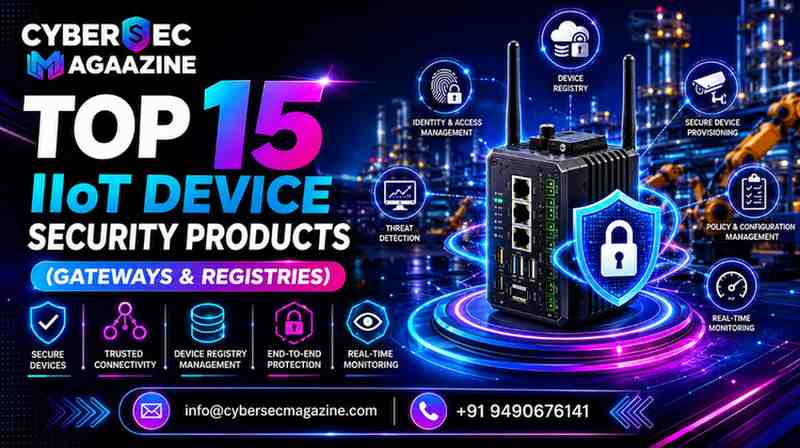
Top 15 IIoT Device Security Products (Gateways & Registries)
Industrial IoT has changed the way factories, utilities, transportation systems, and critical infrastructure operate. Sensors, controllers, cameras, gateways, and edge devices now collect and move data continuously, which improves efficiency but also expands the attack surface. In modern OT and ICS environments, security is no longer only about the network perimeter. It is also about knowing which devices are allowed to connect, how they are provisioned, where data is processed, and how remote access is controlled. That is why registries and gateways have become core security building blocks, not optional add-ons.
The best IIoT security products now do more than connect machines to the cloud. They support device identity, zero-touch provisioning, encrypted communications, anomaly monitoring, remote maintenance, and secure edge processing. Many industrial vendors also align their products and processes with IEC 62443, which has become a key reference point for industrial cybersecurity design and implementation.
Background: Why IIoT Device Security Matters
Traditional IT security tools often struggle in OT environments because industrial systems have longer lifecycles, mixed vendor ecosystems, legacy protocols, and uptime requirements that leave little room for disruption. A weakly managed gateway, an unmanaged remote access path, or a device that is not properly registered can become the entry point for a wider compromise. Current vendor documentation reflects this reality: cloud registries manage identities, device provisioning services automate onboarding, and industrial gateways increasingly combine routing, firewalling, VPN, and local processing in one platform.
For readers evaluating solutions, the important question is not simply “Which product connects my device?” It is “Which product helps me control trust, visibility, and access across the full device lifecycle?” The list below focuses on products that do exactly that.
Top 15 IIoT Device Security Products
1. AWS IoT Core Registry & Fleet Indexing
AWS IoT Core provides a registry that represents physical devices or logical entities as “things,” helping teams manage device identity at scale. AWS also documents registry events for created, updated, and deleted things, thing types, and thing groups, while fleet indexing makes it easier to search and organize large device fleets. For organizations building a cloud-based IIoT control plane, this combination gives a structured way to track assets and react to lifecycle changes.
2. AWS IoT Device Defender
AWS IoT Device Defender is AWS’s managed security and monitoring service for IoT fleets. It audits IoT resources against security best practices and monitors connected devices for abnormal behavior, helping teams spot potential compromise or configuration drift early. In industrial deployments, that monitoring layer is valuable because a device can appear healthy at installation time and later drift into a risky state without warning.
3. AWS IoT Greengrass
AWS IoT Greengrass is an open-source edge runtime and cloud service that helps devices act locally on the data they generate. AWS says it can run machine-learning predictions, filter and aggregate data, and communicate securely with local devices and AWS IoT Core. That makes it especially useful for industrial environments where latency, intermittent connectivity, and local decision-making matter.
4. Azure IoT Hub Identity Registry
Every Azure IoT Hub includes an identity registry that stores the devices and modules permitted to connect. Microsoft notes that a device cannot connect unless an identity exists in the registry, and that the registry can be used to provision devices, control access, and disable devices when compromise is suspected. For enterprise OT teams, this is a foundational control point for trust and access management.
5. Azure IoT Hub Device Provisioning Service (DPS)
Azure IoT DPS enables zero-touch, just-in-time provisioning to the right IoT Hub without requiring human intervention. Microsoft documents it as a secure and scalable way to provision millions of devices, which is exactly what large industrial fleets need when onboarding must be repeatable and low-error. DPS is one of the strongest answers for organizations trying to remove manual enrollment from the security process.
6. Azure IoT Edge
Azure IoT Edge lets organizations run workloads closer to the device and can be configured as a transparent gateway for downstream devices. Microsoft’s documentation shows that IoT Edge supports transparent gateway relationships where a gateway maintains the IoT Hub connection while downstream devices send data through it. That makes it useful for plant-floor scenarios where a single trusted edge node needs to mediate multiple devices.
7. Cisco IC3000 Industrial Compute Gateway
Cisco positions the IC3000 as an industrial compute gateway with multilayered security and policies for data ownership, policy, and privacy. Cisco’s documentation also highlights tamper-proof hardware, secure boot, and certificate-based authentication for management-plane security. For teams that want rugged edge connectivity with a stronger trust model, the IC3000 stands out as a serious industrial gateway platform.
8. Phoenix Contact FL mGuard Security Routers
Phoenix Contact’s mGuard routers are built for secure industrial networking and remote access. The company documents stealth mode deployment, encrypted VPN communication, firewall protection, and certification under IEC 62443-4-1 and IEC 62443-4-2 for the 2000 and 4000 families. It also provides central configuration through the mGuard Device Manager, which is important when a plant has many distributed assets.
9. Phoenix Contact TC ROUTER 3002T-4G
The TC ROUTER 3002T-4G is designed for secure industrial communications with IPsec or OpenVPN tunnels and an integrated stateful packet inspection firewall. That combination makes it well suited for remote maintenance, segmented machine networks, and cellular-backed industrial connectivity where unauthorized access must be tightly controlled.
10. Moxa Secure Routers
Moxa’s EDR Series industrial secure routers combine an industrial firewall, VPN, router, and L2 switching in a single product. Moxa also states that its secure routers are designed around IEC 62443-4-2 and include advanced functions such as IPS, IDS, and deep packet inspection. In industrial environments where secure segmentation is as important as connectivity, that mix is highly practical.
11. Moxa MGate Protocol Gateways
Moxa’s MGate protocol gateways bridge serial devices to Ethernet networks and support conversions across a wide range of industrial protocols, including Modbus TCP, PROFINET, EtherNet/IP, IEC 61850, CANopen, and EtherCAT. These gateways are especially valuable in brownfield OT environments where legacy systems need to be connected without exposing them directly to the broader network.
12. Ewon Cosy+ Remote Gateway
Ewon Cosy gives technicians fast, secure, reliable remote access to machines without disrupting the local network. HMS also states that Cosy+ gateways include a certified secure element chip that creates a hardware root of trust. For machine builders and service teams, that is a strong combination of operational convenience and security discipline.
13. Advantech Industrial IoT Edge Gateway
Advantech’s Industrial IoT Edge Gateway portfolio is designed to bridge data from edge devices to the cloud and can act as protocol converters, data collectors, or data loggers. In practice, that makes it useful for industrial teams that need a rugged gateway layer to normalize data before it is sent into higher-level platforms.
14. Teltonika RUT140 Industrial Modbus Router
Teltonika’s RUT140 is a compact industrial Ethernet router that improves security through network isolation for end devices. It supports industrial protocols such as Modbus, DLMS, DNP3, and OPC UA, and is compatible with Teltonika RMS for remote and on-site management. That makes it a good fit for smaller industrial deployments that still need structured segmentation and remote oversight.
15. Siemens RUGGEDCOM
Siemens RUGGEDCOM is built for harsh industrial environments and supports cybersecurity and edge computing applications in sectors such as power, transportation, and oil and gas. Siemens highlights rugged reliability across extreme temperatures and high EMI conditions, along with features such as zero packet loss, failover, and rapid recovery. For mission-critical OT networks, that reliability is part of the security story.
How to Choose the Right IIoT Security Product
A registry is the right starting point when your biggest challenge is trust, device identity, and onboarding. A gateway is the right starting point when your biggest challenge is segmentation, secure remote access, local processing, or protocol translation. Most mature industrial environments need both. The registry establishes who and what is allowed into the environment, while the gateway enforces how that connection behaves at the edge.
The strongest deployments also align security controls with industrial standards and operational realities. Products that support encrypted remote access, hardware-backed trust, zero-touch provisioning, and central fleet visibility are better suited to OT and ICS environments than simple connectivity devices. That is the key lesson across the current market: IIoT security is not one box, one dashboard, or one policy. It is an architecture.