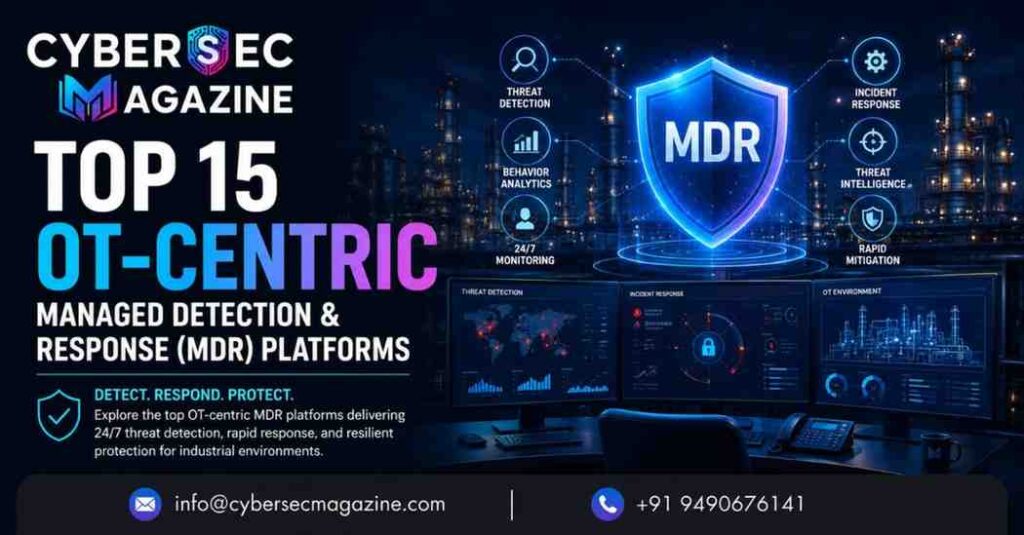
Top 15 OT-Centric Managed Detection & Response (MDR) Platforms
Why OT MDR is different from IT MDR
In IT, containment can often mean isolating a laptop, pushing an agent update, or resetting credentials. In OT, the same action can stop a production line, trigger a safety issue, or violate uptime constraints. That is why OT MDR tools are built around passive monitoring, asset context, protocol awareness, and response playbooks designed for industrial reality. NIST’s OT guidance and Microsoft’s Defender for IoT documentation both highlight agentless or network-based monitoring, device discovery, and risk-based response as core requirements.
A strong OT MDR stack usually does four things well: it discovers assets without interfering with them, understands OT traffic and process behavior, prioritizes risks based on operational impact, and gives analysts and responders enough context to act quickly. The platforms below are ranked editorially based on depth of OT support, response maturity, and how well they fit real industrial SOC workflows.
1) Dragos
Dragos remains one of the strongest names in OT security because it combines platform visibility, threat detection, and incident response services purpose-built for industrial infrastructure. The platform covers asset visibility, vulnerability prioritization, and OT threat detection, while its response workflows and expert retainers are designed specifically for ICS environments.
What makes Dragos stand out is the way intelligence, investigations, and response are tightly connected. Its platform uses OT-specific detections, guided playbooks, and case management to cut mean time to resolution without disrupting operations, while its 24/7 incident response retainers give industrial teams access to experts who understand safety and continuity requirements.
2) Claroty xDome
Claroty’s xDome platform is built for cyber-physical systems across industrial, healthcare, commercial, and public-sector environments, and it emphasizes visibility, exposure management, and threat detection across the XIoT. Claroty also integrates detection with SIEM, SOAR, EDR, and remote access workflows, which makes it a strong fit for organizations building OT-aware SOC operations.
Its MDR relevance is strengthened by ecosystem integrations. Claroty has partnered with Deloitte on an OT module for expanded MXDR, and it also offers remote incident management capabilities that help teams detect, investigate, and respond to incidents across the OT lifecycle. That combination makes Claroty especially attractive for enterprises that want managed security around a broad, converged attack surface.
3) Nozomi Networks
Nozomi Networks is widely recognized for OT and IoT visibility, but the platform has moved well beyond passive discovery. It now combines network and endpoint visibility, threat detection, AI-powered analysis, and response-oriented tooling across cloud and on-prem management models. Its Arc endpoint sensor adds threat prevention and response actions such as detection, quarantine, and delete modes for OT endpoints.
Nozomi is also relevant to MDR-led SOC workflows because it integrates with managed detection and response ecosystems and security operations tools. The platform’s AI-powered analysis and response layer is designed to extend security-team reach, which is particularly useful when a plant or utility lacks a large in-house OT security staff.
4) Armis Centrix for OT/IoT Security
Armis Centrix is a broad cyber exposure management platform, but its OT/IoT security module is highly relevant for converged industrial environments. Armis emphasizes passive, agentless discovery, OT-specific context, and non-intrusive monitoring across IT, OT, IoT, and IoMT assets.
For MDR programs, Armis is useful because it helps teams see what exists, how it behaves, and where risk is accumulating before analysts even start investigation. Its value is especially strong in environments where unmanaged devices, third-party equipment, and network-connected assets create blind spots that a traditional SOC would miss.
5) Microsoft Defender for IoT + MDR for OT ecosystems
Microsoft Defender for IoT provides real-time asset discovery, vulnerability management, and cyberthreat protection for IoT and ICS/OT environments. Microsoft’s documentation also highlights agentless monitoring, OT network sensors, and integration with Microsoft Defender XDR and Microsoft Sentinel for unified investigation and response.
On the managed side, Cegeka’s MDR for OT uses Defender for OT and Microsoft Sentinel to provide 24×7 monitoring and response advice, which makes this ecosystem especially attractive to organizations already standardized on Microsoft security tooling.
6) CrowdStrike Falcon for XIoT
CrowdStrike’s Falcon for XIoT is positioned around unified IT and XIoT security, with 24/7 expert-led MDR and fast asset visibility across operational and connected-device environments. The platform focuses on rich context such as hardware details, Purdue level, and device behavior, which is exactly the kind of context OT responders need.
For organizations looking to reduce tool sprawl, CrowdStrike is compelling because it ties endpoint and XIoT protection into a single operational model. Claroty’s alliance with CrowdStrike further underscores the market direction: industrial visibility and endpoint protection are converging instead of living in separate silos.
7) Darktrace MDR for Critical Infrastructure
Darktrace’s ActiveAI Security Platform provides detection and autonomous response across the digital estate, and its managed services portfolio includes Managed Detection & Response. For critical infrastructure teams, Darktrace explicitly positions its MDR offering around converged IT and OT environments, 24/7 monitoring, AI-led investigations, and OT-specific visibility.
Darktrace is a good fit for teams that want behavior-based detection and response support across mixed environments, especially where traditional signature-heavy approaches struggle with novel or fast-moving threats. The value proposition is less about pure ICS tooling and more about resilient monitoring in converged environments.
8) Fortinet OT Security Platform
Fortinet’s OT Security Platform now includes deeper OT-specific threat visibility, segmentation, secure connectivity, and an upgraded OT SecOps portfolio. Fortinet also ties together managed detection and response, cloud SOC capabilities, and OT-focused network detection with FortiNDR and FortiGuard OT Security Service.
This makes Fortinet attractive for industrial organizations that want one vendor across networking, segmentation, and detection. Its OT NDR capabilities support common industrial protocols and ML-based analysis, helping SOC teams hunt across OT and IT traffic without relying on endpoint agents.
9) Cisco Industrial Threat Defense / Cyber Vision
Cisco’s Industrial Threat Defense package brings asset discovery, microsegmentation, secure remote access, and unified IT/OT threat detection and response into the industrial network. Cisco Cyber Vision is embedded in the network, which helps teams gain OT visibility without dedicated appliances, and Cisco Talos Incident Response adds 24/7 expert response services.
For large industrial environments, Cisco’s biggest advantage is scale. If your OT environment already uses Cisco switching or security infrastructure, the ability to extend security operations through the same fabric can simplify deployment and improve consistency across sites.
10) Forescout 4D Platform
Forescout’s 4D Platform continuously identifies, protects, and governs IT, IoT, IoMT, and OT assets. Its OT-specific capabilities include passive monitoring, 250+ protocol DPI, non-intrusive vulnerability identification, and threat detection and response aligned with MITRE ATT&CK for ICS.
The platform is especially useful for organizations that need asset intelligence and enforcement across highly distributed environments. Forescout’s eyeAlert and eyeInspect products also connect OT telemetry to orchestrated actions across the security stack, which makes it a strong MDR-adjacent option for mature SOCs.
11) Kaspersky Industrial CyberSecurity
Kaspersky Industrial CyberSecurity is marketed as a native XDR platform for critical infrastructure protection. It provides infrastructure visibility, threat elimination, and centralized security operations for OT and IoT environments, including converged, distributed, air-gapped, and legacy systems. Kaspersky also offers an add-on 24/7 MDR service for OT systems.
For industrial enterprises that want a combined platform and managed service model, Kaspersky is notable because it ties detection, response, and operational awareness together. That can be especially valuable in plants that need broad protection but do not want to redesign production architecture.
12) Palo Alto Networks OT Security Solution
Palo Alto Networks’ OT Security Solution focuses on comprehensive visibility, segmentation, and secure operations for industrial environments. The company says its approach uses ML, App-ID, and Device-ID to profile OT, IT, and IoT devices, including DCS and HMI assets, and to accelerate incident response through isolation and quarantine of compromised assets.
This is a strong fit for organizations that want OT capabilities inside a larger Zero Trust architecture. It is not a pure-play MDR vendor, but it is highly relevant for industrial response programs that want prevention, detection, and containment in one policy framework.
13) TXOne Complete
TXOne markets an operations-first OT security platform built around unified network, endpoint, and inspection protection. The company emphasizes zero unplanned downtime, sub-second coordinated response across layers, and broad protocol coverage for industrial networks.
TXOne is especially appealing where legacy OT assets, lifecycle extension, and production continuity matter more than aggressive IT-style containment. In MDR terms, it helps shrink the response gap by coordinating protection and response in a way that is designed for industrial operations rather than enterprise desktops.
14) Check Point ICS Security with OT/IoT integrations
Check Point’s ICS security portfolio focuses on passive OT asset discovery, segmentation, and automated threat detection and response. The company positions its ruggedized gateways and OT security solutions for critical infrastructure, manufacturing, energy, utilities, and transportation.
Check Point becomes more MDR-relevant when paired with OT visibility and automation partners such as Ordr or Nelysis, where agentless discovery and containment can be tied into a broader enterprise security stack. That makes it a practical option for teams that want OT protection but already run a Check Point-centric environment.
15) Secureworks Taegis MDR for OT
Secureworks offers one of the clearest “true MDR for OT” narratives in the market. Taegis MDR for OT is built to provide 24/7 monitoring, detection, investigation, and coordinated response across IT and OT environments, backed by OT-focused security experts and integrations with leading OT toolsets.
This is a strong choice for industrial organizations that want a fully managed SOC experience rather than just tooling. Secureworks also positions the service around playbooks, threat hunting, response workflows, and unified visibility, which makes it especially relevant for mid-sized and enterprise OT teams that need operational lift.
Final thoughts
The OT MDR market is maturing quickly, but the winning platforms all share the same traits: passive visibility, OT-native context, safe response, and a path from alert to action that does not threaten uptime. NIST’s guidance, Microsoft’s OT documentation, and the current product direction from leading vendors all point to the same conclusion: industrial security now depends on platforms that can see, understand, and respond without disrupting operations.