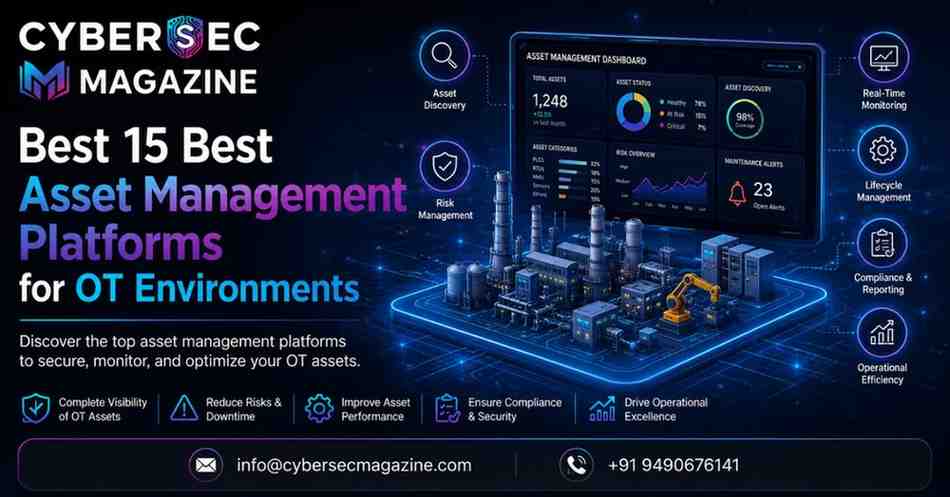
Best 15 Asset Management Platforms for OT Environments
Why OT Asset Management is Uniquely Challenging
In traditional IT, asset discovery relies heavily on active scanning-pinging IP addresses, deploying agents, and forcing devices to report their status. If an IT scanner temporarily slows down a laptop, it is a minor annoyance. If an IT scanner pings a 15-year-old Programmable Logic Controller (PLC) managing a chemical mixing valve, it could crash the device and halt the entire production line.
Managing assets in an industrial environment presents a distinct set of hurdles:
- Fragile Legacy Equipment: Many industrial control systems were designed decades ago with zero built-in security and limited processing power. They cannot handle aggressive active network polling.
- Proprietary Protocols: OT environments communicate using hundreds of specialized, vendor-specific protocols (e.g., Modbus, DNP3, CIP, Profinet). Generic IT tools simply cannot read this traffic.
- Patching Constraints: You cannot simply reboot a SCADA server or patch an HMI mid-production. Vulnerability management in OT requires risk prioritization and compensating controls, not just automated patching.
- Decentralized Operations: Remote substations, offshore rigs, and distributed manufacturing plants require highly scalable monitoring architectures that can operate in low-bandwidth conditions.
To solve these challenges, OT-native asset management platforms utilize passive network monitoring-ingesting a copy of network traffic via a SPAN port or TAP-to silently map the environment. Many now also use highly targeted, vendor-approved “safe active queries” or project file analysis to extract deeper granular details, such as firmware versions and backplane configurations, without risking operational stability.
The Top 15 Asset Management Platforms for OT Environments
Here is a detailed breakdown of the leading platforms dominating the industrial cybersecurity landscape, ranked by their capabilities, market presence, and technological maturity.
1. Claroty (xDome & CTD)
Claroty remains one of the most comprehensive Cyber-Physical System (CPS) protection platforms on the market. Engineered for breadth, it spans across OT, IoT, IoMT (Internet of Medical Things), and BMS (Building Management Systems).
- Key Capabilities: Claroty excels in ultra-deep asset discovery. It combines passive network monitoring with its proprietary “Safe Queries” technology and project file analysis to identify assets down to the granular firmware and component level.
- Why it stands out: Its deployment flexibility is unmatched, offering both the cloud-native Claroty xDome and the on-premises Continuous Threat Detection (CTD) architecture.
- Best For: Large, complex enterprises looking for a single unified platform to cover highly diverse cyber-physical environments.
2. Dragos Platfor
Founded by former intelligence community practitioners, Dragos takes a distinct, threat-intelligence-first approach to OT asset management. Their platform is built specifically for operational technology, completely bypassing the “IT-adapted” trap.
- Key Capabilities: The platform provides real-time passive discovery mapping mapped against an industry-leading OT threat intelligence feed. It continuously parses over 600 industrial protocols through deep packet inspection.
- Why it stands out: Dragos excels in its “Now, Next, Never” vulnerability management framework, which filters out the noise and highlights the critical 6% of vulnerabilities that actually require immediate attention in an industrial setting.
- Best For: Critical infrastructure providers, utilities, and mature security teams that require deep ICS threat intelligence and incident response capabilities.
3. Nozomi Networks (Vantage & Guardian)
Nozomi Networks is a pioneer in bringing AI-driven anomaly detection and massive scalability to industrial asset management.
- Key Capabilities: By deploying Guardian network sensors at the edge and centralizing the data through their cloud-based Vantage platform, Nozomi provides a highly visual, interactive map of complex, distributed networks.
- Why it stands out: The platform learns standard operational baselines and uses AI to immediately flag deviations-whether they are malicious cyber threats or simple operational misconfigurations.
- Best For: Highly distributed industrial environments (like oil & gas pipelines or multi-site manufacturing) that need a scalable, AI-assisted approach to continuous monitoring.
4. Armis Centrix
Armis focuses heavily on the concept of converged asset intelligence. Rather than isolating OT, Armis seeks to secure the entire attack surface by providing absolute visibility into every connected device.
- Key Capabilities: Operating entirely agentless, Armis leverages a massive crowdsourced Device Knowledgebase tracking billions of device profiles. This allows it to instantly identify and classify IT, OT, IoT, and medical devices the moment they connect to the network.
- Why it stands out: Its strength lies in behavioral tracking and policy enforcement, identifying when a seemingly harmless IoT device attempts to communicate with a critical PLC.
- Best For: Converged organizations where the boundaries between IT, OT, and smart IoT devices are heavily blurred.
5. Microsoft Defender for IoT (Formerly CyberX)
Following Microsoft’s acquisition of CyberX, Defender for IoT has evolved into a robust, integrated component of the broader Microsoft security ecosystem.
- Key Capabilities: It delivers agentless, passive network monitoring that rapidly discovers unmanaged OT/ICS assets, maps network topologies, and identifies vulnerable firmware.
- Why it stands out: Its tight native integration with Microsoft Sentinel (SIEM) and Defender for Endpoint creates a unified IT/OT SOC workflow. Security analysts can track multi-stage attacks that originate in the IT network and move laterally into the OT environment from a single dashboard.
- Best For: Organizations heavily invested in the Microsoft Azure and Defender security stacks seeking streamlined SOC convergence.
6. Tenable OT Security
Formerly known as Indegy, Tenable OT Security bridges the gap between traditional IT vulnerability management and industrial operational technology.
- Key Capabilities: Tenable blends passive network monitoring with patented active querying capabilities designed specifically not to disrupt legacy industrial controllers.
- Why it stands out: It provides an incredibly clear picture of asset configurations, tracking unauthorized changes to PLC logic code and maintaining highly accurate vulnerability scores that align perfectly with existing Tenable IT vulnerability metrics.
- Best For: Enterprises already utilizing Tenable.io or Nessus that want to extend a unified vulnerability management framework onto the factory floor.
7. Industrial Defender
Industrial Defender has been a quiet but powerful force in OT cybersecurity since 2006, distinctly focusing on the intersection of asset management and strict regulatory compliance.
- Key Capabilities: Unlike platforms that rely solely on passive listening, Industrial Defender actively and safely communicates with OT endpoints to extract deep configuration data, baseline configurations, and software inventories.
- Why it stands out: It is arguably the strongest platform for managing complex compliance mandates like NERC CIP, NIS2, and IEC 62443, effectively automating the audit reporting process.
- Best For: Power generation, utilities, and heavily regulated industries operating in regions with strict government cybersecurity mandates (such as the Middle East and North America).
8. Forescout (eyeInspect)
Forescout has long been a leader in network access control, and its eyeInspect module (formerly SilentDefense) brings that expertise deep into the OT layer.
- Key Capabilities: It offers granular device profiling and deep packet inspection for industrial protocols, feeding a rich asset inventory into the broader Forescout platform.
- Why it stands out: When combined with Forescout eyeSight and eyeControl, it allows organizations to not just see their OT assets, but actively enforce Zero Trust segmentation policies to isolate compromised devices instantly.
- Best For: Organizations aiming to implement dynamic network segmentation and automated response actions across IT and OT domains.
9. TXOne Networks
A joint venture originally backed by Trend Micro, TXOne Networks approaches OT security from a network defense and endpoint protection mindset.
- Key Capabilities: TXOne excels at creating zero-trust environments for industrial networks. Their asset management capabilities are deeply tied to their ability to enforce micro-segmentation and virtual patching.
- Why it stands out: It offers unique form factors, including industrial-grade hardware IPS/IDS appliances and portable security tools designed to scan air-gapped systems and contractor laptops before they connect to the ICS network.
- Best For: Manufacturing environments that rely heavily on third-party vendors and require strict edge defense and lateral movement prevention.
10. Cisco Cyber Vision
Cisco has embedded OT asset discovery directly into the infrastructure, fundamentally changing how networks collect security data.
- Key Capabilities: Cyber Vision software sensors are embedded directly into compatible Cisco industrial network switches and routers (like the Catalyst IE series).
- Why it stands out: By turning the network infrastructure itself into a giant passive scanner, organizations can achieve 100% visibility without deploying overlay networks, extra SPAN ports, or out-of-band security appliances.
- Best For: Operations teams planning a network refresh or organizations already standardized on Cisco industrial networking hardware.
11. Fortinet (FortiGuard OT Security)
Fortinet is a powerhouse in network security, and its OT solutions are designed for Chief Security Officers who prefer a network-centric approach to industrial protection.
- Key Capabilities: Integrating deeply with the Fortinet Security Fabric, it utilizes FortiNAC for asset discovery and FortiGate Next-Generation Firewalls (NGFW) to secure the perimeter between the IT and OT zones.
- Why it stands out: Fortinet provides robust virtual patching for legacy OT devices, effectively shielding unpatchable assets from known exploits at the network layer.
- Best For: CSOs looking to consolidate vendors and leverage an existing Fortinet firewall footprint to secure industrial environments.
12. Palo Alto Networks (Industrial OT Security)
Palo Alto Networks has aggressively expanded its enterprise security dominance into the cyber-physical realm, offering a fully cloud-delivered OT security solution.
- Key Capabilities: Driven by machine learning, their solution automatically discovers assets, assesses risk, and applies Zero Trust policies natively through their ML-Powered NGFWs.
- Why it stands out: The asset management data feeds seamlessly into Cortex XDR and Prisma SASE, providing a unified security posture that requires minimal deployment overhead if the infrastructure is already in place.
- Best For: Enterprises utilizing Palo Alto Networks as their core cybersecurity backbone, looking for seamless, native OT visibility.
13. Rockwell Automation (SecureOT / Verve)
Following Rockwell Automation’s strategic acquisition of Verve Industrial Protection, their SecureOT offering brings a vendor-agnostic, endpoint-focused approach to the table.
- Key Capabilities: Unlike purely network-based tools, this platform utilizes a lightweight, OT-safe agent (or agentless approach where necessary) to directly interact with endpoints, servers, and controllers.
- Why it stands out: It excels at “closed-loop” remediation. It doesn’t just discover vulnerabilities; it provides the workflow to safely deploy patches, manage configurations, and orchestrate backups across multiple vendor brands.
- Best For: Process manufacturing and automation-heavy industries that need actionable, endpoint-level patch management and lifecycle tracking.
14. Radiflow (iSID)
Radiflow is a specialized vendor focused purely on safeguarding critical infrastructure with a heavy emphasis on dynamic risk assessment.
- Key Capabilities: Its iSID platform provides non-intrusive, passive monitoring to build a comprehensive topology of the industrial network and track all connected devices and their communication patterns.
- Why it stands out: Radiflow differentiates itself with its CIARA module, which uses the asset data to run automated breach and attack simulations (BAS). This allows defenders to calculate the financial risk of specific attack vectors and prioritize their security spend.
- Best For: Risk managers and security architects who need to quantify OT cybersecurity risks in financial terms for board-level reporting.
15. Lansweeper (OT Discovery)
Traditionally known for its massive footprint in IT Service Management (ITSM), Lansweeper has rapidly evolved its scanning engine to accommodate OT and IoT environments.
- Key Capabilities: Lansweeper provides an incredibly broad, agentless scanning capability that builds a unified Configuration Management Database (CMDB) encompassing everything from cloud servers to factory-floor PLCs.
- Why it stands out: It bridges the gap between IT operations and OT security by normalizing asset data into a single, highly queryable database, making it an excellent foundational tool for overall tech estate management.
- Best For: Mid-to-large enterprises seeking a single pane of glass for hardware, software, and license tracking across the entire IT/OT spectrum without the heavy overhead of a purely security-focused ICS platform.
Strategic Guidance: Choosing the Right Solution for Your Architecture
Selecting from this list of 15 elite platforms requires a clear understanding of your organizational maturity and operational architecture. A tool that works perfectly for an interconnected IT/OT pharmaceutical plant might fail utterly in an isolated, low-bandwidth offshore oil rig.
When evaluating these platforms, consider the following strategic pillars:
- Deployment Reality: Do you have the physical infrastructure to support passive SPAN ports everywhere, or do you need a solution embedded in your switches (like Cisco) or a cloud-managed edge collector (like Nozomi)?
- IT/SOC Integration: If your primary goal is feeding data to your IT security analysts, prioritize platforms with native, out-of-the-box integrations with your existing SIEM, SOAR, and ticketing systems (ServiceNow, Splunk, MS Sentinel).
- Active vs. Passive Needs: Passive monitoring is safe but sometimes lacks depth. If you require deep backplane data for precise vulnerability management, ensure the vendor’s active querying technology is explicitly certified by your major automation vendors (e.g., Rockwell, Siemens, Schneider Electric).
- The End Goal: Are you trying to enforce micro-segmentation, achieve compliance, or establish an early-warning threat detection system? Let the end-use case dictate the platform’s primary strength.
The Future of Industrial Visibility
The industrial cybersecurity landscape is maturing rapidly. We are moving away from the era where basic visibility was the ultimate goal. Today, identifying an asset is simply the price of entry. The real value of these 15 asset management platforms lies in what they enable you to do next: enforce Zero Trust boundaries, automate compliance reporting, accurately quantify cyber risk, and ultimately ensure that the critical infrastructure the world relies on continues to operate safely and without interruption.