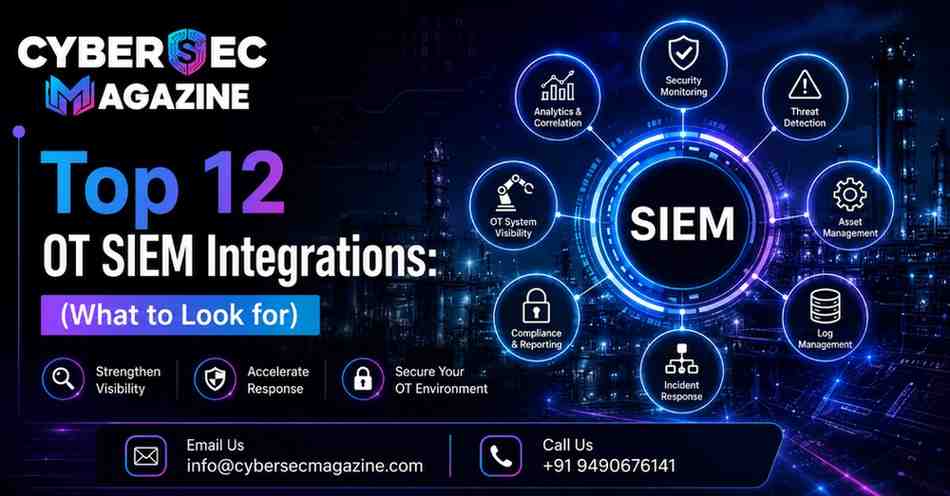
Top 12 OT SIEM Integrations:(What to Look for)
Executive Summary: The Convergence Paradox
For decades, air-gapped systems provided a natural defense for industrial operations. However, the rapid acceleration of digital transformation, cloud analytics, and remote industrial maintenance has rendered the air gap obsolete. Today, Cyber-Physical Systems (CPS) are interconnected with corporate Information Technology (IT) networks. This convergence exposes Operational Technology (OT), Industrial Control Systems (ICS), and the Industrial Internet of Things (IIoT) to sophisticated, nation-state cyber threats and ransomware.
Security Operations Centers (SOCs) rely on Security Information and Event Management (SIEM) platforms to detect and respond to these threats. Yet, standard enterprise SIEMs are inherently blind to the realities of the factory floor. They struggle to parse proprietary industrial protocols like Modbus, DNP3, or Profinet, and their automated active scanning tools risk disrupting sensitive, legacy industrial components.
Bridging this visibility gap requires specialized OT SIEM integrations. This technical long-form guide analyzes the foundational architecture of IT/OT telemetry integration, maps out the top 12 industrial security integrations for modern SIEM environments, and establishes an engineering checklist for building a defensible, multi-tiered industrial SOC.
1. The Architectural Foundations of IT/OT Telemetry Integration
To understand why traditional SIEM platforms fail in industrial environments, we must examine the architectural divergence codified by the Purdue Model for Industrial Control Systems (part of the ISA-95 standard).
Traditional IT security monitoring operates at Level 4 (Enterprise Network) and Level 5 (Cloud/External Matrix). Conversely, the core operations of an industrial facility reside within Levels 0 through 3:
- Level 3: Operations Systems Management (Historians, Engineering Workstations, HMI servers).
- Level 2: Control Systems (Distributed Control Systems [DCS], Supervisory Control and Data Acquisition [SCADA] software).
- Level 1: Local Control (Programmable Logic Controllers [PLCs], Remote Terminal Units [RTUs]).
- Level 0: The Physical Process (Sensors, actuators, pumps, valves).
+——Traditional IT logs are derived from structured operating system events, such as Windows Event Logs (Syslog) or cloud API audits (JSON). Industrial networks, however, exchange raw binary payloads over serial connections or specialized ethernet encapsulations.
If an IT SIEM attempts to scan Level 1 PLCs directly using standard network monitoring tools, the traffic overhead can crash legacy network interface cards, halting physical assembly lines.
Therefore, a modern industrial SOC utilizes a decoupled architecture. Passive network monitoring (PNM) appliances tap into network switches via SPAN ports or network TAPs at the Level 2/3 boundary.
These specialized OT security platforms parse industrial payloads, extract asset metadata, identify anomalies, and forward highly contextualized, normalized security events to the enterprise SIEM via secure APIs or structured syslog feeds.
2. Key Criteria: What to Look for in an OT-to-SIEM Connector
When engineering an integration between an industrial cybersecurity platform and an enterprise SIEM, evaluating data volume alone is insufficient. Security architecture teams must prioritize five key technical parameters:
Protocol Normalization and Parsing Fidelity
The integration must accurately translate proprietary industrial protocol codes into standardized SIEM schemas, such as the Splunk Common Information Model (CIM) or the Open Cybersecurity Schema Framework (OCSF). For example, if a rogue engineering workstation sends a Force Single Coil command (Function Code 05) to a Modbus-controlled water pump, the integration must report this command as a highly specific operational event rather than a generic TCP connection.
Asset Context Enrichment
A raw IP address is functionally useless to a corporate SOC analyst. The integration connector should automatically enrich every forwarded alert with critical OT-specific asset attributes pulled from the industrial discovery engine.
[Unidirectional Data Flow and Demilitarized Zone (DMZ) Compliance
To maintain a defensible architecture under regulations like NERC CIP or standards like IEC 62443, data must flow upward from OT to IT without establishing reverse paths into control environments. Connectors should deploy over secure, unidirectional security gateways or strict, firewalled Industrial DMZs (iDMZs). The SIEM must never maintain direct, uninhibited query access down into Level 1 or Level 2 assets.
Risk-Based Alert Throttling
Industrial networks generate large volumes of repetitive telemetry, such as continuous sensor polling. If an integration forwards every micro-anomaly to a cloud-native SIEM, ingestion charges will spike, and analysts will suffer from alert fatigue. Look for connectors that perform edge aggregation, deduplication, and risk-scoring directly within the industrial network layer before sending alerts up to the SIEM.
3. The Top 12 OT SIEM Integrations Analyzed
The following matrix categorizes the top 12 integrations bridging leading Cyber-Physical System (CPS) protection platforms with premier enterprise SIEM environments.
| # | OT/CPS Source Platform | Target SIEM Environment | Primary Use Case & Core Advantage |
| 1 | Claroty xDome / CTD | Splunk Enterprise Security | Enterprise-wide risk profiling with massive asset metadata injection. |
| 2 | Dragos Platform | Microsoft Sentinel | Threat-intel-driven hunting mapping industrial adversary groups directly to cloud workbooks. |
| 3 | Nozomi Networks | IBM QRadar | Large-scale, geo-distributed asset anomaly correlation for global utilities. |
| 4 | Armis Centrix | CrowdStrike Falcon SIEM | Agentless IT/OT/IoT converged asset visibility integrated with next-gen XDR workflows. |
| 5 | Tenable OT | Splunk Enterprise Security | Consolidated vulnerability management linking IT endpoints with industrial controllers. |
| 6 | Claroty xDome | Microsoft Sentinel | Cloud-native asset exposure management and automated incident playbooks via Logic Apps. |
| 7 | Dragos Platform | Splunk Enterprise Security | Advanced forensic investigations mapping ICS-specific threat vectors to the MITRE ATT&CK for ICS framework. |
| 8 | Nozomi Networks | Microsoft Sentinel | Cross-surface visibility correlating enterprise email and identity vectors with physical process telemetry. |
| 9 | Elisity IdentityGraph | Cisco Splunk / QRadar | Network identity profiling transforming OT asset visibility into real-time microsegmentation policies. |
| 10 | Palo Alto Networks Industrial OT | Cortex XSIEM | Native NGFW inline deep packet inspection unified with cloud-scale security analytics. |
| 11 | Radiflow iSID | LogRhythm Axon | Risk scoring and compliance tracking tailored for mid-market manufacturing operations. |
| 12 | Armis Centrix | Google SecuriSync / Chronicle | Petabyte-scale telemetric ingestion for hyper-scale smart cities and converged infrastructure. |
Detailed Technical Deep-Dives of Leading Integrations
1. Claroty Platform to Splunk Enterprise Securite
Claroty’s integration with Splunk leverages the Claroty Technical Add-on (TA) to map deep packet inspection data directly into Splunk’s Common Information Model (CIM).
- How it Works: Claroty CTD or xDome processes passive network traffic and constructs a granular asset inventory. When an anomaly is detected-such as an unauthorized configuration download via an S7 communication protocol-the Claroty application packages the alert with full asset context (firmware, hardware revision, slot position) and pushes it to Splunk via the HTTP Event Collector (HEC).
- Why it Matters: SOC analysts can run searches using standard Splunk Search Processing Language (SPL) to track behavioral anomalies across both corporate Active Directory servers and factory floor controllers from a single dashboard.
2. Dragos Platform to Microsoft Sentinel
This cloud-to-on-premises architecture couples Dragos’ industrial threat intelligence with Microsoft’s cloud-native SIEM and SOAR infrastructure.
- How it Works: The Dragos platform deploys local network sensors to monitor industrial environments. It normalizes this telemetry and leverages a purpose-built API Data Connector to stream validated ICS events into Azure Log Analytics workspaces.
- Why it Matters: The integration populates specialized Microsoft Sentinel Workbooks with Dragos-vetted threat intelligence. Instead of surfacing generic anomaly flags, it alerts analysts to specific industrial adversary clusters (e.g., targeted threat groups) executing known malicious playbooks. It also initiates automated incident responses via Azure Logic Apps, such as isolating a compromised engineering workstation at the IT/OT firewall boundary.
3. Nozomi Networks to IBM QRadar
Designed for highly distributed critical infrastructure environments, such as smart grids and expansive oil and gas networks, this integration focuses on scalable event correlation.
- How it Works: Nozomi Guardian appliances collect real-time asset data and process logs locally. They format this data into custom Device Support Modules (DSM) for IBM QRadar.
- Why it Matters: QRadar’s Offense Management engine digests Nozomi’s alerts and applies advanced User and Entity Behavior Analytics (UEBA). If QRadar detects a VPN credential login from an unusual external IP address concurrently with a Nozomi alert showing a firmware modification on a remote RTU, it automatically correlates these separate events into a single high-priority security offense.
4. Deep-Dive Use Cases: Real-World Scenarios
To demonstrate the concrete security value of these integrations, we can examine two technical attack scenarios and trace how a unified IT/OT SIEM setup enables rapid mitigation.
Scenario A: Phishing-to-Firmware Ransomware Attack
- The Entry Vector: An operator on the Level 4 corporate network opens a phishing email, compromising a corporate workstation with ransomware.
- Lateral Movement: The adversary locates cached VPN credentials on the workstation and moves laterally through the Industrial DMZ into a Level 3 Engineering Workstation.
- The OT Exploitation: The attacker uses the compromised engineering workstation to initiate an unauthenticated firmware write command to a critical Level 1 PLC controlling a manufacturing line.
The Integrated Defenses
Without an OT-SIEM integration, the IT security team only sees a standard malware infection on a corporate machine, completely blind to the downstream industrial impact until the plant floor stops operating.
With an integrated architecture, the sequence updates in real-time
The enterprise SIEM aggregates these indicators, instantly surfaces the multi-stage attack pathway, and initiates a SOAR playbook to isolate the iDMZ VPN gateway. This stops the attack before the destructive firmware modification can execute.
Scenario B: Insider Threat and Process Manipulation
An authorized internal contractor connects a rogue, dual-homed laptop directly to a Level 2 control network switch to run unauthorized diagnostics.
- The Detection: A passive OT security appliance detects the rogue MAC address and notices unexpected CIP (Common Industrial Protocol) read requests targeting safety-instrumented systems (SIS).
- The Integration Action: The OT platform generates an alert, appends the exact physical switch port location and asset profile, and forwards it to the SIEM.
- The Remediation: The SIEM correlates this network anomaly with corporate physical badge access logs, helping the security team quickly identify which contractor is working near that specific network rack.
5. Engineering Blueprint: Building a Unified SecOps Center
Implementing a reliable, multi-tiered IT/OT SOC monitoring architecture requires strict adherence to an engineering blueprint focused on data integrity and operational safety.
1. Ingestion Strategy and Architectural Isolation
- Edge Collection: Deploy passive network monitoring appliances on mirror or SPAN ports at the aggregation layers of each industrial site. Do not enable active scanning options on these appliances unless they are specifically configured for safe, low-frequency scheduled active queries targeting robust assets.
- iDMZ Intermediate Aggregation: Route all edge sensor outputs through an intermediate syslog concentrator or API forwarder proxy located inside the iDMZ. This proxy acts as a buffer, ensuring the enterprise SIEM never establishes a direct, inbound network connection down into control environments.
- Encrypted Transit: Use TLS 1.3 encryption for all data flowing from the iDMZ forwarder up to the enterprise SIEM ingestion endpoints.
2. Log Normalization and Schema Mapping
- Standardize on Common Schemas: Configure your OT connector to output data in structured formats like JSON, mapped directly to standard cybersecurity framework categories (such as the OCSF network activity profile).
- Enforce Key Fields: Ensure every log sent to the SIEM contains these mandatory
3. Use-Case Customization and False-Positive Reduction
- Establish Baseline Windows: Run passive monitoring sensors for at least 30 to 45 days to accurately baseline normal industrial operations before activating alerting rules in the production SIEM. Industrial schedules vary based on production cycles; alerting too early creates significant false-positive noise.
- Filter Routine Telemetry: Explicitly filter out high-frequency, safe operational traffic (such as routine SCADA-to-PLC read loops) at the edge sensor layer. Do not ingest these standard operational loops into the enterprise SIEM unless they deviate from established timing baselines.
6. Regulatory Compliance and the SIEM’s Role
Integrating OT data into a central SIEM environment is increasingly necessary to meet modern international industrial cybersecurity regulations and standards.
NIS2 Directive (European Union)
The NIS2 framework mandates that operators of essential services implement comprehensive security monitoring and supply chain risk management. An integrated OT SIEM provides the centralized auditing capabilities, asset visibility, and rapid event reporting required to meet these strict compliance guidelines.
NERC CIP (North America – Electric Sector)
For power generation and transmission utilities, NERC CIP standards (specifically CIP-007 and CIP-009) demand strict logging, alert monitoring, and structured incident response processes for critical cyber assets. Integrating OT monitoring platforms with an enterprise SIEM provides an automated path to collect, preserve, and review compliance logs without risking operational impact.
ISA/IEC 62443 Standard
As the foundational blueprint for industrial cybersecurity across sectors, IEC 62443 highlights the importance of establishing structured security zones, robust conduits, and continuous operational visibility. An OT-to-SIEM integration enforces these zone and conduit boundaries while validating that cross-zone communications match approved operational profiles.
Conclusion: Securing the Future of Industry
True operational resilience is impossible without comprehensive visibility. Relying on an enterprise SIEM that is blind to industrial protocols leaves critical physical infrastructure exposed to modern, sophisticated cyber threats. Conversely, keeping OT security isolated within a separate silo prevents security teams from identifying coordinated, multi-tiered attacks that cross IT boundary lines.
Integrating purpose-built OT security platforms with enterprise SIEM systems creates a unified, intelligent defense layer. This architecture provides security teams with the deep asset context, protocol parsing, and behavioral analytics needed to defend complex industrial environments. Implement these integrations safely and systematically to protect your operational availability, maintain regulatory compliance, and secure your physical processes.