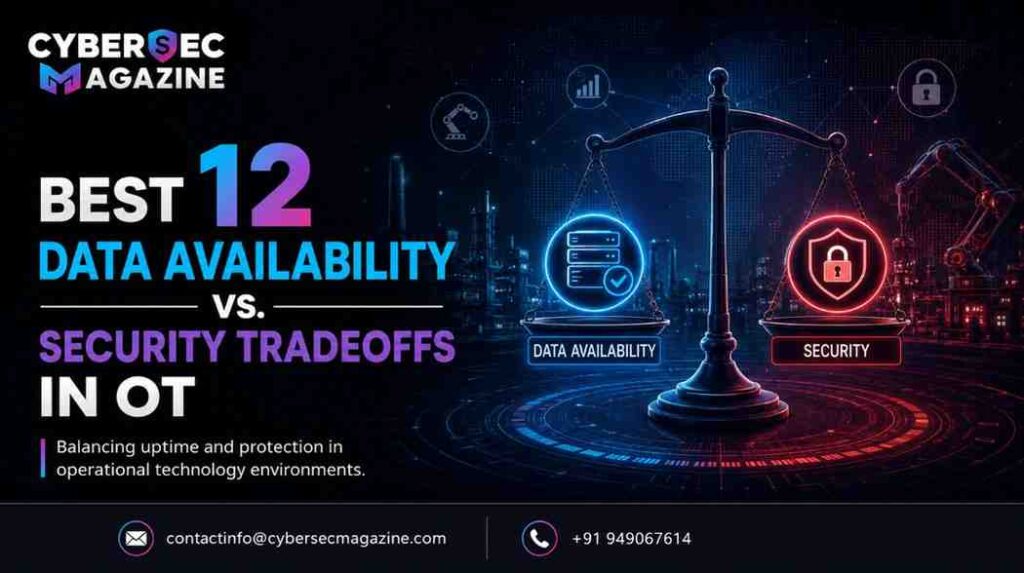
Best 12 Data Availability vs. Security Tradeoffs in OT
Why this tradeoff matters more than ever
In OT, “security” is never just about blocking attacks. It is about protecting production, people, and process continuity at the same time. That is why modern OT guidance keeps emphasizing performance, reliability, and safety alongside cybersecurity. NIST’s current OT guidance, SP 800-82 Rev. 3, was written specifically to address those operational realities, and NIST has already started the process of revising it again to align with CSF 2.0 and newer OT practices.
The hard part is that OT teams are often judged on uptime, not just on control strength. A security control that looks excellent in an IT environment can become a production risk in a plant, substation, water facility, or building automation network. ISA/IEC 62443 takes this reality seriously: it is built as a risk-based, lifecycle-driven framework that explicitly bridges operations, IT, and process safety, and ISA notes that security must be balanced against cost and operational consequence.
That is the real OT dilemma: keep data available enough for operators, engineers, and vendors to do the job, while limiting the chance that the same data, access path, or service becomes an attack route.
The background: OT availability is not the same as “always online”
In IT, an outage is usually a business problem. In OT, it can become a safety event, a quality event, or an environmental event. That is why the best OT strategies are built around zones, conduits, shared responsibility, and carefully scoped access rather than blanket openness. NIST’s OT guidance and ISA/IEC 62443 both push organizations toward architectures that are tailored to the environment, not copied from office networks.
The latest NIST Cybersecurity Framework 2.0 also matters here because it places stronger emphasis on governance and supply chains, which is exactly where many OT availability decisions get made: vendor access, patch timing, backup ownership, and recovery priorities. NIST describes CSF 2.0 as a way for any organization to better understand, assess, prioritize, and communicate cybersecurity outcomes.
Best 12 data availability vs. security tradeoffs in OT
1) Patching fast vs. keeping production stable
The classic OT tension starts with patching. Security teams want vulnerabilities closed quickly; operations teams worry that an untested patch could interrupt a fragile controller, HMI, historian, or engineering workstation. That tension is real, but the answer is not “patch later forever.” The better model is risk-ranked patching, lab validation, maintenance windows, and compensating controls when patches cannot be applied immediately. CISA’s ICS recommended practices include patch management guidance, and current incident-preparation guidance continues to stress planning, asset prioritization, and recovery readiness.
A mature OT program treats patching as a pipeline, not an event. Critical assets get faster attention. Less critical systems may rely on segmentation, allowlisting, and monitored access until the maintenance window opens.
2) Open access for engineering teams vs. network segmentation
OT engineers need to move data, troubleshoot faults, and support remote sites. But every extra route across the network increases exposure. CISA’s remote-access guidance warns that increased integration between business and control networks can reduce security posture, and recommends compensating controls such as DMZs, separate authentication paths, and the elimination of direct connections where possible.
Availability improves when access is intentional. A well-designed segmentation model does not block work; it makes work predictable. Zones, conduits, and tightly scoped trust boundaries reduce the blast radius if a laptop, VPN session, or vendor account is compromised.
3) Convenient remote access vs. controlled remote access
Remote access is one of the biggest availability wins in OT. It keeps OEMs, integrators, and internal specialists from driving to site for every issue. But it is also one of the most abused paths in critical infrastructure. CISA’s remote access practice guide says that without appropriate safeguards, remote access can create opportunities for adversaries to damage critical processes and affect people, society, the economy, and the environment.
The practical balance is not “no remote access.” It is managed remote access: MFA, session logging, role separation, time-limited access, jump hosts, and a clear approval trail. In many OT environments, remote support should be treated like a controlled maintenance operation, not a permanent convenience layer.
4) More network visibility vs. adding traffic and latency
Security teams want deep packet inspection, telemetry, and full visibility. OT engineers want deterministic performance and minimal jitter. In some OT networks, heavy tooling can itself become the problem if it adds traffic, interferes with fragile devices, or creates unacceptable latency. NIST’s OT guidance emphasizes the unique performance and reliability requirements of these environments, which is why passive discovery and carefully placed monitoring are often preferred.
The best practice is to use passive monitoring first, then add active controls only where the process can tolerate them. That means choosing sensors and tooling that read traffic without becoming part of the control loop.
5) Centralized logging vs. limited bandwidth and storage
Security operations teams want logs everywhere. OT networks, especially at remote or legacy sites, may have limited bandwidth, limited storage, or devices that were never designed for heavy telemetry. Yet logs matter because they help investigators reconstruct incidents and separate routine process behavior from malicious activity. CISA’s incident and recovery guidance repeatedly stresses the value of logs, triage, and restoration planning.
A sensible approach is tiered logging: high-value assets, remote access systems, identity systems, and jump servers get priority. That preserves evidence without flooding low-bandwidth links or overloading legacy equipment.
6) Cloud analytics vs. local autonomy
Cloud-based analytics can improve fleet visibility, trend detection, and cross-site reporting. But OT still depends on local control for safety and continuity. If the cloud link drops, the plant still has to run safely. NIST’s CSF 2.0 and zero trust guidance both support outcome-based risk management, not blind adoption of a particular architecture, and zero trust explicitly shifts trust away from network location alone.
The right pattern is usually hybrid: cloud for reporting, benchmarking, and long-horizon analytics; local control for real-time decision-making and fail-safe operation. The cloud should inform OT, not own OT.
7) Strong authentication vs. operator friction during urgent work
Multi-factor authentication and strict role-based access are essential, especially for remote support and privileged users. But OT operators also work under time pressure. If the authentication flow is too slow or too brittle, people create workarounds, and workarounds are where security often collapses. ISA/IEC 62443’s shared-responsibility model and lifecycle approach are useful here because they push organizations to design security around real roles and real workflows.
The goal is not to make access easy. The goal is to make the secure path the practical path. Pre-approved break-glass accounts, time-bound emergency access, and audited approval processes can support urgent operations without giving up control.
8) Sharing process data widely vs. minimizing exposure
Modern OT runs on data: historians, dashboards, quality systems, MES integrations, maintenance analytics, and IIoT sensors all improve decision-making. But every extra data feed increases the risk of leakage, corruption, or unauthorized access. NIST’s OT guidance and CSF 2.0 both support risk-based prioritization rather than universal exposure.
The principle here is simple: share only what each role needs. Operators need current process state. Maintenance needs diagnostic depth. Executives need trends. Not every consumer needs raw controller data.
9) Always-synced backups vs. resilient, offline recovery
Fast synchronization is convenient, but it can also spread corruption, ransomware, or configuration mistakes across sites. That is why CISA strongly recommends offline, encrypted backups and regular testing of backup availability and integrity. CISA also advises maintaining golden images and prioritizing restoration of critical systems during recovery.
In OT, backup strategy is really recovery strategy. The question is not just “Are copies available?” It is “Can we restore a safe, known-good state quickly enough to avoid a prolonged outage?” That is why immutable or offline backups, versioned configuration archives, and tested restoration runbooks matter so much.
10) Application allowlisting vs. maintenance flexibility
Allowlisting is one of the strongest defenses for OT endpoints because it limits what can run. But it can also frustrate maintenance if updates, diagnostic tools, or vendor utilities are not planned in advance. NIST and CISA both continue to point to application control, change management, and integrity checking as useful OT safeguards.
The trick is to build the allowlist around a controlled change process. If a tool needs to run during service work, it should be approved before the maintenance window, not discovered during it.
11) More security testing vs. risk to fragile assets
Security teams want scanning, validation, and continuous assessment. OT systems may not tolerate aggressive scanning, and some legacy assets can behave unpredictably when probed. That is why CISA’s ICS resources emphasize defense-in-depth, careful incident response planning, and tailored practices rather than brute-force IT-style assessment.
Safe OT testing often means using passive discovery, vendor-approved methods, staged environments, and scheduled validation windows. Testing should prove resilience, not accidentally create the very outage it was meant to prevent.
12) Lowest-cost security vs. tolerable risk
The most dangerous assumption in OT is that every site can afford the same security stack. ISA explicitly describes security as a balance of risk versus cost, and its 62443 program is designed to let asset owners choose approaches that fit their operating context. That flexibility is not a weakness; it is a recognition that OT risk can be physical, safety-related, and sometimes irreversible.
The right question is not “What is the strongest control?” It is “What control meaningfully reduces risk without damaging the process we are trying to protect?”
What the best OT teams do differently
The strongest OT programs make availability and security part of the same conversation. They define critical assets, classify data by operational importance, set recovery objectives, and decide in advance which controls can be applied immediately and which need compensating safeguards. That is consistent with NIST CSF 2.0’s outcome-based approach and with ISA/IEC 62443’s lifecycle model.
They also treat recovery as a design requirement. NIST’s 2026 draft work on responding to and recovering from cyber attacks in manufacturing OT environments shows how much attention recovery has gained in industrial cybersecurity planning. The message is clear: resilience is no longer a post-incident afterthought.
A practical way to make the tradeoff less painful
A good OT security decision usually answers five questions: what must stay available, what can be delayed, who is allowed to access it, how the change is monitored, and how fast the environment can be restored if something goes wrong. Those five questions turn a vague argument about “security versus uptime” into a concrete operational decision. The more often an organization uses that model, the fewer surprises it faces when vendors, operators, and security teams need to work together.
Final thought
In OT, availability is not the opposite of security. It is one of the outcomes security is supposed to protect. The smartest programs do not choose between them; they engineer both into the same architecture. That is the shift modern OT cybersecurity has finally embraced: protect the process, reduce the blast radius, and make recovery fast enough that a bad day does not become a long outage.