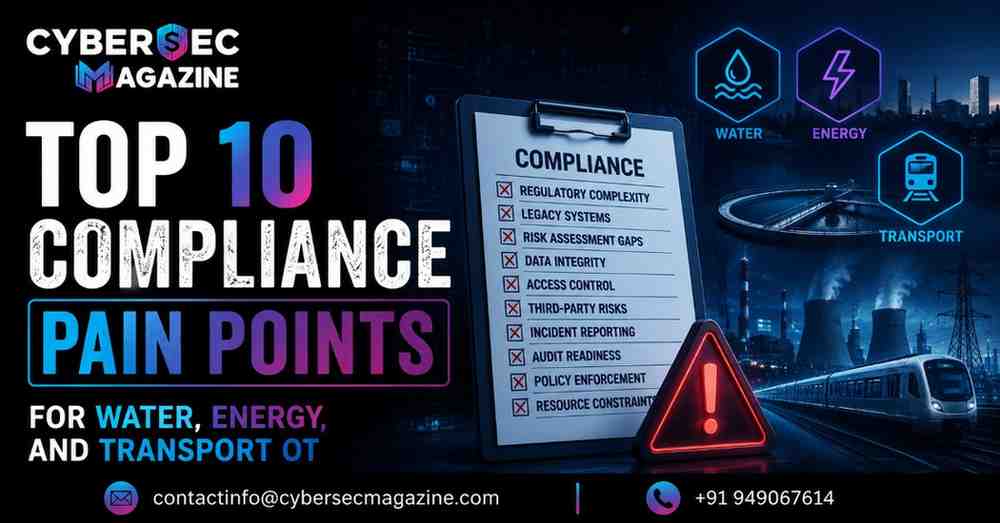
Top 10 Compliance Pain Points for Water, Energy, and Transport OT
Water, energy, and transport operators are now managing a compliance stack that is broader, more connected, and more operationally sensitive than it was just a few years ago. In the EU, NIS2 creates a unified cybersecurity framework across 18 critical sectors, including energy, transport, drinking water, and wastewater. In North America, NERC CIP remains the mandatory baseline for bulk electric system cyber protection, while water utilities are increasingly guided by EPA and AWWA cybersecurity resources. CISA, meanwhile, has been actively updating OT guidance in 2025 and 2026 on asset inventory, procurement, Zero Trust, secure communications, and cross-sector performance goals.
That is why compliance pain in OT is rarely just a paperwork issue. OT systems must preserve performance, reliability, and safety while also meeting increasingly strict cybersecurity expectations, and NIST’s OT guidance makes that distinction explicit. NIST is also continuing to evolve OT guidance into a draft Rev. 4 process in 2026, which shows how active this space remains.
Why water, energy, and transport feel the pressure differently
Water utilities are dealing with a mix of public health expectations, emergency preparedness requirements, and cyber hygiene pressure. EPA continues to publish cybersecurity resources for drinking water and wastewater systems, and AWWA’s guidance is aligned with the NIST Cybersecurity Framework and AWIA Section 2013 risk and resilience work.
Energy operators face the heaviest grid-specific compliance load. NERC’s CIP standards and its CIP-013 supply chain risk management requirements focus directly on reliable operation of the bulk electric system, while NERC’s 2026 CIP roadmap shows the framework is still being actively evolved for the next decade of grid transformation.
Transport operators, especially in Europe, are pulled into NIS2’s transport scope across air, rail, water, and road. That matters because distributed assets, remote depots, subcontractors, and mixed ownership models make evidence gathering and accountability harder than in a single-site industrial plant.
1) Too many rules, not enough one operating model
The first pain point is that compliance obligations do not line up neatly. Water teams may be balancing EPA resources, AWWA tools, and state expectations. Energy teams often have to reconcile NERC CIP with broader enterprise governance. EU operators may need to map NIS2, the Cyber Resilience Act, and sector-specific national rules to one OT environment.
The fix is not another spreadsheet. The fix is a common OT control model that translates each obligation into a single operating picture: what must be inventoried, what must be protected, what must be reported, and who owns the evidence. If your compliance language does not match your engineering language, the budget will be fragmented and the audit trail will be weak.
2) Asset inventory and classification gaps
CISA’s 2025 OT asset inventory guidance is one of the most practical compliance signals to emerge recently. It asks owners and operators to create, maintain, and use OT asset inventories and taxonomies so they can identify, safeguard, and prioritize their most vital systems. In other words, inventory is no longer a nice-to-have; it is the foundation for compliance, remediation, and incident response.
For water, energy, and transport operators, this is often harder than it sounds because the assets are distributed, long-lived, and often managed by different teams or contractors. The budgeting pain is that inventory work does not look urgent until a regulator, insurer, or incident responder asks for it. OT compliance leaders should fund passive discovery, taxonomy building, and lifecycle tracking before they fund more advanced dashboards.
3) Legacy systems that do not fit modern patch cycles
NIST’s OT guidance stresses that OT systems have unique reliability and safety requirements, which is exactly why patching them like office IT is risky. Legacy SCADA servers, PLCs, RTUs, and field devices are often hard to patch, expensive to validate, and tightly coupled to operations. That creates a compliance tension: you need to show vulnerability management, but you cannot simply reboot your way to compliance.
The practical answer is to budget for compensating controls, not just updates. That means segmentation, monitored access paths, maintenance windows, firmware validation, and safe rollback planning. It also means treating unpatchable assets as a lifecycle problem, not a one-time security problem. The most resilient organizations budget for both hardening and replacement, because some compliance gaps can only be closed by retirement, not by patching.
4) Procurement that buys risk instead of reducing it
CISA’s Secure by Demand OT guidance is a clear signal that buyers are expected to push security into procurement rather than pay to compensate for weak product design later. The EU Cyber Resilience Act goes even further: products with digital elements must be designed, updated, and maintained to protect users, and from 11 September 2026, manufacturers must report actively exploited vulnerabilities and severe incidents affecting product security.
For energy operators in North America, NERC CIP-013 specifically exists to mitigate cybersecurity risk through supply chain risk management for BES Cyber Systems. That makes procurement a compliance control, not just a commercial process. In practice, this means every OT buying decision should ask for secure development evidence, vulnerability handling commitments, update support, and clear ownership of software and firmware risk.
5) Remote access and third-party governance
Remote access remains one of the most expensive compliance pain points because it touches identity, logging, approvals, and vendor contracts all at once. CISA’s OT Zero Trust guidance and its secure communications guidance both point toward tighter collaboration between asset owners, system integrators, service providers, and manufacturers, with stronger authentication and controlled communications paths.
The practical burden is that operators must stop treating vendor connectivity as a convenience feature. Secure bastions, session recording, MFA, time-bound approval, and auditable vendor access are now core compliance controls. This is especially difficult in transport and water environments where remote sites, subcontractors, and emergency maintenance are routine, but it is precisely where good governance prevents the most avoidable exposures.
6) Incident reporting and emergency response obligations
NIS2 is not just about technical controls. It also requires cybersecurity risk-management measures and reporting in critical sectors, along with cooperation, information sharing, supervision, and enforcement. That makes incident reporting a legal and operational burden for EU water, energy, and transport operators.
Water utilities face a similar challenge in practice. EPA continues to emphasize cybersecurity resources and emergency preparedness for drinking water and wastewater systems, and AWWA’s guidance is designed to help utilities align cyber risk work with broader resilience efforts. In other words, the compliance pain point is not just “report the incident.” It is “prove you had a working response path before the incident happened.”
7) Evidence collection and audit readiness
OT compliance fails when teams can show policy but cannot show proof. That is why logging, time synchronization, asset records, vendor session recordings, and change control evidence matter so much. NIST’s OT guidance highlights the need to secure OT while preserving reliability and safety, and CISA’s updated CPGs in late 2025 expanded guidance across account and device security, data protection, and incident response.
For compliance teams, the real pain point is evidence gathering across many sites and many owners. A transport operator may need logs from depots, vehicles, control centers, and third parties. A water utility may need evidence from treatment plants, SCADA zones, and remote support sessions. A power operator may need audit trails that satisfy grid reliability expectations under NERC CIP while also supporting internal governance. That is why audit readiness should be funded as a continuous operating capability, not as a one-off project before an inspection.
8) Cross-functional ownership and staffing
One of the most persistent pain points is that compliance work sits between teams. OT engineers understand process risk, IT security understands enterprise controls, procurement understands suppliers, and legal understands regulatory exposure. If no one owns the integration, the organization ends up with partial compliance and weak accountability. NIST and CISA both frame OT security as a multi-stakeholder problem, not a pure SOC problem.
This is where many programs underfund the “glue” work: RACI design, policy harmonization, training, tabletop exercises, and vendor governance. Water, energy, and transport organizations should budget specifically for cross-functional coordination, because that is what turns written obligations into auditable practice. When compliance is shared but ownership is unclear, the cost shows up later as delay, exceptions, and rework.
9) Cloud, analytics, and AI create new compliance surfaces
Modern OT compliance is no longer limited to on-prem SCADA. Water utilities increasingly use cloud-based monitoring and emergency planning resources, energy teams use cloud integrations for analytics and supply chain management, and transport operators depend on remote visibility across distributed assets. That means compliance now includes data flow control, third-party service governance, and access policies that extend beyond the plant boundary.
The latest guidance is moving in this direction. CISA’s 2025 and 2026 work on Zero Trust for OT, secure communications, and secure AI integration in OT reflects a broader shift: operators are expected to think about the integrity of data, telemetry, and automated decision-making, not just about perimeter firewalls. That is a major budgeting and compliance pain point because it expands scope without reducing operational complexity.
10) Budgeting for compliance without starving operations
The final pain point is simply prioritization. CISA’s asset inventory guidance, Secure by Demand procurement advice, and updated CPGs all point toward a practical hierarchy: know what you have, secure how you buy, and control how you connect. NERC’s 2026 CIP roadmap likewise frames the framework as something that must evolve with grid transformation rather than sit still as a static checklist.
For water, energy, and transport operators, the best budgets fund the controls that reduce the most uncertainty first: inventory, segmentation, secure access, procurement, and recovery. That is the difference between spending money on compliance theater and spending money on operational resilience. If your budget does not make the next audit easier and the next incident shorter, it probably is not pointed at the right risk.
A practical compliance budget order for OT teams
A smart OT compliance budget usually starts with visibility, then moves to access control, then procurement, then recovery. First fund the asset inventory and taxonomy. Then fund secure remote access, segmentation, and logging. After that, fund SBOM intake, vendor governance, and contract language. Finally, fund tabletop exercises, reporting readiness, and lifecycle replacement. That order matches the way modern OT guidance from NIST, CISA, EPA, AWWA, NERC, and the EU frameworks has been evolving.
Final thoughts
Compliance pain in water, energy, and transport OT is really a governance problem wrapped in a technical one. The organizations that do well in 2026 will not be the ones that buy the most tools. They will be the ones that build a clear OT operating model, assign ownership across engineering and security, and fund the controls that regulators now expect: inventories, secure procurement, remote access governance, reporting readiness, and lifecycle management. NIS2, NERC CIP, EPA guidance, CISA’s 2025-2026 OT advisories, and the Cyber Resilience Act all point in the same direction: compliance is becoming inseparable from operational resilience.